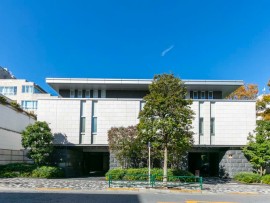
Aoyama
Aoyama Area Guide: Living in the Aoyama District of Tokyo
Aoyama is an upscale, design-led residential district in Minato Ward, central Tokyo, known for its fashion houses, leafy backstreets, and the ginkgo avenue at Meiji Jingu Gaien. The Aoyama district of Tokyo suits professionals, couples, and families who want a calm, walkable home close to Omotesando and Shibuya. It centres on Omotesando and Aoyama-itchome stations. It includes Minami-Aoyama and Kita-Aoyama.

Aoyama at a Glance
| Ward | Minato Ward (港区, Minato-ku), central Tokyo |
|---|---|
| Main sub-districts | Kita-Aoyama (north of Aoyama-dori) and Minami-Aoyama (south) |
| Nearest stations & lines | Omotesando (Ginza, Chiyoda, Hanzomon); Gaienmae (Ginza); Aoyama-itchome (Ginza, Hanzomon, Toei Oedo); Nogizaka (Chiyoda) |
| To nearest major hub | Shibuya in about 4 minutes by train; roughly a 20-minute walk |
| Typical residents | Professionals, creative and fashion workers, couples, and families; a visible international community |
| Defining features | Designer boutiques, the Nezu Museum, Aoyama Cemetery, Meiji Jingu Gaien, low-rise residential pockets |
| Nearest international schools | Clarence International School (preschool, Minami-Aoyama); larger campuses cluster nearby in Azabu, Hiroo, and Roppongi |
| Indicative prices | Resale condos in Minami-Aoyama averaged about ¥2.85 million/m² (May 2025); MLIT residential land averaged ¥3.26 million/m² (2026, +14.3% YoY). Rents run from ~¥350,000/month for a 1LDK to ¥900,000+/month for a 3LDK. |
What Is Aoyama Known For?
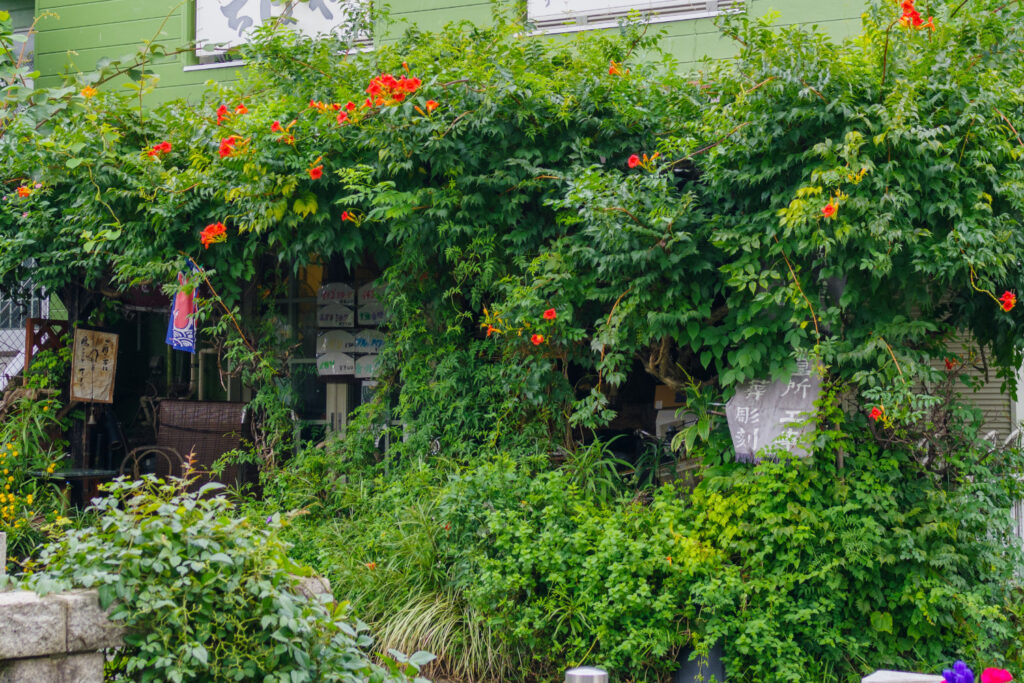
Aoyama (青山) is one of Tokyo’s most recognisable addresses for fashion, design, and quiet affluence. Flagship stores from international labels line Aoyama-dori and the backstreets of Minami-Aoyama, many of them housed in buildings by leading architects. Away from the boutiques, the area is mostly residential: narrow streets of low-rise apartments, small galleries, and independent cafes. It carries a calmer, more grown-up reputation than neighbouring Harajuku or Shibuya, which is a large part of its appeal.
The name comes from Aoyama Tadanari, a samurai who served the Tokugawa shogunate and held land here. Today the district pairs that long history with a strong creative identity, anchored by the Nezu Museum, the Spiral building, and the ginkgo avenue at Meiji Jingu Gaien. For people moving to Tokyo, Aoyama offers a central, walkable base that feels residential rather than commercial.

Where Is the Aoyama District of Tokyo Located?
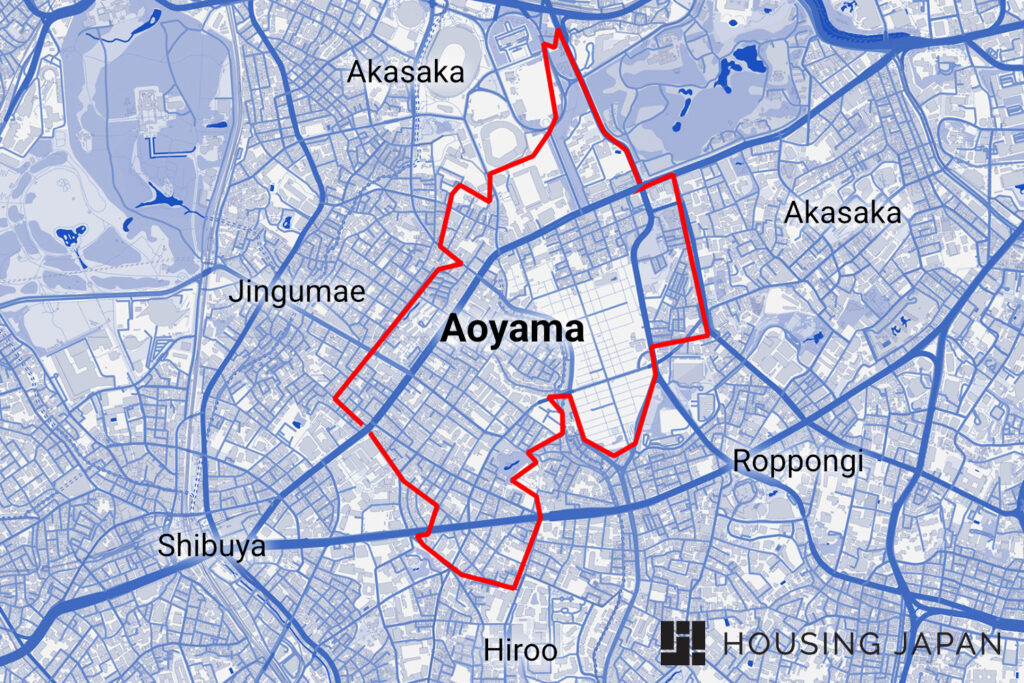
Aoyama sits in the northwest of Minato Ward (港区, Minato-ku), one of the three central wards of Tokyo alongside Chiyoda and Chuo. Aoyama-dori, the area’s main avenue, splits it in two: Kita-Aoyama (北青山, “North Aoyama”) to the north, between Akasaka Palace and Aoyama Gakuin University, and Minami-Aoyama (南青山, “South Aoyama”) to the south, running down toward the edges of Roppongi, Azabu, and Hiroo. The heart of the district is the crossing of Aoyama-dori and Omotesando.
Its position explains much of its character. Aoyama borders Omotesando and Harajuku to the west, Akasaka to the east, and the upmarket Roppongi, Nishi-Azabu, and Hiroo neighbourhoods to the south. Shibuya is two stops away, and Tokyo Station is reachable in under 20 minutes. Being part of Minato Ward matters in practice: Minato has one of the city’s highest concentrations of embassies, company headquarters, and services aimed at foreign residents, which shapes the international feel of daily life here.
Minato Ward also operates the area’s public elementary and junior high schools and runs many of the support services international families rely on. There are also many international schools based in Minato Ward, See this Housing Japan article on internatal school for more information.
A Brief History of Aoyama
Aoyama began as samurai land in the Edo period (1603–1868), dotted with temples, shrines, and the residences of warrior families. The district takes its name from the Aoyama family, retainers of the Tokugawa shogunate. In 1874 part of that land became Aoyama Cemetery, Japan’s first public cemetery, which from the Meiji era held the graves of many foreign residents who had come to help modernise the country.
The area changed shape sharply in the 20th century. Aoyama and nearby Akasaka were heavily damaged by air raids in the Second World War, and the district was rebuilt in the run-up to the 1964 Tokyo Olympics. Aoyama-dori, once a narrow road, was widened to its current 40 metres at that time. In the decades since, the avenue and the streets around Omotesando grew into one of Tokyo’s leading fashion and design districts, drawing flagship boutiques, galleries, and the head offices of Japanese and international companies.
What Is Daily Life in Aoyama Like?
Daily life in Aoyama is calmer than its retail reputation suggests. The main avenues are busy, but a few streets back you find quiet residential blocks, especially in Minami-Aoyama, where low-rise apartments and small houses sit among trees. Most errands are walkable, and the area is well set up for residents who want a central home without the crowds of Shibuya or Shinjuku.
For groceries, the flagship Kinokuniya International supermarket sits in the Ao Building at 3-11-7 Kita-Aoyama, about a minute from Omotesando Station. It is a long-standing favourite with international residents for imported foods and an in-house bakery, and is open daily from about 9:30am to 9:00pm. Smaller supermarkets such as Tokyu Store and Peacock also serve the residential pockets, and the depachika food halls of nearby department stores cover specialist shopping.
Healthcare is a strength of central Minato. The ward has a high concentration of clinics used to treating foreign patients, and larger English-friendly medical centres sit a short ride away in Akasaka, Roppongi, and Hiroo. For day-to-day healthcare with English-speaking staff, Minami-Aoyama has Stay Fit Clinic for internal medicine and mental-health care, about 5 minutes’ walk from Omotesando Station, and Ishigami Dental Office for English-language dental care from US-trained specialists, also around 5 minutes from Omotesando. For fitness, the area has private gyms and studios, and the open paths of Aoyama Cemetery and Meiji Jingu Gaien are popular with runners. In short, the trade-off is space for location: homes tend to be compact for the price, but almost everything is within walking distance.
Transport and Connectivity: How Well Connected Is Aoyama?
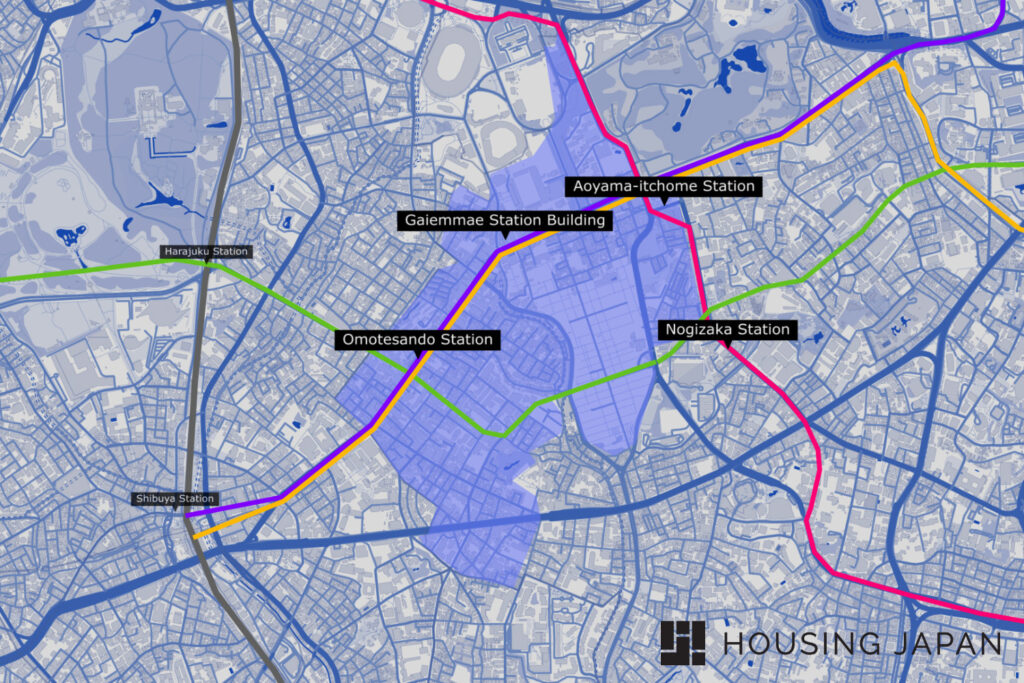
Aoyama is one of the better-connected residential districts in central Tokyo, served by four subway stations across five lines. Omotesando Station is the main hub, with same-direction cross-platform transfers between the Ginza and Hanzomon lines that make changing trains easy. There is no JR station inside the district, but Harajuku Station on the JR Yamanote Line is about a 10-minute walk away.
| Station | Lines | Useful for |
|---|---|---|
| Omotesando | Tokyo Metro Ginza, Chiyoda, Hanzomon | Shibuya, Ginza, Otemachi, Yoyogi-Uehara |
| Gaienmae | Tokyo Metro Ginza | Meiji Jingu Gaien, Shibuya, Ginza, Asakusa |
| Aoyama-itchome | Tokyo Metro Ginza, Hanzomon; Toei Oedo | Akasaka, Roppongi, Shinjuku (via Oedo) |
| Nogizaka | Tokyo Metro Chiyoda | Roppongi, Aoyama Cemetery, Otemachi |
| Destination | Time | Route |
|---|---|---|
| Shibuya | ~4 min | Ginza or Hanzomon Line, direct |
| Ginza | ~16 min | Ginza Line, direct |
| Shinjuku | ~16 min | via Shibuya, transfer to JR Yamanote Line |
| Tokyo Station | ~19 min | via Shimbashi, transfer to JR Yamanote Line |
| Haneda Airport | ~55 min | train |
Note on spellings: this guide uses “Omotesando” (sometimes written Omotesandō), “Gaienmae” (sometimes Gaiemmae), and “Aoyama-itchome” throughout.
Dining, Shopping, and Local Amenities
Shopping is what first made Aoyama famous. Omotesando, often called Tokyo’s answer to the Champs-Élysées, runs into Aoyama-dori and is lined with flagship stores, several of them architectural landmarks: the Prada Aoyama building by Herzog & de Meuron, the Dior Omotesando store by SANAA (see this article on Kazuyo Sejima, one of the co-founders of SANAA), Tod’s Omotesando by Toyo Ito, and the Gyre complex by MVRDV. The backstreets of Minami-Aoyama and Kotto-dori add antique shops, smaller designers, and independent galleries.
Dining ranges from casual bakeries and coffee shops to some of Tokyo’s most acclaimed restaurants, with a strong showing of European cuisine alongside Japanese fine dining. On weekends, the Farmers Market at the United Nations University on Aoyama-dori draws more than 40 stalls of regional produce, baked goods, and food trucks, and has become a fixture of local life. Omotesando Hills, the Tadao Ando–designed shopping complex, sits at the western edge for everyday and higher-end retail.


Parks, Culture, and Recreation
For green space, Aoyama Cemetery (Aoyama Reien) is the district’s open heart: a 26-hectare, Tokyo-managed park-cemetery opened in 1874, criss-crossed by tree-lined avenues that turn into one of central Tokyo’s best cherry-blossom walks each spring. To the northeast, Meiji Jingu Gaien, the outer garden of Meiji Shrine, is famous for its avenue of ginkgo trees, which draws crowds for its golden colour in late autumn.
Culture is dense for such a small area. The Nezu Museum holds a collection of more than 7,400 works of Japanese and East Asian art, set behind a Kengo Kuma–designed building and a traditional garden in Minami-Aoyama. The Taro Okamoto Memorial Museum occupies the avant-garde artist’s former home and studio, and the Watari Museum of Contemporary Art (Watari-um), designed by Mario Botta, sits on the northern edge. Live music has a long home here too, at venues including Blue Note Tokyo.
The biggest recent change is the long-term Jingu Gaien redevelopment, led by Mitsui Fudosan, Meiji Jingu, the Japan Sports Council, and Itochu. The project is rebuilding the area’s ageing sports facilities, including the baseball and rugby grounds, and adding offices, a hotel, and more open space. According to the developers’ plan, the four rows of ginkgo trees will be preserved, the total number of trees is set to rise from 1,904 to 2,304, and public open space in the planning area is projected to grow from about 21% to roughly 44%. The plan has also drawn sustained public opposition over tree felling and the scale of construction, and remains a live local debate. The Meiji Memorial Picture Gallery is closed for renovation from April 2025 until around late May 2027.
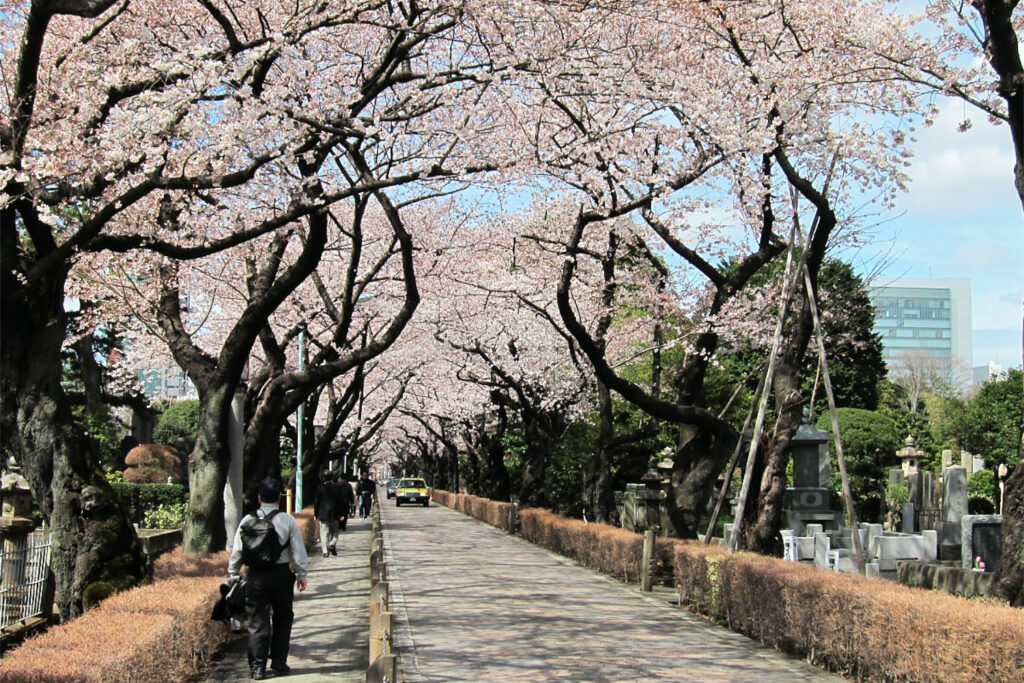
Photo: Aoyama Cemetery by Rs1421, cropped and resized, via Wikimedia Commons, licensed under CC BY-SA 3.0

Who Lives in Aoyama?
Aoyama draws a mix of established professionals, people working in fashion, design, and the arts, couples, and families who want to stay central. Because it falls within Minato Ward, home to a large share of Tokyo’s embassies and multinational offices, the area has a steady international population, and many residents work nearby in Akasaka, Roppongi, or Shibuya. Minami-Aoyama tends to feel the most residential and quiet, while Kita-Aoyama is livelier and closer to the shopping and nightlife of Omotesando.
For families, the practical draw is location and access rather than abundant local school options. Public schools are run by the Minato City Board of Education, and a number of international campuses sit a short distance away in Azabu, Hiroo, and Roppongi. Within Aoyama itself, international education is mostly at the preschool level, such as Clarence International School in Minami-Aoyama.
How Does Aoyama Compare to Nearby Areas?
Aoyama sits between several well-known central districts, and the differences are real enough to matter when choosing where to live. The table below compares it with three neighbours.
| Area | Character | Relative price | Best for |
|---|---|---|---|
| Aoyama | Design-led, residential-leaning, calmer than its retail front | High | Professionals and families who want central but quiet |
| Omotesando | Fashion and dining boulevard; busier, more commercial | High | Those who want shopping and cafe life on the doorstep |
| Roppongi | Nightlife, art, and large mixed-use towers; very international | High | Singles and professionals who want amenities and energy |
| Akasaka | Business and dining district with a quieter residential side | High | Professionals who want a central business-friendly base |
Aoyama Real Estate Overview
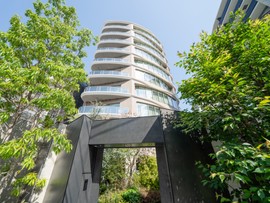
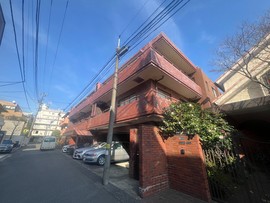
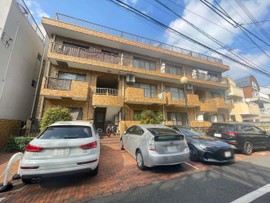
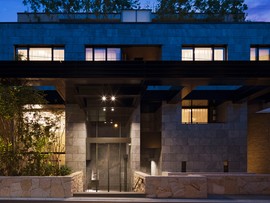
Aoyama is one of central Tokyo’s most expensive residential markets, and prices have climbed steadily. Housing stock is varied: low-rise designer apartments and older renovated buildings fill the quiet streets of Minami-Aoyama, while taller condominium towers cluster nearer Aoyama-itchome and the main avenues. The market leans toward owner-occupied homes at the top end, with a strong rental segment serving international professionals and corporate tenants.
The clearest official signal is land value. Under MLIT‘s 2026 official land price survey (kōji chika, as of 1 January 2026), residential land in Minami-Aoyama averaged about ¥3.26 million per m², up 14.3% year-on-year, with one benchmark point (Minami-Aoyama 4-chōme) assessed at ¥3.77 million per m². For ward context, the most expensive residential land point in all of Japan is in nearby Akasaka, Minato Ward, at ¥7.11 million per m², its ninth straight year in first place. Land value is a vacant-land valuation rather than an apartment price, but the double-digit rise signals the direction of the wider market.
Actual apartment prices sit higher per square metre of floor space. As of May 2025, resale condominiums in Minami-Aoyama averaged roughly ¥2.85 million per m², on an average building age of about 24 years; newer prime towers trade above ¥3 million per m². The table below gives indicative bands by unit type.
Indicative Aoyama condo prices and rents by unit type (resale market, 2025–2026)
| Unit type | Typical size | Indicative sale price | Indicative monthly rent |
|---|---|---|---|
| 1LDK (1-bed) | ~45–70 m² | ¥130M–¥280M | ¥350,000–¥700,000 |
| 2LDK (2-bed) | ~70–100 m² | ¥210M–¥450M | ¥550,000–¥1,200,000 |
| 3LDK (3-bed) | ~100–145 m² | ¥370M–¥1,100M + | ¥900,000–¥2,500,000+ |
Ranges reflect wide variation by building age and grade, older units have traded near ¥1.2 million per m², while prime towers reach ¥3 million per m² and above. Rent anchors include a 2024-built 1LDK of about 45 m² near Gaienmae listed at ¥350,000 per month, and prime 3LDK units in established Minami-Aoyama buildings renting in the ¥790,000–¥850,000 range, with the top towers higher. Figures are indicative, as of 2025–2026, and blend MLIT transaction data with current agency and portal listings; they are market context only and not a forecast of future value.
If you are weighing a move to Aoyama, Housing Japan offers local market knowledge and English-language support for buying, renting, and managing homes in central Tokyo.
Living in Aoyama: Is It Right for You?
Aoyama works well for people who value a central, walkable, design-conscious neighbourhood and are comfortable trading floor space for location. It is a strong fit for professionals, couples, and families who want easy access to Shibuya, Roppongi, and the rest of central Tokyo while coming home to quieter streets and green space. The international services concentrated in Minato Ward make settling in relatively smooth for newcomers to Japan.
It is less suited to those who need large homes on a modest budget, or families who want full international schooling within the immediate neighbourhood rather than a short ride away. For many, though, the combination of central access, greenery, culture, and calm is exactly what makes Aoyama one of Tokyo’s most desirable places to live.

Frequently Asked Questions About Aoyama
Which ward is Aoyama in?
Aoyama is in Minato Ward (港区, Minato-ku), in the northwest of the ward in central Tokyo. It is split by Aoyama-dori into Kita-Aoyama to the north and Minami-Aoyama to the south, and borders Omotesando, Harajuku, Akasaka, and Roppongi.
Is Aoyama a good place to live?
Aoyama is one of central Tokyo’s most desirable residential districts. It offers quiet, walkable streets, strong transport links, green space, and a steady international community, all close to Shibuya and Roppongi. The main trade-off is cost, as homes are expensive.
How long is the commute from Aoyama to Shibuya?
Shibuya is about 4 minutes from Omotesando Station on the Ginza or Hanzomon Line, with no transfer needed. It is also walkable in roughly 20 minutes, which suits residents who prefer to avoid the train for short trips.
Is Aoyama expensive?
Yes. Aoyama is among Tokyo’s priciest neighbourhoods, sitting above the Minato Ward average, and Minato itself records the highest average rents of the 23 wards. Both sale prices and rents have risen in recent years across central Tokyo.
What is the nearest international school to Aoyama?
Within Aoyama, Clarence International School in Minami-Aoyama offers a British-curriculum preschool. Larger international schools serving older children, such as Nishimachi International School and Tokyo International School, are a short distance away in the Azabu, Hiroo, and Roppongi areas.
What is there to do in Aoyama?
Aoyama is known for designer shopping along Omotesando and Aoyama-dori, the Nezu Museum and its garden, the Taro Okamoto Memorial Museum, and the weekend Farmers Market at the United Nations University. For green space, Aoyama Cemetery and the ginkgo avenue at Meiji Jingu Gaien are local landmarks.
What is the difference between Kita-Aoyama and Minami-Aoyama?
Kita-Aoyama (“North Aoyama”) lies north of Aoyama-dori and is livelier, closer to Omotesando’s shopping and nightlife. Minami-Aoyama (“South Aoyama”) lies to the south and is quieter and more residential, with low-rise apartments, galleries, and the Nezu Museum.
What Next?
At Housing Japan, we specialise in buying, selling, and managing residential luxury real estate in central Tokyo. Whether you are a local resident or simply seeking a second home or temporary residence for business trips, we have you covered. Our one-stop service includes expert management services, so you can sit back and relax knowing that everything is taken care of. Whether you are looking for a luxurious living experience or an investment opportunity, we are here to help you every step of the way.
View properties for sale in the Aoyama area here
Location
Featured Properties in Aoyama