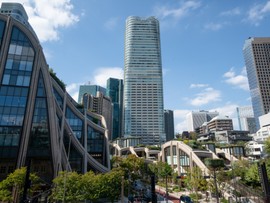
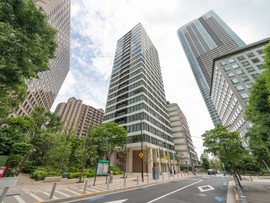
The Shibuya Station area redevelopment is one of Tokyo’s most significant urban projects, led by Tokyu Corporation, JR East, and Tokyo Metro. The project includes Shibuya Scramble Square Phase II, a new pedestrian network, and the already-completed Shibuya Sakura Stage complex. The full redevelopment is scheduled for completion by fiscal 2034.

May 9, 2025
~ The final chapter of the “once-in-a-century” Shibuya Station area redevelopment project begins ~
Republished and Translated Press Release by Tokyo Metro – www.tokyometro.jp/news/2025/220646 (Japanese Only)
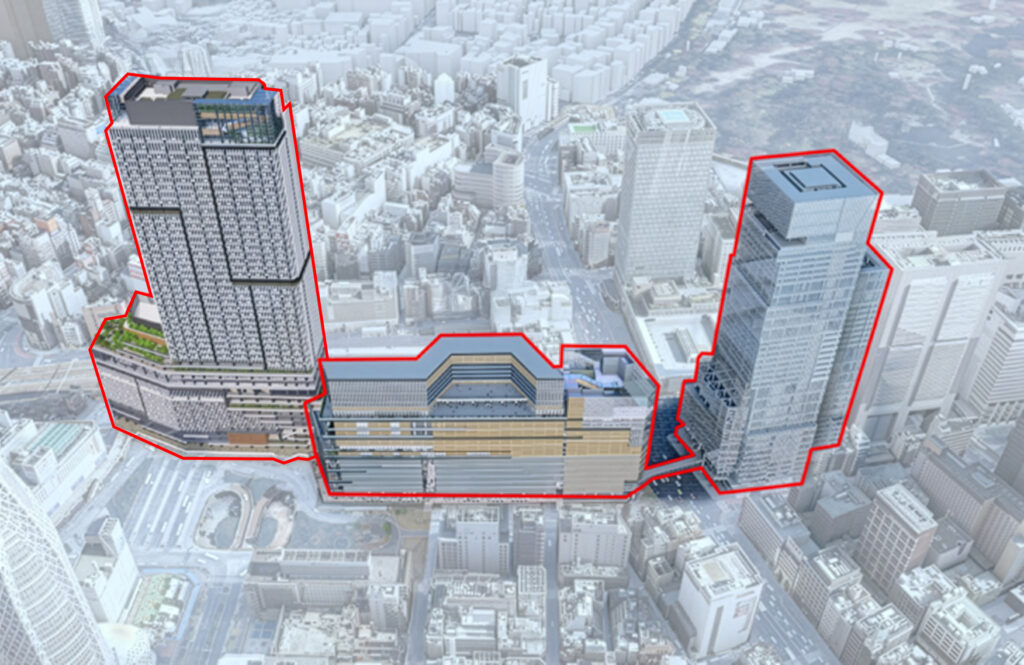
Tokyu Corporation, East Japan Railway Company, and Tokyo Metro Co., Ltd. are advancing the Shibuya Station Area Project, a large-scale redevelopment that has been more than two decades in the making. This project brings together the development of Shibuya Scramble Square, upgrades to Shibuya Station itself, and improvements to public spaces including Hachiko Square and the East Exit Plaza. Following the 2019 opening of Shibuya Scramble Square Phase I (East building), construction of Phase II (Central and West buildings) commenced in May 2025, marking the beginning of the project’s final chapter.
How Did the Shibuya Redevelopment Begin?
The transformation of Shibuya has unfolded across more than a decade and five major development sites. Planning began around 2010, with infrastructure work, including flood control improvements and the relocation of railway platforms on the Saikyo and Ginza lines. This laid the groundwork for what was to come. The sequence of completed projects gives a clear picture of how much has already changed.
Shibuya Hikarie opened in 2012, a 34-story tower built above the newly underground Tokyu Toyoko Line, and marked the start of the visible transformation. Shibuya Stream and Shibuya Fukuras followed in 2018, both developed on former railway land along the south and west sides of the station. Shibuya Scramble Square Phase I (the East building, 47 stories and approximately 230 meters tall) opened in November 2019, becoming the tallest building in the ward. Most recently, Shibuya Sakura Stage opened in 2024, transforming the long-neglected Sakuragaoka district to the south of the station.
Each project has been built while the station continued to operate, an unusual technical challenge given that Shibuya is served by nine railway lines operated by four different companies. The developers have had to revise construction plans repeatedly to maintain safety and keep the station functional throughout.
What Has Already Been Completed?
While the Scramble Square Phase II construction now begins its final chapter, much of the wider Shibuya redevelopment is already open and in use. Shibuya Sakura Stage, a 254,620-square-metre complex on the south side of the station developed by Tokyu Land, fully opened in July 2024. The complex brought new retail, dining, offices, and a Hyatt House hotel to the Sakuragaoka district. Also, a new JR South Exit that replaced a temporary structure that had been in place since 2008. For people who live and work near Shibuya, the change to the south side of the station is already clearly visible on the ground.
Key Highlights of the Project:
- By fiscal 2030, a multi-layered pedestrian network connecting the east, west, north, and south sides of Shibuya at ground and elevated deck levels will be substantially complete. This will significantly improve how people move through and around the station. It will bring the vision of an integrated station-and-town development much closer to reality.
- Improvements to JR Shibuya Station’s ticket gates and concourses will mostly be complete by fiscal 2030. A new east-west free passageway up to 20 meters wide will also be built, making the station easier and more comfortable to navigate at all hours.
- In fiscal 2031, Shibuya Scramble Square Phase II (Central and West buildings) will open. Together with Phase I (the East building), the combined commercial area will offer approximately 6,000 m² per floor, making it one of the larger shopping complexes in the Tokyo metropolitan area.
- The entire redevelopment, including a rebuilt Hachiko Square, is scheduled for completion by fiscal 2034. During construction, the developers are working to maintain the station’s full operations, prioritise safety for everyone moving through the area, and minimize disruption to local businesses and daily life.

Overview of the Project Timeline and Development:
The project has evolved considerably since planning began around 2010. Early infrastructure work included flood control improvements and platform relocations. The Saikyo Line and Ginza Line platforms were both moved as part of the wider effort to reshape the station’s internal layout. Phase I opened in 2019, and the overall project has since been adjusted to accommodate a growing number of visitors. This included international tourists, and to respond to changes in how people use public space.
Shibuya Station’s physical complexity has been one of the main challenges throughout. Multiple railway lines cross at different heights, and several buildings sit directly above or around the platforms. This has made each phase of construction more difficult to plan and required repeated revisions to ensure the station could keep running safely throughout.
The broader aim has always been to create a connected, walkable station area. One where the east and west sides of Shibuya, which have long been divided by the JR line and main roads, can be reached easily from one another. The projects completed so far have made progress on this, and the final phases will finish the job.
Overview of the Project Timeline and Development
The project has evolved considerably since planning began around 2010. Early infrastructure work included flood control improvements and platform relocations, the Saikyo Line and Ginza Line platforms were both moved as part of the wider effort to reshape the station’s internal layout. Phase I opened in 2019, and the overall project has since been adjusted to accommodate a growing number of visitors, including international tourists, and to respond to changes in how people use public space.
Shibuya Station’s physical complexity has been one of the main challenges throughout. Multiple railway lines cross at different heights, and several buildings sit directly above or around the platforms. This has made each phase of construction more difficult to plan and required repeated revisions to ensure the station could keep running safely throughout.
The broader aim has always been to create a connected, walkable station area, one where the east and west sides of Shibuya, which have long been divided by the JR line and main roads, can be reached easily from one another. The projects completed so far have made progress on this, and the final phases will finish the job.
Key Facilities and Features
What Is the East Exit Skyway?
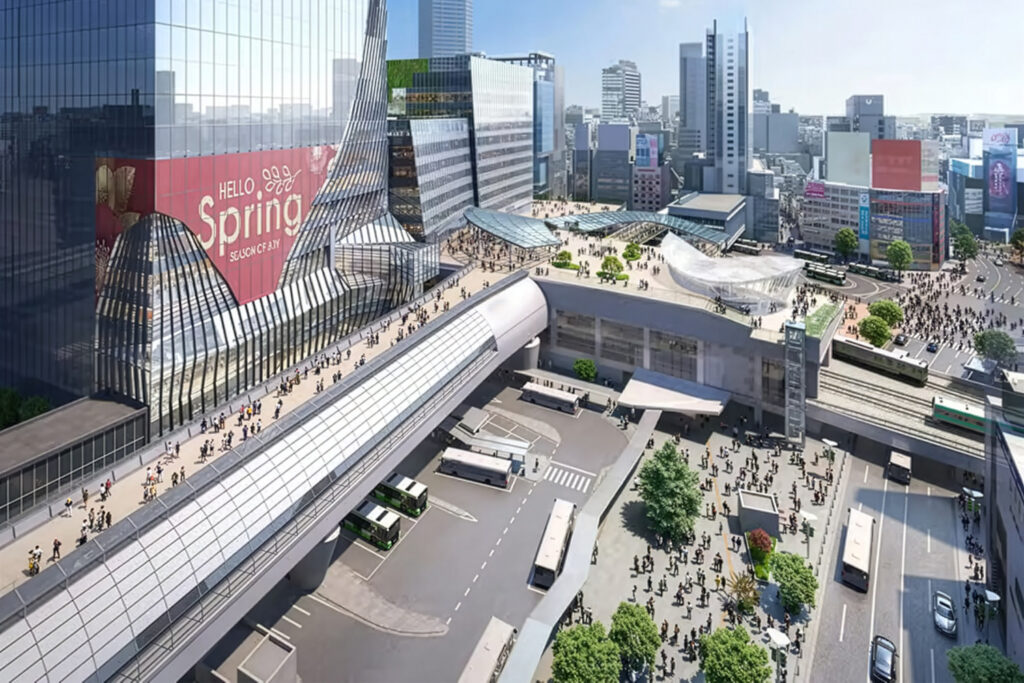
One of the most striking new additions will be the 4th Floor East Exit Skyway, an elevated pedestrian walkway planned for completion by fiscal 2030. The Skyway will be built directly above the Ginza Line Shibuya Station platforms, connecting the Hikarie Deck on the 4th floor of Shibuya Hikarie to the rooftop of the Ginza Line station. This creates a continuous aerial corridor linking the east and west sides of JR Shibuya Station, meaning people will be able to walk between Shibuya Hikarie, Shibuya Scramble Square, and Shibuya Mark City without descending to street level or crossing a main road. The facility will be designed by architect Naito Hiroshi, who also designed the Ginza Line Shibuya Station itself.
At ground level, two new east-west free passages will be built, each up to 22–23 meters wide, running in front of the JR Hachiko ticket gate and the JR South ticket gate. These wider, clearer routes will ease the congestion that has been a daily challenge at Shibuya for years.
By 2030:
- Major facilities, including relocated concourses, ticket gates, and stairways, will be substantially complete.
- New pedestrian connections will open at deck levels (2nd to 4th floors), including the 4th Floor East Exit Skyway above the Ginza Line platforms and a new pedestrian deck, the West Exit 3rd Floor Aerial Facility, to the west of the Scramble Square West building, designed by Naito Architect & Associates.
- New east-west free passages up to 22–23 meters wide at ground level will dramatically improve connectivity and ease congestion. This will create a more comfortable and accessible experience for everyone passing through the station.
By 2031:
- Shibuya Scramble Square Phase II (Central and West buildings) will open, offering approximately 6,000 m² of retail space per floor.
- A unique 10th Floor Pavilion on the Central building rooftop will serve as a cultural exchange venue developed in collaboration with embassies, offering panoramic views of Shibuya and Shinjuku. This space will be designed by world-renowned architecture practice SANAA. Read this article on Pritzker Architecture award winner Kazuyo Sejima, one of the lead architects who formed SANAA.
By 2034:
- The entire project will be complete, including multiple new public plazas totaling approximately 20,000 m². It will be designed to serve both as daily community spaces and as emergency refuge areas.
- The 4th Floor Pavilion, designed by Kengo Kuma & Associates, will be completed on the Central building, directly overlooking the Shibuya Scramble Crossing.
Initiatives During Construction
Despite the scale of the work, the developers are committed to keeping Shibuya operational and accessible throughout. Temporary route changes and some inconveniences are unavoidable, but safety and station functionality are being prioritized at every stage. Regular public updates will be provided, and site tours will be held so the public can follow the progress as the area is transformed.

Project Summary
| Detail | Information |
| Developers | Tokyu Corporation, JR East, Tokyo Metro |
| Location | Shibuya 2-chome, Shibuya-ku, Tokyo |
| Usage | Shops, offices, parking, cultural facilities |
| Total floor area | Approx. 95,000 m² for Phase II (approx. 276,000 m² upon full completion) |
| Central building | 10 stories above ground, 2 below (approx. 61m) |
| West building | 13 stories above ground, 4 below (approx. 76m) |
| East building (Phase I) | 47 stories above ground, 7 below (approx. 230m) |
| Design | Joint venture led by Nikken Sekkei, Kengo Kuma & Associates, and SANAA |
| Construction period | FY2025–FY2031 (Phase II) |
| Full completion | FY2034 |
www.tokyometro.jp/news/2025/220646 (Japanese Only)
What Does This Mean for Shibuya Beyond 2034?
The 2034 completion date marks the end of what planners call “Phase 1” of the Shibuya transformation. Further development is already planned for surrounding areas. The Miyamasuzaka District Redevelopment Project, approved by the Tokyo Metropolitan Government in April 2025, will add a 180-metre, 33-story tower to the east side of the station, housing offices, a hotel, a conference center, and business incubation facilities. A separate retail building and a rebuilt Miyamasu Mitake Shrine are also part of the plan. Construction is scheduled to begin in FY2027, with completion targeted for FY2031. This means this project will run in parallel with the final stages of the Scramble Square work.
Further redevelopment is also planned for the Shibuya 2-chome West district, facing Aoyama-dori and Roppongi-dori, and for the Koen-dori West area. If longer-term plans for the Shibuya Ward Office and the NHK Broadcasting Centre are also carried out, the transformation of the area will continue well into the 2030s and beyond.
Housing Japan’s Outlook
The steady progress of Shibuya’s redevelopment is already being reflected in property values across the area. According to the Ministry of Land, Infrastructure, Transport and Tourism’s 2025 Land Price Survey, residential land prices in Shibuya Ward rose 11.5% year-on-year and commercial land prices rose 13.3%, among the strongest results across Tokyo’s 23 wards. This reflects sustained demand from both domestic and international buyers drawn to one of Tokyo’s most connected and commercially active districts.
As the redevelopment moves into its final phases, properties within walking distance of the station are likely to see continued interest. The improved pedestrian networks, expanded public spaces, new cultural facilities, and the broader transformation of areas like Sakuragaoka and Miyamasuzaka will make the area more practical and more pleasant for daily living.
Understanding how a project of this scale affects individual streets, buildings, and neighbourhoods requires local knowledge and experience. Housing Japan has been active in Tokyo’s property market for over 25 years and understands how major infrastructure changes shape demand at the street level. Whether you are looking to buy near Shibuya or want to understand how the redevelopment may affect a property you already own, our team can help you make sense of a market that is changing quickly.
Frequently Asked Questions About the Shibuya Redevelopment
When will the Shibuya redevelopment be finished? The full project is scheduled for completion by fiscal 2034, including a rebuilt Hachiko Square and new public plazas. The pedestrian network and station improvements will be substantially complete by fiscal 2030, with Scramble Square Phase II opening in fiscal 2031.
What is Shibuya Scramble Square Phase II? Phase II adds a Central building (10 stories, approx. 61m) and a West building (13 stories, approx. 76m) alongside the existing 47-story East building that opened in 2019. Together the three buildings will offer approximately 6,000 m² of retail space per floor. Construction runs from FY2025 to FY2031, led by Tokyu Corporation, JR East, and Tokyo Metro.
How will the redevelopment change getting around Shibuya? New east-west passages up to 22–23 metres wide will reduce ground-level congestion. The 4th Floor East Exit Skyway will create an aerial walkway connecting Shibuya Hikarie, Scramble Square, and Shibuya Mark City. this will allow people to cross between the east and west sides of the station without touching street level. Most improvements will be in place by fiscal 2030.
What is Shibuya Sakura Stage? A 254,620 m² mixed-use complex that opened in July 2024 on the south side of the station, developed by Tokyu Land. It includes retail, dining, offices, a Hyatt House hotel, and a startup programme developed with MIT. It is part of the broader Shibuya transformation but a separate project from Scramble Square.
Does the redevelopment affect nearby property values? Land prices in Shibuya Ward rose 12.53% year-on-year in 2025, reaching the third-highest level nationwide. Properties close to the station and the new pedestrian networks have seen particularly strong interest.