The Greater Tokyo Area’s existing condominium market extended its growth streak to 15 consecutive months in January 2026. According to the Real Estate Information Network for East Japan (REINS), transactions rose 3.1% year-on-year to 3,343 units, while the average price per square meter climbed 6.3% to ¥869,900. That price-per-square-meter figure has now risen for 69 straight months, a run dating back to May 2020.
For anyone watching Tokyo’s property market, this report confirms two things. Demand for existing condos remains strong, and prices keep climbing even as interest rates rise. Here is what the numbers show and what they mean for buyers, sellers, and anyone thinking about the Tokyo housing market.
What Does the January 2026 Data Show?
The January 2026 Market Watch report covers both condominiums (called “mansions” in Japanese) and detached houses across the Greater Tokyo Area. This includes Tokyo, Saitama, Chiba, and Kanagawa prefectures. The data tracks three types of properties: those that sold during the month, newly listed properties, and properties still available for sale.
How Are Existing Tokyo Condo Sales Performing?
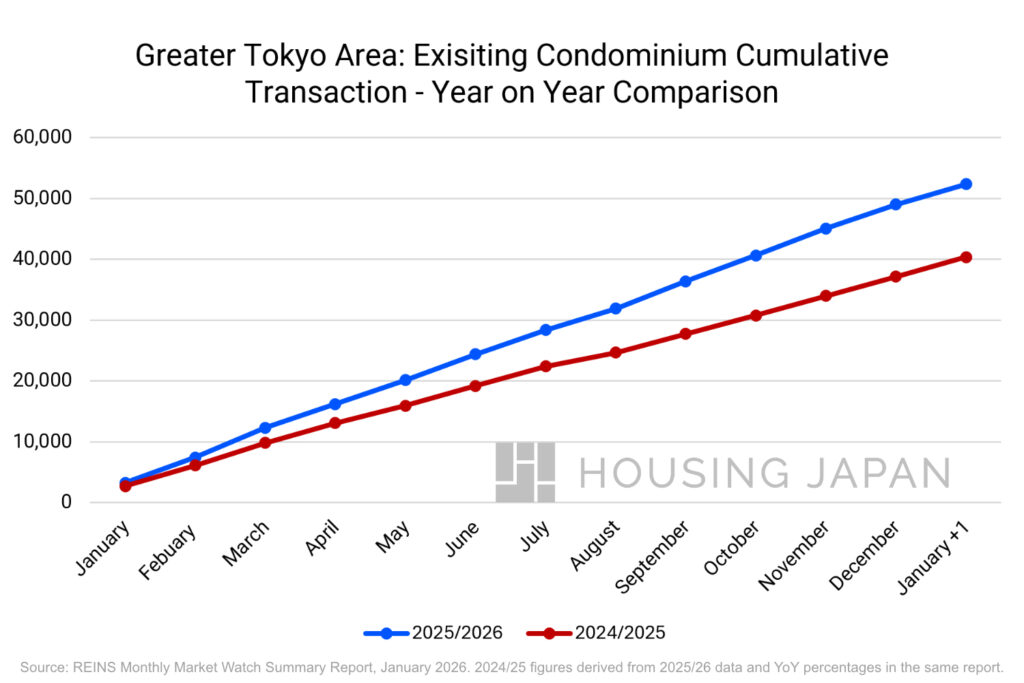
Existing condominium transactions across the Greater Tokyo Area reached 3,343 units in January 2026. That is a 3.1% increase from the same month last year and continues a trend that started in November 2024. While the growth rate has slowed compared to the double-digit jumps seen in late 2025, the direction has stayed the same for over a year.
New listings rose 0.4% year-on-year to 15,514 units, a modest increase for the second month running. Meanwhile, the number of condos sitting unsold on the market fell 1.5% to 44,776 units. This marks six consecutive months of declining inventory, meaning available supply is tightening.
In simple terms, more condos are selling, fewer are sitting on the market, and new supply is only trickling in. That combination tends to support prices.
How Much Do Existing Tokyo Condos Cost Now?
The average transaction price per square meter reached ¥869,900 in January 2026, up 6.3% from a year earlier. To put that in context, this figure has now surpassed the previous highest recorded level last seen in September 1990, when it was ¥850,000 per square meter. The average total transaction price for a condo was ¥54.93 million (roughly $365,000 USD at current exchange rates), up 6.7% year-on-year. This is new highs for Tokyo Real Estate.
The average floor area of condos that sold was 63.15 square meters, which is about 680 square feet. This is a standard two-bedroom apartment size in Tokyo. The average building age was 26.78 years, meaning most transactions involve properties built in the late 1990s.
How Do Prices Vary Across the Greater Tokyo Area?
Prices and transaction activity vary a lot depending on location. Central Tokyo leads in price per square meter, but some outer areas saw faster growth in the number of deals. Here is how each area performed in January 2026.
| Area | Units Sold | YoY Change | ¥/m² | Price YoY | Avg Price |
| Tokyo 23 Wards | 1,433 | -2.4% | ¥1,375,000 | +11.3% | ¥79,520,000 |
| Tokyo (Tama) | 319 | +9.6% | ¥581,500 | +3.4% | ¥39,390,000 |
| Saitama | 397 | +9.4% | ¥467,600 | +10.5% | ¥31,900,000 |
| Chiba | 355 | -3.0% | ¥386,000 | -6.5% | ¥27,490,000 |
| Kanagawa | 839 | +11.3% | ¥620,700 | +5.4% | ¥41,370,000 |
| Yokohama/Kawasaki | 595 | +8.8% | ¥696,100 | +6.7% | ¥46,240,000 |
Source: REINS Monthly Market Watch Summary Report, January 2026. Price per m²
Tokyo’s 23 central wards remain the most expensive area, with an average price per square meter of ¥1.375 million. That is more than double the figure in Saitama or Chiba. However, transaction numbers in the 23 wards actually dipped 2.4% from a year earlier, while Kanagawa surged 11.3% and Saitama grew 9.4%. This suggests some buyers are looking outside central Tokyo for more affordable options.
Chiba stood out as the only prefecture where both transactions and prices fell year-on-year, dropping 3.0% and 6.5% respectively. This was the first decline in transactions for Chiba since October 2023.
What About Detached Houses?
Existing detached house transactions also showed strong momentum. Sales climbed 17.0% year-on-year to 1,496 units, extending the growth streak to 15 months with sustained double-digit gains. The average transaction price rose 7.1% to ¥40,560,000, the third consecutive month above the ¥40 million mark.
By prefecture, transactions rose 11.9% in Tokyo (453 deals), 30.5% in Saitama (351), 15.8% in Chiba (307), and 13.2% in Kanagawa (385). New listings increased 2.1% to 6,361, while inventory edged up just 0.4% to 23,539 units, extending a modest but steady rise for the 41st consecutive month.
Why Are Prices Still Rising?
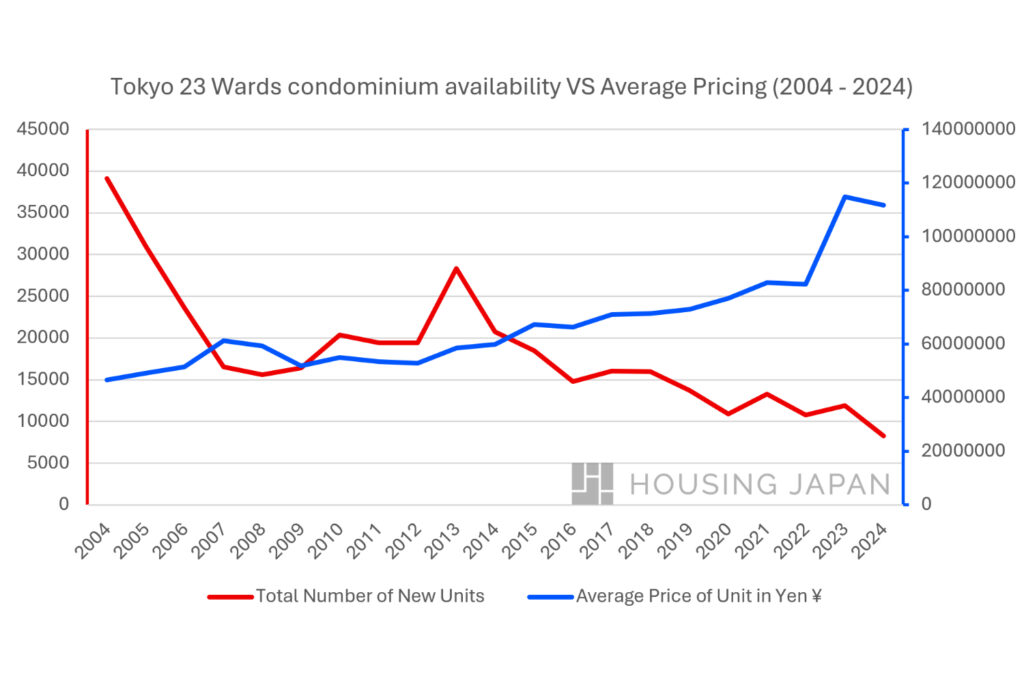
Source: Tokyo Condominium Prices Surge as New Supply Drops | Housing Japan
Several factors help explain why Tokyo’s existing condo prices have risen for 69 straight months.
Limited new supply. Construction costs in Japan have risen sharply due to higher material prices and labor shortages. This has slowed the pace of new condominium development, pushing more buyers toward the existing market. When fewer new homes are built, competition for existing ones increases.
Foreign buyer demand. The Japanese yen has remained relatively weak compared to the US dollar, euro, and other major currencies. This has made Tokyo property more affordable for overseas buyers. Foreign capital has become a significant force in Tokyo’s premium property market, with buyers from the United States, Europe, Southeast Asia, and Greater China active in high-end transactions.
Interest rates are still low by global standards. The Bank of Japan raised its policy rate to 0.75% in December 2025, the highest level in 30 years. However, compared to mortgage rates in the United States or Europe, Japanese borrowing costs remain very low. Most variable-rate mortgages in Japan are still below 1%, and many fixed-rate options remain under 2%. This keeps monthly payments manageable for many buyers.
Shrinking inventory. With condo inventory falling for six straight months, buyers have fewer options to choose from. This creates competition for well-located properties and pushes prices upward, especially in popular neighborhoods near major train stations.
What Does This Mean for Buyers and Sellers in Tokyo?
If You Are Thinking About Buying a Tokyo Property
The data suggests that waiting for a major price drop in central Tokyo is unlikely to pay off in the near term. Prices have risen consistently for nearly six years, and the factors supporting them, such as limited supply, foreign demand, and low interest rates, remain in place. That said, the market is becoming more selective. Properties in strong locations near train stations continue to sell quickly, while units with drawbacks like poor building management or inconvenient access are taking longer to move.
Buyers should also note the regional differences. The 23 wards of central Tokyo carry the highest price premiums, but areas like Kanagawa and Saitama are seeing faster transaction growth and offer lower entry points. A two-bedroom condo that might cost ¥79,520,000 in the 23 wards could be found for ¥31.90 million in Saitama.
If You Are Thinking About Selling a Tokyo Property
Sellers currently benefit from tight inventory and steady demand. With available condo listings falling for six consecutive months, well-priced properties in good locations are attracting buyers relatively quickly. The spring months of February through April tend to be the most active period for real estate transactions in Japan, so timing a listing for this window could be advantageous.
How Could Japan Interest Rate Changes Affect the Market?
The Bank of Japan’s December 2025 rate increase to 0.75% was widely expected. Most analysts expect two to three additional rate increases through the end of 2026, potentially bringing the policy rate to around 1.0% to 1.25%. Many Japanese banks review their base mortgage rates in April and October, so borrowers on variable-rate loans may see small increases in the coming months.
However, a sudden sharp rate spike is considered unlikely. The Bank of Japan has signaled a gradual approach to rate normalization. Even with further increases, Japanese mortgage rates would remain well below those in most other developed countries. The bigger concern for some buyers may be the combination of rising rates and already-high prices, which together reduce purchasing power.
January 2026 Greater Tokyo Area: At a Glance
| Metric | Condos | Detached Houses |
| Transactions | 3,343 | 1,496 |
| Year-on-year change | +3.1% | +17.0% |
| Consecutive months of growth | 15 | 15 |
| Average transaction price | ¥54,930,000 | ¥40,560,000 |
| Price year-on-year change | +6.7% | +7.1% |
| Price per m² (condos only) | ¥869,900 | — |
| Months of consecutive m² price rises | 69 | — |
| New listings | 15,514 | 6,361 |
| Inventory (units for sale) | 44,776 | 23,539 |
| Inventory year-on-year change | -1.5% | +0.4% |
Source: REINS Monthly Market Watch Summary Report, January 2026
Q&A: Tokyo’s Existing Condo Market in 2026
What is REINS and why does its data matter? REINS stands for Real Estate Information Network System. It is a government-designated computer network operated by the Real Estate Information Network for East Japan, a public interest foundation under the Ministry of Land, Infrastructure, Transport and Tourism. Licensed real estate agents are required to register property listings through REINS, making it one of the most comprehensive sources of transaction data for the Greater Tokyo Area.
Have condo prices in Tokyo at new highs? Yes, on a price-per-square-meter basis. The average transaction price per square meter in January 2026 was ¥869,900, which exceeds the September 1990 figure of ¥850,000 per square meter. However, the market today is different from the 1990s era. Current prices are supported by real demand from domestic and international buyers, low interest rates, and genuine supply constraints, rather than speculative lending.
Are prices rising everywhere in the Tokyo area? No. The January 2026 data shows clear differences by location. Tokyo’s 23 wards and Kanagawa both saw price increases, but Chiba experienced a 6.5% decline in average transaction price. Even within Tokyo, the 23 central wards saw transactions dip slightly while the western Tama region posted a 9.6% increase in deals. The market is becoming more selective, with strong demand concentrated in well-connected areas.
How do interest rate increases affect existing condo prices in Tokyo? Rising interest rates increase monthly mortgage payments, which can reduce how much buyers are able to borrow. However, the Bank of Japan has taken a gradual approach, and Japanese mortgage rates remain very low by international standards. Most analysts do not expect a sudden price drop from rate increases alone. The combination of limited supply, foreign demand, and a weak yen continues to support prices in major urban areas.
Is now a good time to buy a condo in Tokyo? This depends on individual circumstances. The data shows that well-located properties continue to sell quickly and prices have risen steadily for nearly six years. Waiting for a major correction has not been a winning strategy in recent years. However, buyers should be selective. Properties near train stations with good building management tend to hold value, while units with drawbacks are taking longer to sell. Buyers should also factor in potential future rate increases when calculating their budget.
What Next?
Whether you are just starting to explore the Tokyo property market or are ready to make a move, Housing Japan is here to help. We specialize in buying, selling, and managing luxury residential real estate in central Tokyo. With 25 years of experience our multilingual team can guide you through every step of the process, from understanding market data like the REINS reports to finding the right property and completing the transaction.
Source: Real Estate Information Network for East Japan (REINS), Monthly Market Watch Summary Report, January 2026 (JP only)