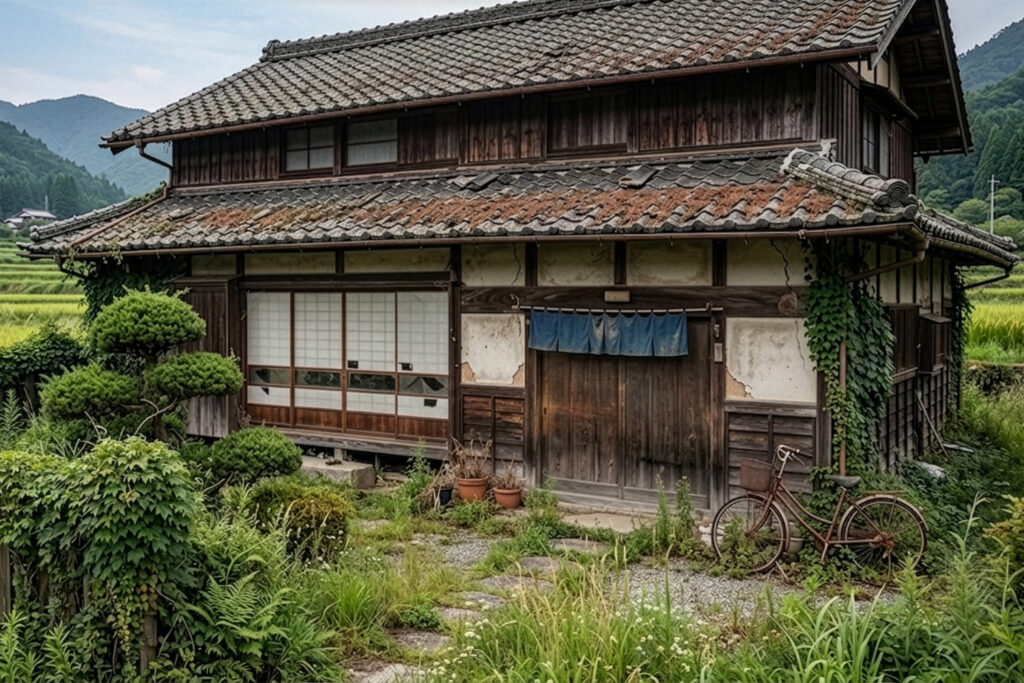
An akiya is a vacant or abandoned home in Japan, and foreigners can legally buy one regardless of visa status. Low purchase prices and the chance to restore a traditional home make them appealing. The real costs, though, lie in seismic safety, tax rules, rebuild restrictions, title checks, and renovation budgets that often run to several times the purchase price.
Key Facts
- Buying an akiya does not grant residency rights or a visa in Japan, no exceptions.
- Japan’s modern seismic building code took effect in 1981 (新耐震基準). Most affordable akiya predate it.
- Land under a home used as a residence qualifies for a property tax reduction, as little as 1/6th of the standard assessed value on the first 200 square metres per dwelling (住宅用地の特例). Demolish the building and that reduction disappears; in practice the land tax bill often rises by around three to four times.
- A property designated a Specified Vacant House (特定空家) by the municipality also loses that tax reduction, and the city can demolish it and bill the owner.
- Excluding homes for rent, sale, or use as second homes, Japan had about 3.85 million vacant homes in 2023 (Statistics Bureau), a large and growing pool of low-cost properties. Many depopulating municipalities now offer renovation and relocation subsidies, and some akiya are well-built traditional kominka (古民家) suited to restoration. Some akiya carry 再建築不可 (non-rebuildable) status, they cannot legally be rebuilt or substantially renovated.
- Japanese banks frequently decline mortgage applications on akiya even when the borrower qualifies. Cash purchases are common.
- MLIT estimated that 90% of Japan’s homes met modern seismic standards in 2023, up from 87% in 2018, leaving roughly 5.7 million homes that do not.
- MLIT targets substantially eliminating seismically deficient residential housing nationwide by 2030.
Does buying an akiya give you a visa or residency rights in Japan?
No. Purchasing an akiya, or any property in Japan, does not entitle you to a visa, residency status, or the right to live in the country. This is one of the most common misconceptions circulating in foreign-language coverage of the akiya phenomenon.
Japan has no investor visa or golden visa programme that grants residency through residential property purchase, unlike some European countries. Foreigners can legally buy real estate in Japan regardless of visa status, but ownership confers no immigration benefit whatsoever. To live in the property, you still need a valid visa, a work visa, spouse visa, long-term resident status, or permanent residency.
The misconception spreads through YouTube videos and social media content that conflates “you can buy” with “you can stay.” These are entirely separate legal matters governed by entirely separate laws. For visa questions, consult a licensed immigration lawyer, not a real estate agent.
Is an akiya safe in an earthquake?
Many are not. The most important structural question for any akiya is whether it was built before or after 1981, the year Japan’s revised Building Standards Act introduced the 新耐震基準 (new seismic standards). Properties permitted before that date were built under the weaker 旧耐震基準 (old seismic standards) and frequently do not meet modern earthquake resistance requirements.
Most affordable akiya are old. The older and cheaper the property, the more likely it predates 1981. MLIT explicitly identifies this pre-1981 building stock as the primary residential seismic risk category in Japan. Earthquakes that caused catastrophic damage to wooden homes, the 1995 Hanshin-Awaji earthquake, the 2016 Kumamoto earthquake, the 2024 Noto Peninsula earthquake, disproportionately destroyed buildings from that era.
Seismic retrofitting (耐震改修) is not legally mandatory for individual homeowners, but MLIT states clearly that earthquake preparedness is the owner’s individual responsibility. Subsidy programmes exist at national and municipal level for seismic diagnosis and retrofit work, buyers should contact the relevant municipal office before purchase, not after. MLIT also warns that door-to-door contractors claiming to conduct seismic surveys on behalf of the national government are operating fraudulently. The national government does not conduct these surveys directly.
MLIT published an updated Wooden Housing Safety Assurance Manual (木造住宅の安全確保方策マニュアル) Japanese only in August 2024, revised March 2025, covering risk-reduction options where full retrofits are not feasible. The geographic context matters too, MLIT warns of high-probability future earthquake events including the Nankai Trough earthquake (南海トラフ地震) and the Tokyo Metropolitan Inland Earthquake (首都直下地震). Where an akiya sits on the map is not a minor detail.
According to MLIT, 90% of Japan’s homes met modern seismic standards as of 2023, leaving roughly 5.7 million that do not, and the national target is to substantially eliminate seismically deficient residential housing by 2030.
What to check before you buy: seismic status
Confirm the building permit date (建築確認済証). If the property was permitted before June 1, 1981, assume old seismic standards apply. Ask whether a seismic diagnosis (耐震診断) has already been conducted and request the report. Get retrofit cost estimates before signing anything, costs vary widely by structure type, condition, and region. Check whether the municipal government offers retrofit subsidies but note that applications must typically be submitted before work begins and is usually done entirely in Japanese. A property already retrofitted using government subsidies may also qualify for property tax reductions. Subsidy availability and terms vary by municipality; verify current programmes directly with the relevant local authority.
What is the property tax trap that akiya owners fall into?
There are two distinct tax traps, and either one can turn a cheap akiya into an expensive liability. Both involve the residential land special measure (住宅用地の特例), which reduces property tax on land used for residential purposes, and which disappears under specific circumstances that akiya owners routinely trigger by accident.
Under this measure, land with a residential building on it receives a significant property tax reduction. The portion of land up to 200 square metres qualifies for a reduction to 1/6th of the standard assessed tax base for fixed asset tax purposes, under the Local Tax Act (地方税法第349条の3の2) Japanese Only, as set out by the Ministry of Internal Affairs and Communications (総務省). The portion above 200 square metres is reduced to 1/3rd. Demolish the building, whether to clear a dangerous structure or to rebuild, and you lose that residential classification. The reduction disappears and the land tax rises sharply, in practice the bill commonly increases by around three to four times once the land is taxed as non-residential.
This is precisely why many owners of derelict properties leave them standing even in dangerous condition. Demolition triggers a tax spike that makes clearing the land economically painful. Buyers planning to tear down and rebuild must account for the full tax impact of the gap between demolition and completion of a new structure.
The second trap is government designation as a 特定空家 (Specified Vacant House) under the Act on Special Measures Concerning Vacant Houses (空家等対策の推進に関する特別措置法). Once designated, a property loses the 1/6th tax reduction even while the building still stands. Designation criteria include structural deterioration posing safety risks, unsanitary conditions, significant impact on the surrounding landscape, and being a nuisance to neighbours.
A Specified Vacant House designation also gives the municipality authority to issue improvement orders and ultimately to demolish the structure and bill the owner. Before purchase, check with the relevant municipal government whether the property is already under 特定空家 review or has received any related notices. For more on property taxes in Japan, our detailed guide covers the broader tax landscape.
What is non-rebuildable status and why does it matter for akiya?
Some akiya are legally classified as 再建築不可 or non-rebuildable in English. If the building is demolished or destroyed, it cannot be replaced with a new structure on the same site. This is a fundamental legal constraint, not a renovation challenge, and it materially affects the property’s value, usability, and financing options.
Non-rebuildable status typically arises from one of two situations: the land does not front a road recognised under the Building Standards Act (建築基準法上の道路), or the road frontage is less than the legally required 2 metres. Many rural and old urban akiya were built before these access rules were strictly enforced and now sit on landlocked or under-fronted plots. Renovation is possible, but only to a limited extent, major structural work that legally constitutes new construction or exceeds defined thresholds requires a building permit that will be refused.
Banks will almost universally refuse to lend on 再建築不可 (non-rebuildable) properties, making this status effectively disqualifying if you plan to finance the purchase. The resale market is also significantly narrower than for rebuildable land, which constrains your exit options. Always verify rebuildable status with the local city or ward office (役所) and confirm road designation before making any offer.
How much does it actually cost to renovate an akiya?
The renovation cost of a typical akiya can exceed the purchase price by a large multiple. A property listed at ¥500,000 or ¥1,000,000 can require ¥8,000,000 to over ¥20,000,000 (roughly US$50,000–US$130,000) to bring to a liveable standard, this is a representative range based on practitioner experience rather than a fixed figure, and actual costs vary considerably by property condition, location, and scope of work.
Common requirements in pre-1981 wooden akiya include full roof replacement, foundation repair or underpinning, structural reinforcement for seismic compliance, rewiring, replumbing (including replacement of lead or obsolete pipe materials), insulation installation, most older Japanese homes have none, kitchen and bathroom gut-renovation, and mould and pest remediation. In rural areas, limited access to qualified contractors and logistics can add meaningfully to an already substantial bill.
Indicative costs by work item (Housing Japan Research estimates, based on prevailing Japanese renovation-market ranges; seismic figures from the Minister of Land, Infrastructure, Transport and Tourism Designated Seismic Retrofit Support Center (国土交通大臣指定耐震改修支援センター / 日本建築防災協会):
| Work item | Typical cost range | Notes |
|---|---|---|
| Building inspection (建物状況調査) | ¥50,000–¥100,000 | Before purchase |
| Seismic diagnosis (耐震診断) | ¥100,000–¥400,000 | Can be free/subsidised for pre-1981 homes |
| Seismic retrofit (耐震改修) | ¥1,500,000–¥8,000,000 | ~¥1.0 – 1.5M for moderate work; full structural reinforcement of a derelict pre-1981 home reaches the upper end |
| Roof replacement (屋根葺き替え) | ¥1,000,000–¥5,000,000 | Metal-conversion/lightening from ~¥1.0M; full kominka re-roof ¥4.0–5.0M |
| Foundation repair (基礎補強) | ¥200,000–¥2,000,000 | Crack injection ¥200,000–¥300,000; new concrete footing ~¥50,000/metre |
| Full rewiring (電気配線) | ¥500,000–¥2,000,000 | Whole-house |
| Replumbing – supply & drainage (給排水管) | ¥500,000–¥2,000,000 | Whole-house |
| Insulation (断熱改修) | ¥500,000–¥2,000,000 | Floors, walls, internal windows |
| Wet areas – kitchen, bath, toilet, basin (水回り) | ¥1,500,000–¥4,000,000 | Full replacement set |
| Mould & termite remediation (防蟻・カビ対策) | ¥200,000–¥1,000,000 | Where damage is present |
| Interior finishes & joinery | ¥1,000,000–¥4,000,000 | Floors, walls, ceilings, fittings |
| Estimated costs of Akiya renovation | ~¥10,000,000 – ~¥25,000,000+ | Renovation costs can vary greatly by property |
Figures are estimated indicative ranges for an older, pre-1981 wooden akiya and assume a full rehabilitation. Actual costs vary widely by property condition, location, and scope of work. Always obtain firm quotes from licensed contractors before committing to a purchase.
The correct sequence is: identify the property, commission a building inspection and a seismic diagnosis, obtain renovation quotes from licensed contractors, then decide. Not: buy first, discover the costs later. Municipal and national subsidy programmes exist for renovation of traditional wooden housing and for seismic retrofitting, but these require advance application and approval as well as Japanese Language understanding. They reduce cost; they do not eliminate it. Factor in the cost of alternative accommodation during renovation, potentially a year or more for a full rehabilitation. Subsidy availability varies by municipality; verify current programmes directly with the relevant local authority.
Housing Japan Research estimates the cost of bringing an older akiya to a comfortable, modern liveable standard at ¥10,000,000–¥20,000,000, with a full skeleton (スケルトン) renovation of a derelict pre-1981 property reaching ¥25,000,000 or more. These figures are indicative; actual costs depend on the property’s condition, location, and scope of work, and on whether seismic, roof, foundation, and services work is needed.
Who actually owns the akiya, and can they sell it?
Title and ownership complexity is among the most underestimated risks in the akiya market. Many vacant properties have passed through multiple generations without formal inheritance registration, leaving title unclear, ownership fragmented among dozens of heirs, or legally unresolved. In the worst cases, it is genuinely impossible to purchase clean title.
Japanese inheritance law does not automatically transfer property title. Heirs must affirmatively register ownership, and many do not, particularly for properties with low or negative value. A property can legally have dozens of co-owners spread across Japan and overseas, each of whom must consent to a sale. Tracking them all down can be impossible.
Japan made inheritance registration mandatory on 1 April 2024 (相続登記の義務化). According to the Ministry of Justice (法務省), heirs must apply within three years of learning they have acquired the property, and failure without good reason can incur an administrative fine of up to ¥100,000 under the Real Property Registration Act (不動産登記法第76条の2). Inheritances that arose before April 2024 are also covered, with a deadline of 31 March 2027. However, the enormous existing backlog of unregistered titles will take years to resolve. Some akiya listed in akiya banks are listed by municipalities or community groups, not legal owners, and the path to a clean transaction is unclear.
Before any offer, a thorough title search (登記事項証明書) must be conducted at the relevant Legal Affairs Bureau (法務局). This is non-negotiable. If title issues are found, resolution may require a court process (遺産分割調停 or similar). Engage a Japanese lawyer (弁護士) or judicial scrivener (司法書士) with inheritance expertise. Foreign buyers cannot navigate Japanese inheritance and title law without professional Japanese-language legal support, budget for it.
Can a foreigner get a mortgage to buy an akiya in Japan?
In practice, it is difficult. Even when a foreign buyer personally meets a Japanese lender’s income and creditworthiness requirements, the property itself frequently fails to qualify, particularly for older, rural, or structurally compromised akiya. Most akiya purchases by foreigners are cash transactions.
Japanese banks assess both the borrower and the property. An akiya with structural issues, non-rebuildable status, unclear title, or located in a declining rural market may be refused as collateral regardless of borrower quality. Some Japanese lenders further restrict mortgage access for non-permanent residents, permanent residency, or a Japanese co-borrower, can improve access, but does not resolve the property qualification issue.
Without a mortgage, the buyer must have sufficient liquid capital to cover the purchase price, transaction costs (typically 6–10% of the purchase price in taxes, agent fees, registration costs, and legal fees), and full renovation costs. Cash buyers should be particularly rigorous about due diligence, the disciplines that lenders would otherwise impose through their own valuation and survey requirements must be self-imposed. Some regional financial institutions (地方銀行) or credit unions have offered renovation loan products for traditional housing, but availability is inconsistent and terms vary.
Where are most akiya actually located, and what does that mean for daily life?
The cheapest akiya are almost always in rural Japan, depopulating villages, mountain towns, and coastal communities that have been losing residents for decades. That is precisely why they are cheap. For a foreigner expecting to live there full-time, the lifestyle implications and infrastructure limitations deserve serious, clear-eyed consideration.
Akiya vacancy rates are highest in Japan’s most rural prefectures. Properties priced below ¥1,000,000 are overwhelmingly located in areas with severely limited public transport, ageing or declining local services, and often no English-language support infrastructure. Driving is frequently not optional, it is essential. Foreign buyers should assess whether they can legally drive in Japan and whether they are prepared for a car-dependent lifestyle. Read our article on How to Transfer Your Foreign Driver’s License to a Japanese Driver’s License.
Local hospitals, schools, and shops may be limited, distant, or declining further as surrounding populations shrink. The resale market for rural akiya is very limited. In many locations, the realistic exit may be donation to the municipality rather than sale. Rental income potential is similarly limited, the population to rent to may not exist. Urban and peri-urban akiya do exist, including in some areas near Tokyo and Osaka, but prices in those locations reflect better fundamentals and are not typically in the ¥500,000 range.
According to the 2023 Housing and Land Survey (Statistics Bureau, 総務省), Japan had about 9 million vacant homes, a record vacancy rate of 13.8%. Excluding homes for rent, sale, or use as second homes, roughly 3.85 million were genuinely vacant “other” homes, the category most akiya fall into. Vacancy rates are highest in western and rural prefectures, where the cheapest akiya are concentrated.
A precise build-year breakdown of vacant stock is not separately published, but MLIT identifies pre-1981 housing as the primary seismic-risk category, and the cheapest akiya are overwhelmingly old.
Who does buying an akiya actually work for?
An akiya works well for a specific kind of buyer: someone paying cash, with a renovation budget several times the purchase price, the time to manage a long project, and a real reason to be in a particular area. For these buyers, the low entry price and the chance to restore a traditional home are the appeal rather than the obstacle.
The clearest fit is the hands-on renovator. Buyers who want a kominka (古民家, traditional folk house) to restore, who enjoy the work or can manage contractors patiently, and who are not relying on a quick resale, tend to be happy with the result. A second group is lifestyle relocators, people moving to the countryside for space and a slower pace, often helped by the relocation and renovation subsidies many depopulating towns now offer.
Akiya also suit buyers with local knowledge or support. Some Japanese-language ability, or a trusted local broker, lawyer, or contractor, makes the title checks, subsidy applications, and building work far smoother. Buyers who already live in Japan carry less risk than overseas buyers managing everything remotely.
Who should think twice? Anyone expecting a mortgage, a fast renovation, rental income, or an easy resale. Anyone treating the purchase price as the total cost. And anyone hoping the property will answer a visa or residency question, because it will not. The honest test is simple: if the project still makes sense once you add full renovation costs, professional fees, and a year or more of patience to the headline price, an akiya can be a rewarding home. If it only makes sense at the headline price, it usually does not.
Are akiya bank listings accurate and reliable?
Akiya bank listings are not regulated real estate marketplaces and should not be treated as such. Listings are frequently inaccurate, outdated, or incomplete. The akiya bank is a starting point for identifying properties, not a reliable substitute for professional due diligence.
Akiya banks (空き家バンク) are typically operated by municipal governments or community organisations with the goal of connecting vacant properties with potential buyers. They are not licensed real estate brokerages. Unlike listings on licensed real estate platforms, akiya bank listings are not subject to the accuracy and disclosure standards imposed on licensed brokers under the Real Estate Transactions Business Act (宅地建物取引業法). Common problems include properties already sold but not removed from the database, inaccurate or absent information about building condition and legal status, and listed contacts who are no longer reachable.
The municipality listing the property may not be the owner and may have limited knowledge of the property’s legal, structural, or tax situation. Treating an akiya bank listing as a starting point, then engaging a licensed broker to conduct proper verification, is the appropriate approach. Any licensed broker engaging with an akiya transaction must by law provide a 重要事項説明書 (Explanation of Important Matters), which covers key legal and physical attributes of the property. This document is a legal requirement and a critical protection for the buyer.
Who should I work with to buy an akiya, and who should I avoid?
Work with a licensed real estate broker (宅地建物取引業者) registered with the relevant prefectural authority. Avoid unlicensed consultants, and be cautious of anyone charging large fees on top of standard statutory agent commissions without clear disclosure of what those fees cover.
In Japan, real estate brokers must hold a 宅地建物取引業 licence issued by the relevant prefectural governor or the Minister of Land, Infrastructure, Transport and Tourism. Licence numbers are public and verifiable. Licensed brokers are legally required to provide a 重要事項説明書 delivered by a qualified 宅地建物取引士 (licensed transaction specialist). This document discloses legal status, zoning, building conditions, and known risks. Unlicensed consultants cannot provide this.
Statutory agent commission on a property sale is capped by law. On properties priced at ¥4,000,000 or above, the cap is 3% of the purchase price plus ¥60,000, plus consumption tax. This is a statutory cap under the Real Estate Transactions Business Act (宅地建物取引業法), buyers should be sceptical of additional large fees charged on top of this without clear justification and disclosure.
The akiya influencer economy has produced a category of consultants, often foreigners who have themselves bought one akiya, charging significant fees to connect buyers with properties. These individuals are typically not licensed, do not carry legal liability for the advice they give, and cannot provide the legal protections that a transaction through a licensed broker must include. Verify any broker’s licence number on the MLIT or prefectural government database before engaging.
Housing Japan specialises in central Tokyo property and does not broker akiya or rural vacant homes; buyers pursuing an akiya should engage a licensed broker in the relevant region, who can provide the 重要事項説明書 and local due diligence such a purchase requires. For readers weighing rural akiya life against staying in the city, our guide comparing Tokyo with rural Japan sets out the practical trade-offs, and our overview of buying property in Japan as a foreigner covers the standard purchase process.
Frequently Asked Questions
Can I get a visa if I buy an akiya in Japan?
No. Buying property in Japan, including an akiya, does not grant any visa, residency status, or right to live in the country. Japan does not have a residential property investor visa. To reside in Japan, you need a qualifying visa category independent of any property ownership. This misconception is widely repeated in English-language social media and YouTube content about akiya. Immigration status and property ownership are governed by entirely separate laws in Japan. Consult a licensed immigration lawyer for visa questions.
What is the 1981 rule for Japanese houses?
Japan revised its Building Standards Act in 1981, introducing the 新耐震基準 (new seismic standards). Buildings permitted before June 1, 1981 were built under weaker seismic standards and often lack adequate earthquake resistance. This is an important date in Japanese residential real estate for safety purposes. MLIT identifies pre-1981 residential stock as the primary seismic risk category and has set a national target of substantially eliminating seismically deficient housing by 2030. Before buying any older Japanese property, confirm the building permit date and commission a seismic diagnosis.
What does 再建築不可 mean for an akiya?
再建築不可 means the property cannot be rebuilt. If the existing structure is demolished or destroyed, no new building can legally be erected on the same site. This status typically arises because the land lacks the legally required road access. It severely restricts renovation options, eliminates mortgage access, and limits resale. Non-rebuildable status is a legal classification, not a renovation problem. Always verify rebuildable status with the local municipal office before making an offer, and confirm the road designation of any land you are considering.
Why would my property tax go up if I demolish an old building?
Because Japan’s residential land special measure (住宅用地の特例) reduces property tax on land with a residential building to as little as 1/6th of the standard rate. Remove the building and the land loses that classification; the reduction disappears and the bill rises sharply, in practice often by around three to four times. This is why many owners leave derelict structures standing rather than clearing them. Buyers planning to demolish and rebuild must account for this tax increase in the period between demolition and completion of the new structure.
How much does it really cost to renovate an akiya?
Far more than the purchase price in most cases. A property priced at ¥500,000 to ¥1,000,000 routinely requires ¥8,000,000 to over ¥20,000,000 to bring to a liveable standard, covering structural, seismic, electrical, plumbing, insulation, and finishing work. Always get firm contractor quotes before committing to a purchase. The realistic project budget must include all renovation costs, professional fees, permits, and living costs during renovation, which can span one to two years for a full rehabilitation.
Can foreigners buy akiya in Japan?
Yes. Japan imposes no nationality-based restrictions on foreign property ownership. Foreigners can purchase real estate in Japan, including akiya, without a visa or residency status. However, ownership does not confer any immigration benefit, and practical challenges around financing, title complexity, and renovation mean professional guidance is essential. While the purchase right itself is unrestricted, foreign buyers face additional complexity around mortgage access, language barriers in legal due diligence, and the risk of unlicensed consultants. Working with a licensed, English-speaking real estate broker is strongly advisable.
Is buying an akiya ever a good idea?
Yes, for the right buyer. An akiya can suit a cash buyer who wants a renovation project or a rural or second home and has the budget and time to restore it properly. Many municipalities offer renovation or relocation subsidies. It works far less well for anyone needing a mortgage, a quick resale, rental income, or a visa.
Sources:
- Statistics Bureau (総務省), 2023 Housing and Land Survey – https://www.stat.go.jp/data/jyutaku/2023/tyousake.html
- MLIT (国土交通省), Seismic retrofitting of homes and buildings – https://www.mlit.go.jp/jutakukentiku/house/jutakukentiku_house_fr_000043.html
- 総務省, Fixed asset tax / residential land special measure – https://www.soumu.go.jp/main_sosiki/jichi_zeisei/czaisei/czaisei_seido/150790_15.html
- Ministry of Justice (法務省), Mandatory inheritance registration – https://www.moj.go.jp/MINJI/minji05_00599.html
- MLIT, 2024 Survey of Housing Market Trends (令和6年度住宅市場動向調査) – https://www.mlit.go.jp/report/press/content/001900652.pdf
- e-Gov 法令検索 (Digital Agency), for statutory text of the Building Standards Act (建築基準法), Local Tax Act (地方税法), and Real Estate Transactions Business Act (宅地建物取引業法) – https://laws.e-gov.go.jp/
All information and data in this article are provided in good faith for general guidance only and do not constitute legal, tax, financial, or immigration advice. Laws, taxes, and subsidy programmes change and vary by area and circumstance. Readers should do their own research and consult qualified professionals before making any decision. Housing Japan accepts no liability for actions taken based on this content.