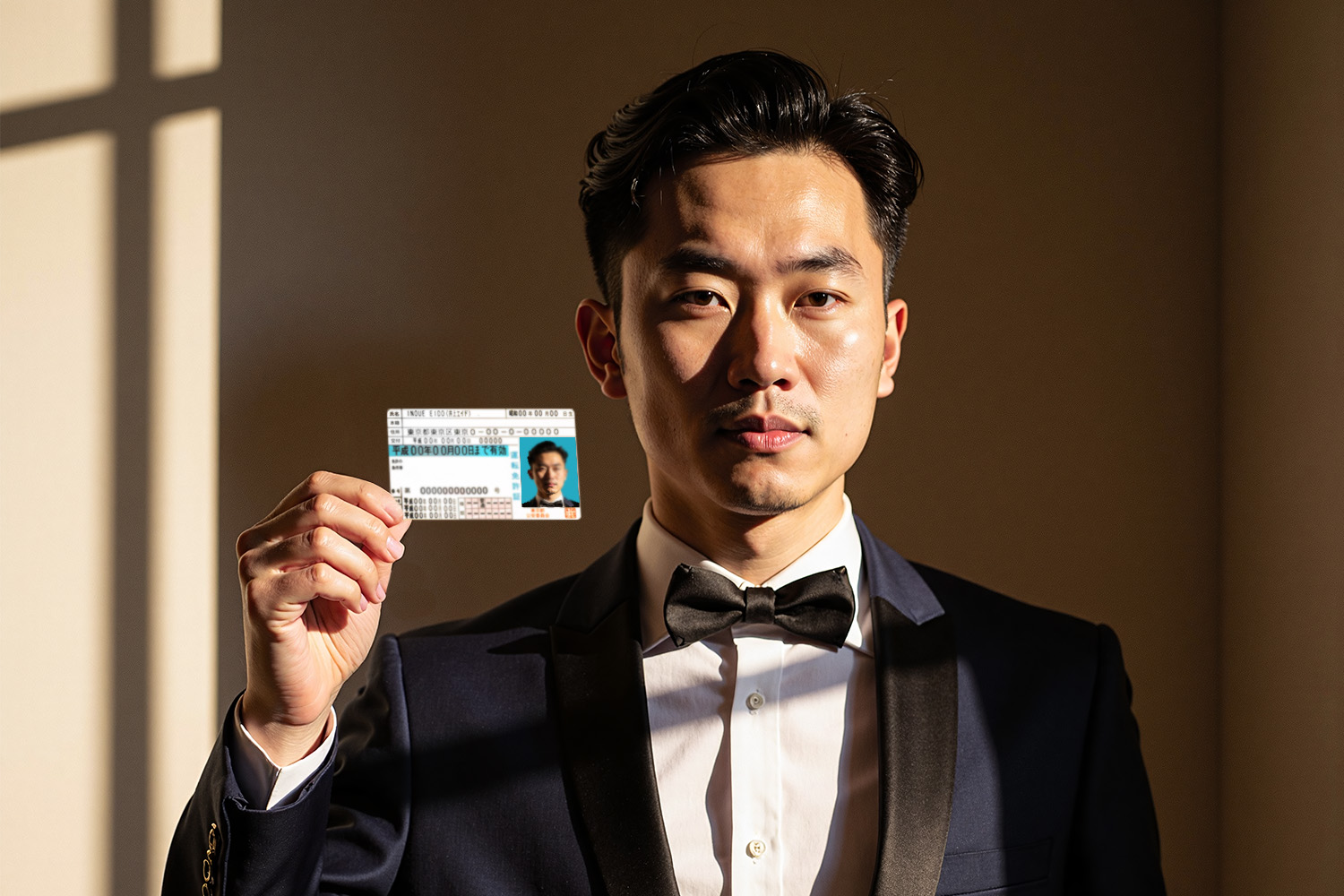
Holders of a Driver’s licence from one of 29 exempt countries and regions can convert it to a Japanese Driver’s licence through gaimen kirikae (外免切替) with an eye test and document check only. In Tokyo you need a JAF translation (¥6,600), a residence certificate, proof of three months in the issuing country, and ¥4,850 in fees at the licence centre.
Key Facts (as of October 2026)
- Exempt from both tests: 29 countries and regions, including seven US states (Tokyo MPD, September 2026)
- Tokyo fees for an ordinary car licence: ¥2,500 application plus ¥2,350 issuance, ¥4,850 in total (MPD)
- JAF translation: ¥6,600 since 1 July 2026, with an average of 5 to 10 business days for most countries (JAF)
- Residence certificate: issued within six months, showing nationality and status of residence, without My Number (MPD)
- Photo: 3cm × 2.4cm, taken within six months (MPD)
- Tokyo venues: Fuchu and Samezu accept all licences; Koto accepts only the 29 exempt countries and regions
- Reception: weekdays 8:30am to 3pm, closed 11am to 1pm
- International Driving Permit: valid for one year from landing, for residents and visitors alike (NPA)
What is gaimen kirikae, and what changed in October 2025?
Gaimen kirikae (外免切替), literally “foreign licence switch”, is the procedure under Article 97-2 of the Road Traffic Act (道路交通法). It lets the holder of a valid foreign licence obtain a Japanese licence without attending a Japanese driving school (National Police Agency).
A revision to the Road Traffic Act Enforcement Regulations (道路交通法施行規則) took effect on 1 October 2025 and tightened three parts of the process (Tokyo Metropolitan Police Department, MPD):
- Applicants must now submit a residence certificate, so people on short-term or tourist status can no longer apply.
- The knowledge test changed from 10 illustrated questions with a 70% pass mark to 50 written questions with a 90% pass mark (Aichi Prefectural Police notice, 17 September 2025).
- The driving test added railway crossings and hill starts (Osaka Prefectural Police, 2025).
Holders of licences from the 29 exempt countries and regions still skip both tests. For them, the 2025 changes mainly affect paperwork: the residence certificate and proof of time spent in the issuing country.
This guide covers the ordinary car licence, futsū menkyo (普通免許). Other classes, such as motorcycles and large vehicles, carry different application fees and eyesight standards (MPD, as of September 2026).
The step-by-step section below draws on the author’s own conversion at the Koto Driver’s License Testing and Issuing Center (江東運転免許試験場) in October 2025, after the new rules took effect. Koto handles only licences from the 29 exempt countries and regions, while Fuchu and Samezu accept all foreign licences (MPD, as of September 2026).
Which countries can transfer a licence to Japan without a test?
Japan waives both the knowledge test and the driving test for licences issued in 29 countries and regions, as listed by the MPD (page updated 7 September 2026). The United States counts as one entry, and only seven states qualify. Applicants with these licences take an eyesight test and a document check only.
Countries and regions exempt from both tests (MPD, as of September 2026): Australia, Austria, Belgium, Canada, Czech Republic, Denmark, Finland, France, Germany, Greece, Hungary, Iceland, Ireland, Italy, Luxembourg, Monaco, Netherlands, New Zealand, Norway, Poland, Portugal, Slovenia, South Korea, Spain, Sweden, Switzerland, Taiwan, the United Kingdom and the United States (seven states only).
US states exempt from both tests: Colorado, Hawaii, Maryland, Ohio, Oregon, Virginia and Washington. Indiana licences are exempt from the driving test only, so Indiana holders still take the 50-question knowledge test (MPD, as of September 2026).
Who is eligible to convert a foreign licence in Japan?
Applicants in Tokyo must meet four conditions set by the MPD:
- a valid foreign licence;
- a registered address in Tokyo;
- at least three months in the issuing country after obtaining the licence;
- the minimum age for the class. For an ordinary car licence, this is 17 years and six months, with issue from age 18.
People with a status of residence such as work, study, spouse or permanent residence can apply, because they are on the Basic Resident Register, jūmin kihon daichō (住民基本台帳). Short-term visitors, including tourists, are not on the register and cannot apply. Diplomats, US military personnel and a few other groups follow a separate document list (MPD, as of April 2026).
Your registered address appears on your residence certificate, jūminhyō (住民票), which you submit as proof. The MPD requires a copy issued within six months that shows your nationality, status of residence, period of stay and residence card number, and does not show your My Number (MPD Required Documents, as of September 2026).
The three-month rule counts total days spent in the country or region that issued your licence after you obtained it, not days in Japan, and separate stays can be added together. The MPD uses the same total for two other checks: one year or more exempts you from the beginner sticker and lets you carry a passenger on a motorcycle (MPD Notes, as of September 2026).
How does the process differ for licences from other countries?
Licence holders from outside the exempt list take both a knowledge test and a driving test, and in Tokyo they must apply at Fuchu or Samezu. The table compares the two routes as of September 2026.
| 29 exempt countries and regions | All other licences | |
|---|---|---|
| Tokyo venue | Fuchu, Samezu or Koto | Fuchu or Samezu |
| Knowledge test | Waived | 50 written questions; 45 correct to pass (90%) |
| Driving test | Waived | Required on the centre’s course; booked separately |
| Eyesight test | Required | Required |
| Visits | One, in the author’s experience | At least two; the MPD says driving tests are usually scheduled 3 to 4 months after booking |
Sources: MPD; Aichi Prefectural Police, September 2025
Before October 2025, the knowledge test had 10 illustrated questions and needed seven correct answers (Aichi Prefectural Police, September 2025). The new written format has no illustrations. If your licence is not on the exempt list, it must also stay valid until your driving test date (MPD Required Documents, as of September 2026).
How do you get a JAF translation of your licence?
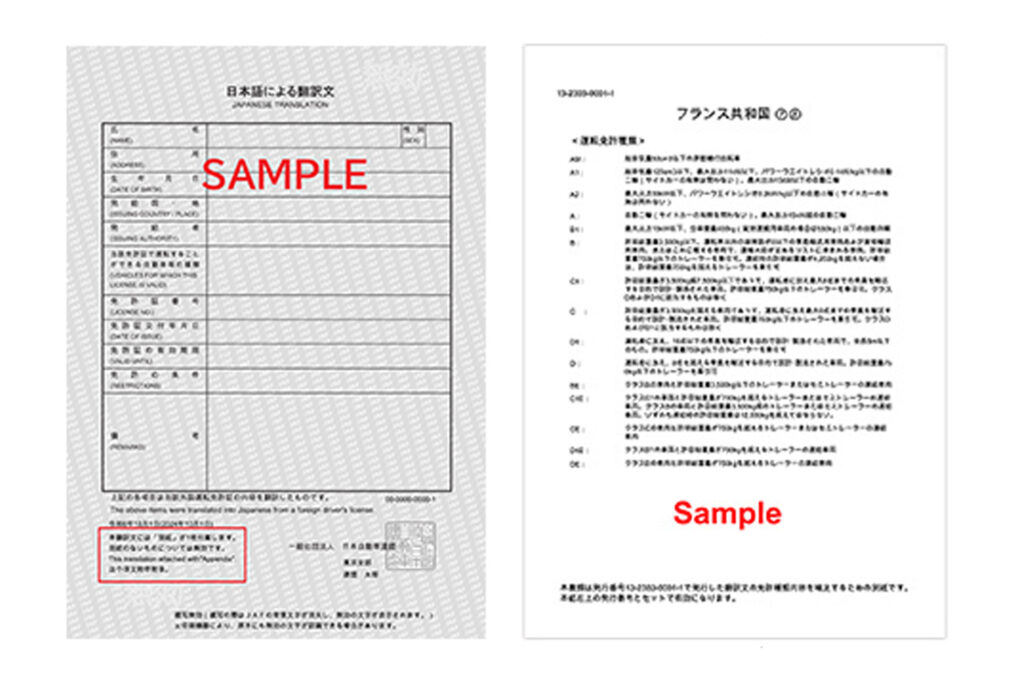
Every applicant needs an official Japanese translation of their foreign licence. The MPD accepts translations from five sources (MPD Required Documents, as of September 2026):
- the issuing country’s embassy in Japan;
- the Japan Automobile Federation (JAF);
- the German automobile club ADAC, for German licences only;
- ZIPLUS, for 12 listed countries and regions including the US;
- ALADDIN, for seven listed countries and regions including France and Germany.
JAF handles licences from most countries, and it is the route the author used.
JAF accepts translation applications online only, through a site that can be reached only from networks inside Japan. It does not accept applications at the counter or by post (JAF, as of October 2026).
JAF raised its fee for translations used to convert a licence to ¥6,600 including consumption tax on 1 July 2026, up from ¥6,000 (JAF, as of October 2026). You upload JPEG photos of the front and back of your licence. You then pay by credit card (debit and prepaid cards are refused) or in cash at a convenience store. Once the translation is ready, you print it at a convenience store multifunction printer for ¥20 per page using a print reference number. The number is valid for one week, and you can reissue it from your JAF My Page for up to a year.
JAF gives an average of 5 to 10 business days for most countries, and 2 to 3 business days for licences from Switzerland, Germany, France, Belgium, Monaco and Taiwan (JAF, as of October 2026). Some licences need extra documents: Korean licences, for example, require a residence card, residence certificate or passport. If JAF attaches an appendix describing your licence categories, print it and bring it with the main translation.
Each translation is tied to the licence it describes, so renewing your foreign licence or changing its details means applying for a new translation (JAF, as of October 2026). JAF allows each translation to be printed only once, so keep the paper copy safe until your appointment.
How do you book a licence conversion appointment in Tokyo?
Tokyo appointments are booked online through the MPD administrative procedures site (警視庁行政手続オンライン). The site is open to applicants who live in Tokyo and have spent at least three months in the issuing country (MPD, as of September 2026). In October 2025, the author found new slots released two months ahead at midnight on weekdays, and they went within minutes. Diplomats and Specified Skilled Worker applicants book by phone instead, calling the centre directly between 4pm and 5pm.
The MPD booking site is in Japanese only. In the author’s experience, browser translation helped with reading it but broke parts of the form. A Japanese-speaking friend or colleague makes booking much easier, since a missed field can cost you the slot.
If you plan to bring an interpreter, add them to the booking. To cancel, phone the centre: Koto 03-3699-1151, Samezu 03-3474-1374 or Fuchu 042-362-3591 (MPD, as of September 2026).
What documents do you need to convert a foreign licence in Tokyo?
The MPD requires the original of every document and refuses photocopies (MPD, as of September 2026). A missing item means rebooking, so check the MPD’s country-by-country list as well as the general list below.
Required documents for registered residents (summarised from the MPD English list, September 2026)
- Foreign driver’s licence card: the physical card, valid on the day you apply, since a digital licence alone is not accepted; bring any earlier licences from the same country too
- Japanese translation of the licence from JAF, an embassy, ADAC, ZIPLUS or ALADDIN
- Japanese licence or My Number Card with licence details, if you have held one
- Proof of three months or more in the issuing country since obtaining the licence: your passport, plus entry and exit records if you used automated gates
- One application photo per licence class: 3cm × 2.4cm, taken within six months
- Jūminhyō issued within six months, showing nationality, status of residence, period of stay and residence card number, without My Number
Diplomats and others not on the resident register follow a separate MPD document list.
Your original foreign driver’s licence
Bring the physical card plus any earlier licences from the same country. The licence must be valid on the day you apply, and JAF notes that an expired licence cannot be converted (JAF, as of October 2026). If the card does not show when you first obtained the licence, the MPD asks for a driving record that does (MPD, as of September 2026).
Your translated licence
Hand in the printed translation together with any appendix JAF issues. Staff keep the translation, while you only show them the foreign licence (MPD Required Documents, as of September 2026).
Proof of three months in the issuing country
Passport entry and exit stamps are the standard proof. If you passed through automated immigration gates, which leave no stamp, the MPD asks for official entry and exit records from the issuing country. Staff may request these records even when stamps exist (MPD, as of September 2026). Bring older passports too if they cover the months after you obtained your licence.
A recent photo
Bring one photo per licence class, 3cm high by 2.4cm wide and taken within six months. It must be front-facing, with a plain background and no hat (MPD, as of November 2025). The NPA also asks for your name and the date the photo was taken on the back. Fuchu, Samezu and Koto all have instant photo booths on site, and the Koto booth cost about ¥1,000 at the author’s visit in October 2025.
Jūminhyō (住民票)
You can print a jūminhyō with a My Number Card at the multifunction printers in 7-Eleven, FamilyMart, Lawson and Ministop, or request one at your ward office. At the convenience store kiosk, choose to include your nationality, status of residence and residence card number, and choose to leave out your My Number. The MPD requires the first three and refuses the last. Fees depend on the ward: Minato-ku charges ¥300 at the counter and ¥10 at a convenience store until 31 March 2027 (Minato City, 2026).
Your residence card
Bring your residence card, zairyū kādo (在留カード), as well. It is not on the MPD’s general list for registered residents, but it shows your status of residence if staff ask.
Passport
Bring your current passport and any older passports that cover the three months after you obtained your licence.
Take your My Number Card, plus both cash and a payment card for the fees.
What happens on the day at a Tokyo licence centre?
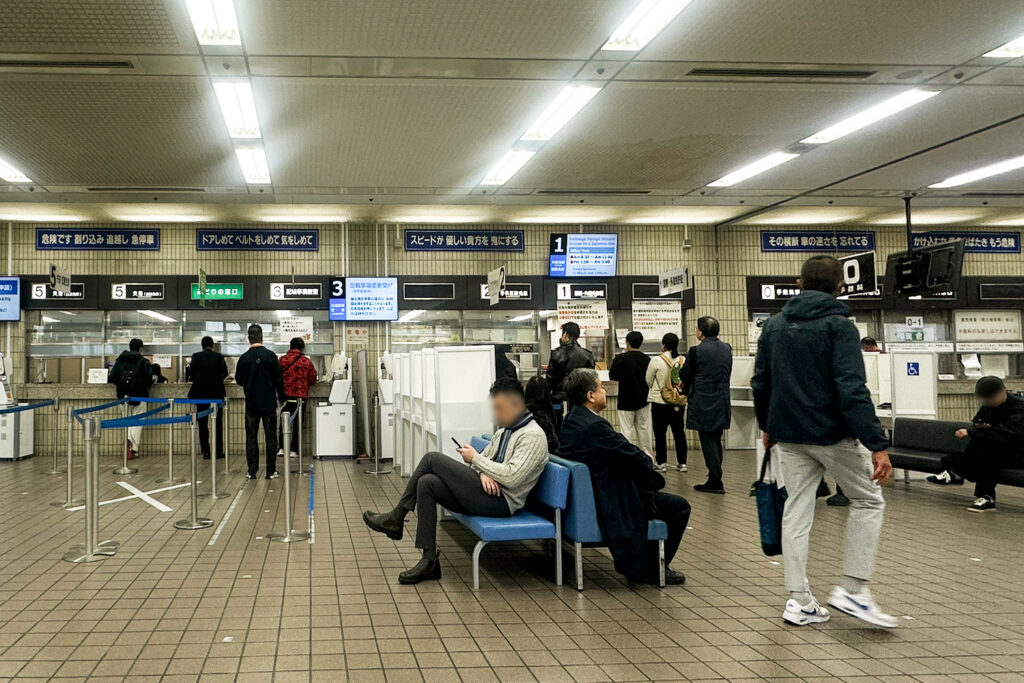
The author’s appointment at Koto in October 2025 took most of the day, with several rounds of document checks and waiting between steps. All three Tokyo centres take conversion applications on weekdays from 8:30am to 3pm, with no reception between 11am and 1pm (MPD, as of September 2026).
Step 1: Hand in your documents
Staff at the main information desk direct you to the conversion counter. The MPD says non-Japanese speakers may be asked to bring an interpreter (MPD, as of September 2026). At Koto, staff worked in Japanese throughout, and the author needed an interpreter at every stage.
At the counter you hand over all your documents, answer a few questions and receive a coloured, numbered ticket. Staff then check that everything is complete and correctly translated.
Step 2: Document checks
Over the next hour or more, staff call your ticket number several times. You sign the application form, shinseisho (申請書), and the health questionnaire, shitsumonhyō (質問票), which is a yes-or-no list of medical conditions. Staff confirm that your licence is valid, that you spent three months in the issuing country, and what your status of residence is.
Expect questions about when you obtained your licence, whether you attended a driving school, how long you lived in the issuing country afterwards, and whether you drove regularly before coming to Japan.
Step 3: Payment
After the first checks you receive a second ticket and join the payment queue. Tokyo charges a ¥2,500 application fee and a ¥2,350 issuance fee for an ordinary car licence, ¥4,850 in total (MPD, as of September 2026). Koto accepted both cash and cards in October 2025, but bring both in case other centres differ.
Step 4: Further document checks
Document checks continue after payment until your ticket is called for the eyesight test. You may sign further forms at this stage.
Step 5: Eye test
The eyesight test uses a chart of circles with a gap, like the letter C. You say which way the gap faces as the circles shrink. An ordinary car licence needs vision of 0.7 or better with both eyes, and at least 0.3 in each eye (MPD, as of September 2026).
At Koto, people who wear glasses try the test without them first, then with them if needed. Passing only with glasses adds a condition to your licence requiring you to wear them when driving.
A second test shows two lights that turn green, yellow or red. You say which colour appears and whether it is the top or bottom light, which checks that you can read traffic signals.
Step 6: Photo and final documents
After the eye test you sign one more document and take it to the photo area, where staff photograph you for the licence card.
At Koto, you then take a new ticket and go upstairs to the collection counter.
Step 7: Collection
Koto issued the author’s licence on the same day: you wait for your number and collect the card at the counter.
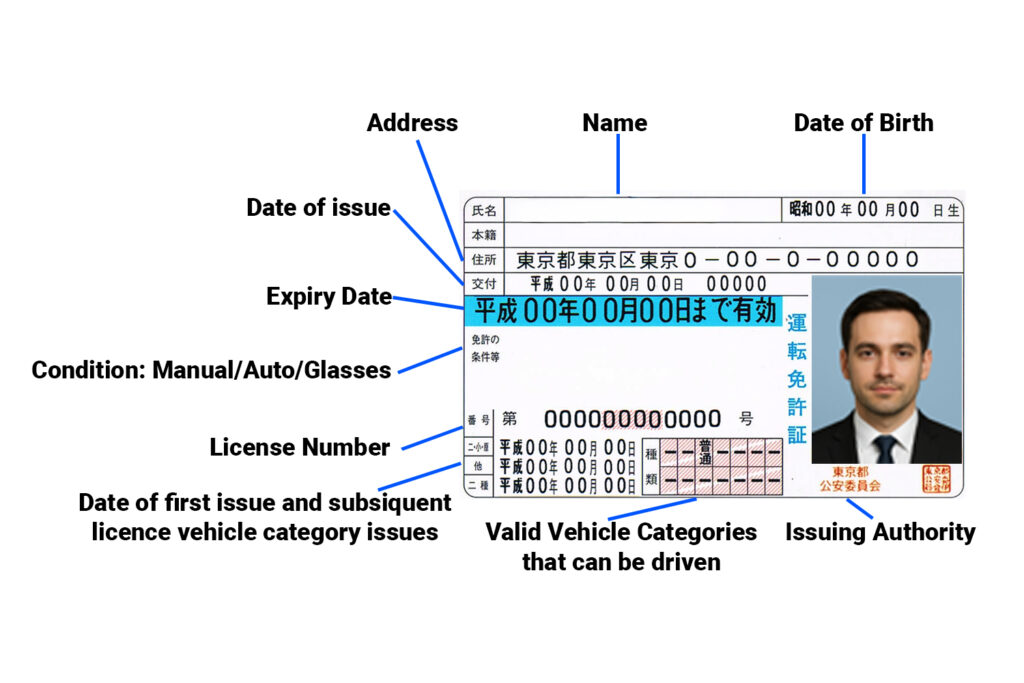
Before leaving, use the IC licence reader near the counter to check your details. Your nationality is stored on the card’s chip rather than printed on it. Your date of birth appears in the Japanese era format, so add 2018 to a Reiwa year, 1988 to a Heisei year or 1925 to a Shōwa year to get the Western year (MPD, as of September 2026).
Some prefectures do not issue on the day. The Yamagata Prefectural Police, for example, ask applicants to return on a later date for the photo and card.
Your first Japanese licence has a green band and is valid until one month after your third birthday following the issue date. At renewal it may change to a blue or gold licence with five years’ validity, depending on your driving record (MPD, as of September 2026).
What happens to your foreign licence after conversion?
You keep your foreign licence: the MPD lists it as a document to be shown, not handed in (MPD Required Documents, as of September 2026). Keep it valid if you drive abroad. If you renew it, it will need a fresh JAF translation should you ever use it in Japan again.
How can you make conversion day go faster?
Book the first appointment of the day if you can, since the process takes several hours. Have the MPD booking site open and your details ready before new slots are released.
Bring a Japanese-speaking companion if you can. At Koto, every question about the author’s driving history was asked in Japanese.
Bring a charged phone or a book for several hours of waiting. The centres usually have vending machines for drinks and snacks.
Check the issue date on your jūminhyō the night before. A copy older than six months means rebooking.
The photo taken on the day stays on your licence until your first renewal, about three years later, so dress for it.
How much does it cost to convert a foreign licence in Tokyo?

The fixed official costs in Tokyo total ¥11,450: ¥6,600 for the JAF translation and ¥4,850 in MPD fees for an ordinary car licence (JAF and MPD, as of October 2026). Printing, the residence certificate and a photo add a small amount on top.
| Item | Cost | Source |
|---|---|---|
| JAF translation for licence conversion | ¥6,600 incl. tax | JAF, from 1 July 2026 |
| Convenience store printing | ¥20 per page | JAF, October 2026 |
| Jūminhyō (Minato-ku example) | ¥10 at a convenience store, ¥300 at the counter | Minato City, 2026 |
| Application photo | About ¥1,000 at the Koto booth | Author’s visit, October 2025 |
| Application fee, ordinary car licence | ¥2,500 | MPD, September 2026 |
| Licence issuance fee | ¥2,350 | MPD, September 2026 |
Since 24 March 2025, licence details can also be recorded on a My Number Card. Prefectural police fee tables list ¥1,550 for the My Number Card only and ¥2,450 for both the card and a plastic licence, compared with ¥2,350 for the plastic licence alone (Gunma Prefectural Police, fee revision of 24 March 2025). Ask at the counter which options the Tokyo centre offers.
Tokyo driving schools publish standard automatic car courses for learners with no licence at ¥366,960 (Ohji Driving School, Kita-ku) and ¥378,000 (Toshima Driving School), including tax, as of October 2026. Both prices are before test and licence fees, so conversion costs a small fraction of learning from scratch.
Can you drive in Japan on an International Driving Permit instead?
An International Driving Permit (IDP) issued under the 1949 Geneva Convention lets you drive in Japan for one year from the date you land, or until the permit expires one year after issue, whichever comes first (National Police Agency; Road Traffic Act, Article 107-2). Permits in other formats, such as the 1968 Vienna Convention format, are not valid in Japan (MPD, as of August 2025).
A residence card does not cancel an IDP, and the same one-year limit applies to residents and visitors. Someone arriving on a work or spouse visa can therefore drive on an IDP until one year after the landing date. Registered residents cannot restart that year with a short trip, however. If you are on the resident register and return within three months of leaving, your return does not count as a new landing, even with a new IDP (Road Traffic Act, Article 107-2). The National Police Agency gives the example of a foreign student who has lived in Japan for more than a year: a new IDP lets them drive only after a continuous absence of three months or more, and driving without one counts as unlicensed driving (NPA Q&A, as of October 2026).
Budget Rent a Car Japan applies a stricter reading. It states that customers on the resident register may drive on an IDP only within one year of returning from three or more consecutive months abroad, and it asks visa holders for documents showing their latest entry and exit dates (Budget Rent a Car, as of October 2026). Anyone who plans to live in Japan beyond a year, or rent cars as a resident, needs a Japanese licence.
A Japanese licence also works as everyday photo ID that is easier to carry than a passport. If you are still choosing where to live, our Tokyo area guides cover transport, parking and daily life in each central neighbourhood.
Frequently asked questions
How long does it take to convert a foreign licence in Tokyo?
The JAF translation averages 5 to 10 business days for most countries. After that, you wait for an online appointment slot, and the appointment itself took most of a day at the Koto centre in October 2025. Licences from the 29 exempt countries and regions can be converted in a single visit.
Other licences need at least a second visit for the driving test, which the MPD says is usually scheduled three to four months after booking. Make sure your foreign licence will still be valid on the test date.
Can I keep driving on my IDP after I get a residence card?
A residence card does not cancel an IDP. You can drive on it until one year after the date you landed, provided the permit itself is less than a year old. Registered residents cannot reset that year with a trip abroad shorter than three months, and some rental companies ask residents for proof of a longer absence.
The legal basis is Article 107-2 of the Road Traffic Act. Budget Rent a Car Japan, for example, asks visa holders for entry and exit records before renting on an IDP.
Can I convert a foreign licence on a tourist visa?
Tourists cannot convert a foreign licence. Since 1 October 2025, applicants must submit a jūminhyō, which only people on the Basic Resident Register can obtain. Short-term visitors are not registered, so they are excluded. Diplomats, US military personnel and a few other groups follow a separate document list.
Visitors can drive with a Geneva Convention IDP for up to one year from entry. Holders of licences from Switzerland, Germany, France, Belgium, Monaco and Taiwan can instead drive with their original licence plus an official Japanese translation, also for up to one year from entry (JAF, as of October 2026).
My US licence is not from an exempt state. What do I need to do?
US licences from outside the seven exempt states go through the full test route at Fuchu or Samezu. This means a 50-question written knowledge test needing 45 correct answers, followed by a driving test on the centre’s course. Indiana licences skip the driving test but still take the knowledge test (MPD, as of September 2026).
The MPD lists the languages in which the knowledge test is offered on its foreign-language exam page. ZIPLUS also translates US licences, as an alternative to JAF.
Do passport stamps prove my three months in the issuing country?
Passport stamps are the standard proof, but automated immigration gates often leave no stamp. In that case the Tokyo MPD asks for official entry and exit records from the country that issued your licence. Staff may request these even when stamps exist, so check your country on the MPD’s country-by-country document list first.
Bring your older passports and licences as well, since they help staff count your total days in the issuing country.
Will I have to display a beginner driver sticker?
Converted licence holders display the beginner mark, shoshinsha māku (初心者マーク), for one year unless they can prove a total of one year in the issuing country after obtaining the licence (MPD Notes, as of September 2026). The mark is a green and yellow sticker shown on the front and back of the car.
During a beginner year, reaching three or more penalty points leads to a mandatory beginner driver course. The threshold is four points if the total comes from a single three-point violation (MPD, as of September 2026).
How much does the whole process cost?
The fixed official costs in Tokyo total ¥11,450 for an ordinary car licence: ¥6,600 for the JAF translation and ¥4,850 in MPD application and issuance fees, as of October 2026. Printing at ¥20 per page, a jūminhyō and an application photo add a small amount on top.
Fees for other classes differ. The MPD charges a ¥3,900 application fee for large, medium and semi-medium vehicles, and ¥2,800 for most other classes.
Useful Resources
- Book an appointment, licences from the 29 exempt countries and regions: MPD reservation page
- Book an appointment, all other licences: MPD reservation page
- Apply for a JAF translation: JAF translation application site
- Check the documents for your country: MPD List of Required Documents by Country (English PDF)
- Knowledge test languages (non-exempt licences): MPD foreign-language exams
- Licence centre addresses and access: Fuchu, Samezu and Koto
- MPD English guide to licence procedures: Driver’s licences (English)
Remember to check the official websites for any updates to requirements or procedures, as rules can change. Having accurate, up-to-date information helps make your license transfer as smooth as possible.
Looking for a Tokyo home with parking?
Registering a car in Tokyo requires a parking space certificate, shako shōmei (車庫証明), which proves you have an off-street space within 2km of your home (Act on Securing Parking Spaces for Motor Vehicles). This means the home you choose decides whether you can keep a car at all, so parking belongs on your list from the first viewing.
Housing Japan has helped people find homes in central Tokyo since 2000 as a licensed real estate brokerage (Tokyo Governor (3) No. 98912). Our bilingual team handles buying, selling, property management and long-term rentals, and can shortlist homes with parking, or with a parking space nearby, before you visit.
If you are moving to Tokyo or planning to drive once your licence arrives, contact our team below with your preferred area, budget and move-in date.
Sources
Tokyo MPD: Converting a foreign driver’s licence (updated 7 September 2026)
Tokyo MPD: Required Documents, all applicants (English PDF)
JAF: How to apply for a translation
National Police Agency: Holders of foreign driving licences
Tokyo MPD: Driving in Japan with an International Driving Permit
This article is provided for general information only. The step-by-step section is based on the author’s experience at the Koto Driver’s License Testing and Issuing Center in October 2025, and official requirements were last checked on 5 October 2026. Procedures can vary between licence centres, and individual experiences differ. Housing Japan is not liable for any issues, delays or outcomes during your licence conversion. Requirements and fees are set by Japanese authorities and can change, so always confirm current information with the Metropolitan Police Department, your licence centre or the Japan Automobile Federation (JAF) before applying.