Foreign nationals can buy a house in Japan with the same legal rights as Japanese citizens, no visa, residency, or citizenship required. The process takes about 60 to 90 days, and total purchase costs typically run 5 to 6% of the price (plus 1 to 2% for mortgage buyers). From April 2026, non-residents must also file a Bank of Japan FEFTA report within 20 days of acquisition. Housing Japan’s licensed team handles this filing as part of every purchase we manage, and has guided expat buyers through the process since 2000.

Key Facts for 2026
- There are no nationality restrictions on buying property in Japan.
- Total buying costs typically run 5–6% of the purchase price, plus 1–2% in bank fees if you use a mortgage.
- The brokerage fee is capped at 3% + ¥60,000 + 10% consumption tax.
- Non-residents must file FEFTA Form 22 via the Bank of Japan within 20 days of acquisition. From 1 April 2026 this applies to own-residence purchases too, which were previously exempt.
- From 5 October 2026, all buyers must state their nationality when registering ownership. This is a disclosure rule, not a restriction.
- A typical purchase, from offer to keys, takes 60–90 days.
Can a Foreigner Buy a House in Japan?
Yes. A foreigner can buy a house in Japan with the same legal rights as a Japanese citizen. You do not need to be a resident, hold a visa, or have lived in Japan before. The Real Property Registration Act applies the same rules to every buyer regardless of nationality, and there is no quota on how many units in a building can be foreign-owned.
This makes Japan one of the most open property markets in Asia. The legal right to buy is completely separate from the right to live in Japan, so many international buyers complete their purchase while visiting on the visa-free entry available to nationals of 74 countries and regions, including the United States, the United Kingdom and Australia. Owning a property does not grant residency; to live in your home long-term, you still need a separate work, spouse, or business visa.
The practical work, finding a property, financing, contracts, and registration, is more involved than the legal question. The rest of this guide explains exactly how the process works, what it costs, and what changed in 2026.

How Do You Buy a House in Japan? Step-by-Step Process
Buying a home in Japan typically takes 60 to 90 days from your first offer to receiving the keys. The process follows eight defined steps. Knowing them in advance helps you plan your travel, your finances, and your paperwork.
1. Choose an Experienced Bilingual Agent
In Japan, your real estate agent does work that in many other countries belongs to a lawyer. Licensed brokers handle market research, negotiations, contract drafting, and the legal paperwork around title transfer. A bilingual, licensed agent is your single most important professional. The right agent provides:
- Legal safety throughout the transaction
- Translation and clear explanation of Japanese-language documents
- Advisory on pricing and current market trends
- Property viewing coordination and on-site due diligence
- Guidance on market standards and realistic expectations
- Negotiations and formal contract handling with the seller
Tell your agent your target area, property type, budget, and timeline at the first meeting. A good agent should also screen for off-market listings, which make up a meaningful share of central Tokyo luxury inventory.
It is important to work with a licensed real estate agent based in Japan. Under the Real Estate Transaction Business Act, only brokers licensed by a prefectural governor or MLIT can legally handle property transactions, and every agency must have a qualified Real Estate Transaction Specialist (宅建士, takken-shi) on staff to deliver the Explanation of Important Matters before signing. A Japan-based licensed agent also gives you access to REINS, the national listings database, plus local knowledge of building condition, zoning, and pricing, none of which an overseas-only or unlicensed introducer can legally provide. Ask any agency for its own licence number and confirm the Real Estate Transaction Specialist handling your file is employed in-house. Licence-lending is prohibited under the Act, and an introducer borrowing another company’s licence cannot lawfully broker your transaction. Housing Japan is licensed by the Tokyo Metropolitan Government, Tokyo Governor License (3) No. 98912.
2. View Properties On-site

3. Talk to a Bank About Financing
If you are paying cash, you can skip this step. If you need a mortgage, start the conversation with a bank before you make an offer, since an informal pre-approval strengthens your position.
Mortgage access in Japan depends far more on your residency status than your nationality. One rule applies to everyone: the lender needs Japanese-sourced, taxed income. A Japanese citizen earning entirely overseas faces the same obstacle a foreign national does.
| Permanent / Special Permanent Resident | Long-term visa, non-PR | Non-resident overseas | |
|---|---|---|---|
| Access | Full mainstream market | Restricted, specialist products | Very limited |
| Typical requirement | Same as a Japanese citizen | Usually 2–3 years’ employment in Japan, stable income | Japan income normally absent, so most buy cash |
| Flat 35 | Available | Not available — JHF requires PR or Special PR | Not available |
| Lenders | Mizuho, MUFG, SMBC, Resona, Flat 35 (JHF) | SMBC Trust Prestia, Tokyo Star, Suruga, SBI Shinsei, AEON Bank | Yen Loans, ORIX Asia, UOB Singapore, CTBC, Sumitomo Mitsui Trust |
| Typical LTV | 100–110% | 80% | 50–70% |
| Rate, Aug 2026 | 0.9–1.2% variable | 1.2–3.9% variable | 3.1–4.7% variable |
Verified August 2026. Megabank variable index 1.082%, Flat 35 3.290%, BOJ policy rate 1.0%. Confirm current terms with each lender.
4. Submit a Letter of Intent
Once you decide on a property, your agent submits a Letter of Intent (買付証明書, kaitsuke shōmeisho) to the seller. This expresses serious purchase intent and sets out your offer price and conditions. Letters of Intent are usually treated on a first-come, first-served basis, so having financing already lined up gives you a real advantage.
5. Negotiate Terms and Sign the Purchase Contract
Your agent negotiates price, payment timing, fixtures, and handover conditions with the seller’s side. This usually takes one to two weeks. When terms are agreed, both parties sign the formal purchase contract. At this stage, a cash deposit (手付金, tetsukekin) of 5–10% of the purchase price is typically paid directly to the seller. This often surprises foreign buyers, since earnest money in many other countries is held by a third party such as an escrow agent. The idea behind the practice is that Japan is a trust-based society, paying part of the cost up front is a sign of commitment and solidifies trust between buyer and seller. Even buyers using a mortgage need to bring this deposit in cash.

6. Review the Explanation of Important Matters
Before signing, your agent provides the “Explanation of Important Matters Regarding the Property and Transaction” (重要事項説明書, jūyō jikō setsumeisho). This document covers ownership type, building condition, management association rules, zoning, and cancellation provisions. Reputable agencies provide an English translation, but only the Japanese version has legal effect, translations exist solely as reference. This is why bilingual representation matters.
7. Final Loan Approval (Mortgage Buyers Only)
If you are using a mortgage, your final loan approval comes through after the contract is signed. You will sign the loan agreement at the bank, usually on a weekday and lasting several hours. Cash buyers can move directly to settlement.
8. Final Settlement and Title Transfer
Settlement usually happens at the buyer’s bank and is handled by a judicial scrivener (司法書士, shihō shoshi). The buyer transfers the remaining balance to the seller’s account, the keys are handed over, and the scrivener files the ownership transfer at the Legal Affairs Bureau. Your name appears in the official property register within a few business days, which is the moment you become the legal owner, not the contract signing.
That’s the process from offer to keys. If you’re ready to see what’s actually available, browse current Tokyo listings, including off-market inventory we don’t advertise publicly, or talk to our team about your budget and timeline before you start viewing.
How Much Does it Cost to Buy a House in Japan?
Total purchase costs in Japan typically run 5 to 6 percent of the purchase price. If you use a mortgage, expect an additional 1 to 2 percent in bank-related fees on top of that. The breakdown below uses official rates from the National Tax Agency, the Ministry of Land, Infrastructure, Transport and Tourism (MLIT), and Tokyo Metropolitan Government for 2026.
| Cost | What it is | Typical rate (2026) |
| Brokerage fee | Paid to your real estate agent on a successful purchase. Capped by MLIT. | 3% of price + ¥60,000 + 10% consumption tax (≈3.3%). Properties at or below ¥8m: up to ¥330,000 including tax, by prior agreement |
| Registration & license tax (land) | Paid to register the land transfer at the Legal Affairs Bureau. | 1.5% of assessed value (reduced rate extended to 31 March 2029); standard rate 2.0% |
| Registration & license tax (building) | Paid when ownership of the building is transferred or first registered. | 2.0% standard; 0.1%–0.3% reduced for qualifying homes (until 31 March 2027) |
| Real estate acquisition tax | One-off prefectural tax billed 3–6 months after registration. | 3% on residential land and homes; 4% on non-residential buildings (3% rate runs until 31 March 2027) |
| Stamp duty | Revenue stamp affixed to the purchase contract. | ¥30,000 for contracts of ¥50m–¥100m; ¥60,000 for ¥100m–¥500m. Reduced rates apply to contracts executed to 31 March 2027 |
| Judicial scrivener fee | Pays the legal professional who handles the title transfer. | ¥80,000–¥200,000 (more for mortgages) |
| Annual fixed asset tax | Paid every year by the registered owner as of 1 January. | 1.4% of assessed value |
| Annual city planning tax | Applies to property within designated urban planning zones. | Up to 0.3% of assessed value |
Most taxes are calculated from the property’s assessed value (固定資産評価額), not thepurchase price, and the assessed value is usually well below market price, which keeps the actual tax bill lower than the headline rates suggest. The reduced 1.5% land registration rate runs through 31 March 2029, and reduced building registration rates through 31 March 2027, so check current rates with your agent before closing. The real estate acquisition tax bill arrives 3–6 months after registration, so set funds aside for it.
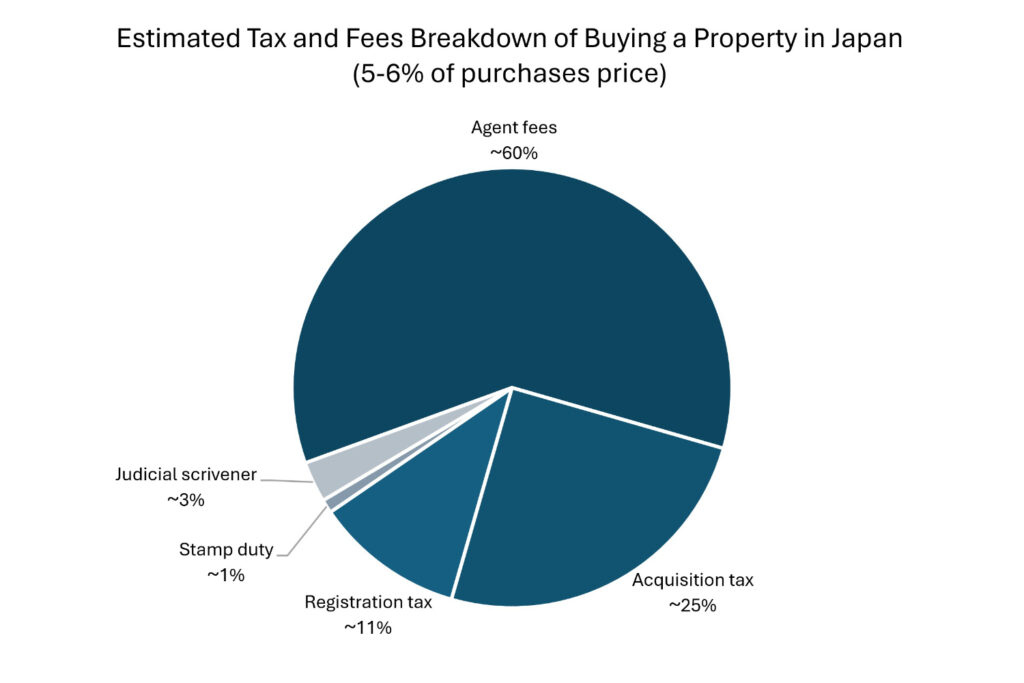
| Cost | Share of total closing costs |
| Agent Fee | ~60% |
| Acquisition Tax | ~25% |
| Registation Tax | ~11% |
| Juducial Scriverner | ~3% |
| Stamp Duty | ~1% |
Based on a sample central Tokyo residential purchase. Actual shares vary with assessed value and whether reduced rates apply.
As the chart shows, the agent fee is the single largest line item in your closing costs, typically larger than all government taxes combined. This is why choosing the right agent matters: in Japan, your broker does the work that a lawyer would handle elsewhere, including contract drafting, legal disclosures, and title transfer coordination. The fee you pay is for that full scope of work, not just property search.
What does this look like on a real purchase?
Illustrative only, using a ¥100,000,000 resale condominium in central Tokyo built after 1981, bought by a cash buyer. Assessed values (固定資産評価額) are assumed at ¥40m for the land share and ¥10m for the building, assessed values sit well below market price, and the gap is widest in high-land-value central wards.
| Item | Basis | Amount |
|---|---|---|
| Brokerage fee | ¥100m × 3% + ¥60,000, +10% tax | ¥3,366,000 |
| Registration tax, land | ¥40m × 1.5% | ¥600,000 |
| Registration tax, building | ¥10m × 0.3% (qualifying home) | ¥30,000 |
| Stamp duty | Reduced rate, ¥50m–¥100m band | ¥30,000 |
| Judicial scrivener | Typical range | ¥80,000–¥200,000 |
| Real estate acquisition tax | Billed 3–6 months later, after residential reductions | Varies; often reduced to nil on a qualifying home |
| Approximate total | ~¥4.2m, or ~4.2% of price |
The single largest line is the agent fee, which exceeds every government tax combined. Add 1–2% if you are using a mortgage.
These percentages are a rough estimate based on a sample Tokyo residential purchase. Actual costs vary depending on the property’s assessed value, whether reduced tax rates apply, and the type of building. For a complete breakdown of every tax and fee involved in a Japanese property purchase, read our full guide to buying taxes and fees.
Other costs might include registration fee and or property management fees. There is also Asset Tax and City Tax that count as ongoing yearly costs of owning a property in Japan as well as loan/mortgage repayments if you have borrowed.
To get an estimate on your monthly loan payments in Japan, you can refer to our Yen Loan Calculator.
What Documents Do You Need to Buy a House in Japan?
The required documents depend on whether you live in Japan or abroad. In both cases, your agent and judicial scrivener will guide you through the exact paperwork.
If You Live in Japan
- Residence card and passport
- Inkan (registered personal seal) and seal certificate (印鑑登録証明書)
- Proof of income, three years of records if applying for a mortgage
If You Live Outside Japan
- Passport
- Notarised affidavit in place of the inkan and seal certificate
- Proof of address, often in the form of a utility bill or bank statement
- From April 2026: information needed for the FEFTA Form 22 filing, see below

What Changed for Foreign Buyers in 2026?
Two important administrative changes took effect in April 2026. Neither restricts your right to buy, both add a reporting step.
1. FEFTA Form 22 Reporting for Non-Residents
Under Japan’s Foreign Exchange and Foreign Trade Act, a non-resident who acquires real estate in Japan must submit Form 22 to the Minister of Finance via the Bank of Japan within 20 days of acquisition. This obligation is not new. What changed on 1 April 2026 is that the exemption for property acquired as the buyer’s own residence was removed, so all acquisitions are now reportable regardless of purpose, amount or floor area. Acquisitions dated 1 April 2026 or later also require additional information, including whether the counterparty was a resident or non-resident. The 20-day clock runs from the acquisition date, normally the contract date or the date of transfer of ownership; if the deadline falls on a weekend or public holiday it moves to the next business day. A resident agent, such as your licensed broker, can prepare and file on your behalf, which is the standard approach, and filing can be done on paper or online. The report is for government statistics and compliance; it does not block your purchase.
2. Nationality Disclosure at Registration
The Ministerial Ordinance Partially Amending the Real Property Registration Rules (不動産登記規則の一部を改正する省令, MOJ Ordinance No. 23) was promulgated in the Official Gazette on 31 March 2026. From 5 October 2026, any natural person becoming a registered owner through a preservation, transfer or correction of ownership registration must provide their nationality as search-reference information. This applies equally to Japanese and foreign buyers. Nationality is recorded only in an internal “search information management file” maintained by the Ministry of Justice and does not appear on the public Real Property Register (登記簿). Privacy protections apply equally to all buyers.
What did NOT change: Foreign nationals still have the same property ownership rights as Japanese citizens. There is no foreign ownership cap, no minimum investment, no reciprocity test, and no “golden visa”, buying a house does not give you a visa or residency.
For a quick FAQ-style summary of foreign ownership rules and the primary Ministry of Finance source, see our guide: Can Foreigners Buy Property in Japan?
What Should Expats Know Before Buying a House in Japan?
A few features of the Japanese system regularly surprise international buyers. Understanding them up front avoids costly mistakes.
Lawyers Are Not Part of a Standard Purchase
Japan does not use a notary or buyer-side lawyer for residential property. Licensed brokers and judicial scriveners handle the legal work. This makes choosing an experienced, well-staffed agency far more important than in markets where a separate lawyer reviews everything.
All Documents Have Legal Effect Only in Japanese
Every contract, disclosure, and registration is in Japanese. Reputable agencies provide English translations, but only the Japanese version has legal standing, translations are reference materials. Always work with an agency that has both bilingual front-line staff and a Japanese-qualified legal team behind them.
Ownership is Confirmed by Registration, Not by Signing
In some countries, the moment you sign and pay you are the owner. In Japan, ownership only becomes legally secure when your name is recorded in the official property register at the Legal Affairs Bureau. Your judicial scrivener handles this within days of settlement, but it is the registration, not the contract, that secures your title.
Non-Resident Owners Need a Tax Representative
If you live outside Japan, you must appoint a tax representative (納税管理人, nōzei kanrishin) at a Japan address to receive your fixed asset tax bill each year. Many foreign buyers use their judicial scrivener, agent, or a specialised mail-handling service for this.
Should You Buy in Japan for Short-Term Rental Income?
Japan’s Private Lodging Business Act (住宅宿泊事業法), in force since June 2018, caps short-term rentals at 180 days per calendar year, and the large majority of condominium management associations prohibit short-term rentals outright in their bylaws. Tokyo wards including Shinjuku, Shibuya, and Minato restrict residential-zone minpaku further to weekends and holidays. That does not close the door on short-term rental income, it just means the property type and operating model matter more than they would elsewhere. Investors typically pursue one of three routes: buying an entire apartment building, developing in a designated National Strategic Special Zone (特区民泊) that allows 365-day operation, or operating under a hotel or ryokan licence (旅館業法) instead of minpaku.
Housing Japan’s sister company, Ken’s Place, specializes in this work across central Tokyo, Minami Azabu, Roppongi, Azabu-juban, Omotesando, and Akasaka, supporting investors through business planning, design, license application, and day-to-day operation. If short-term rental income is part of your buying thesis, talking to both teams early keeps the acquisition and the operating model aligned from day one.
How Does the Process Differ for Residents and Non-Residents?
Most legal points are identical. The differences are practical: which IDs you can use, which banks will lend to you, and which reports you must file.
| Item | Resident in Japan | Non-resident overseas buyer |
|---|---|---|
| Right to buy | Same as Japanese citizens | Same as Japanese citizens |
| ID required | Residence card, passport, inkan | Passport plus a notarized affidavit in place of an inkan |
| Mortgage access | Available from most major banks at competitive rates | Generally cash-only; a small number of lenders work with non-residents |
| FEFTA reporting | Not required for personal home purchase | Form 22 to the Bank of Japan within 20 days of acquisition (from April 2026) |
| Tax representative | Not required | Required to receive property tax bills in Japan |
Do Properties in Japan Lose Value? Not in Central Tokyo
The standard advice is that Japanese buildings depreciate to near zero within 20 to 30 years. That holds for wood-frame housing in much of the country. It has not described central Tokyo for some years.
In the 2026 official land price survey (公示地価, valued at 1 January 2026 and published 17 March 2026), Tokyo’s all-use average rose 8.4%, up from 7.3% the previous year. Residential land rose 6.5% and commercial land 12.2%, the fifth consecutive annual increase. Of 2,503 comparable survey points across Tokyo, 2,445 rose and 14 fell. Within the 23 wards, all 1,530 continuing points rose; none fell. Tokyo residential land averaged ¥565,100 per square metre, the highest of Japan’s 47 prefectures, and Akasaka 1-14-11 in Minato-ku was the most expensive residential land point in the country for the ninth consecutive year at ¥7.11m per square metre, up 20.5%.
The resale market tells the same story. REINS reported a Greater Tokyo contracted unit price of ¥863,400 per square metre for used condominiums in March 2026, a 71st consecutive monthly rise and above the September 1990 peak of ¥855,000. Tokyo’s 23 wards reached ¥1,361,000 per square metre, roughly ¥95m for a 70 square metre home. Across the first quarter of 2026, resale units in the 23 wards traded at an average of 117.7% above their original new-build price.
You can check the official price for any specific site on MLIT’s Real Estate Information Library.
The honest counterweight. These are historical figures for a specific market over a specific period, not a forecast. Three things deserve weight. The national picture is genuinely different, depreciation remains the norm for wood-frame housing outside major urban land markets. The rate of increase in the 23 wards is decelerating; Osaka outpaced Tokyo in early 2026. And borrowing costs are rising: the Bank of Japan lifted its policy rate to 1.0% in June 2026, the highest in about three decades, with further increases anticipated.
For owner-occupiers, the appeal remains the city itself: efficient transport, world-class amenities, low crime, and architecture ranging from quiet residential streets in Hiroo to landmark towers in Minato and Shibuya. For investors, yen-denominated assets and a stable legal framework make Tokyo a natural diversification market.

Ready to Buy a House in Tokyo?
Housing Japan has guided international buyers through Tokyo property purchases for over 25 years. Our bilingual, Tokyo Metropolitan Government–licensed team handles every step, FEFTA filings, tax representative arrangements, and negotiation, so nothing gets lost in translation or paperwork.
Including exclusive off-market properties not listed elsewhere.
Contact our expert bilingual Tokyo real estate agents:
Q&A: Buying a House in Japan as an Expat
Can foreigners buy property in Japan in 2026?
Yes. Foreign nationals can buy land, houses, and apartments in Japan in 2026 with the same legal rights as Japanese citizens. There are no nationality, residency, or visa requirements. From April 2026, non-residents must file a Bank of Japan FEFTA Form 22 within 20 days of acquisition, and all buyers disclose nationality at registration, but neither rule blocks foreign purchases.
Do I need a visa or residency to buy a house in Japan?
No. You do not need a Japanese visa or residence permit to buy property in Japan. Nationals of 74 countries and regions, including the United States, Australia and most of the EU, can enter Japan visa-free for up to 90 days, which is enough time to view properties and sign a purchase contract. UK, German, Austrian, Irish, Swiss, Liechtenstein and Mexican nationals may stay up to six months under bilateral arrangements, subject to an extension application to the Immigration Services Agency after 90 days. Buying a house does not grant you any visa or right to live in Japan long-term, those are handled separately by the Immigration Services Agency.
How much does it cost to buy a house in Japan?
Total buying costs in Japan typically run 5 to 6 percent of the purchase price, with an additional 1 to 2 percent in bank fees if you take a mortgage. The largest single cost is the brokerage fee, capped at 3% of the price plus ¥60,000 plus 10% consumption tax. Other costs include registration tax (1.5% on land, reduced rate extended through 31 March 2029), real estate acquisition tax (3% on residential land and homes), stamp duty, and judicial scrivener fees.
Can foreigners get a mortgage in Japan?
It depends on your residency status. Foreign nationals living in Japan with stable local income can get a mortgage from most major banks at the same rates as Japanese citizens. Non-resident buyers living overseas have far fewer options, most Japanese banks require Japan residency and Japan income, but a small number of specialist lenders offer mortgages to non-residents, usually at higher rates and with loan-to-value ratios of 50–70%.
How long does it take to buy a house in Japan?
A standard purchase in Japan takes 60 to 90 days from the initial Letter of Intent to final settlement and key handover. Cash buyers can sometimes close in 30 to 45 days. The main steps are property search and viewings, contract negotiation, deposit payment, mortgage approval (if applicable), and final settlement at the buyer’s bank. Title transfer registration at the Legal Affairs Bureau usually completes within a few business days of settlement.
What is FEFTA Form 22 and do I need to file it?
FEFTA Form 22 is the report non-resident buyers file with the Bank of Japan after acquiring real estate in Japan. The filing requirement itself is long-standing. From 1 April 2026 it applies regardless of whether the property is for residence or investment, because the previous exemption for own-residence purchases was removed. Your real estate agent or judicial scrivener can file on your behalf, which is the standard practice. The filing is for government statistics and does not require approval to complete your purchase.
Are there areas in Japan where foreigners cannot buy property?
There are no general bans, but a small number of designated zones near defence facilities, government installations, and remote border islands fall under the Important Land Survey Act. Buyers in these zones must file a post-transaction notification within two weeks of signing. Central Tokyo, Osaka, Fukuoka, and other major urban markets are not affected. Your agent will check the zoning before you make an offer.
Do I have to pay tax in Japan if I rent out my property?
Yes. Rental income from Japanese real estate is taxable in Japan regardless of where the owner lives. Non-resident landlords are subject to 20.42% withholding on rent, deducted and paid directly to the tax office by the tenant. This applies where the tenant is a corporation, and also where an individual tenant is not using the property as a residence for themselves or a relative. Income tax is filed annually and tax treaties (such as the US-Japan and UK-Japan treaties) usually prevent double taxation. A licensed Japanese tax accountant should handle the filings.
Can I do Airbnb with a property I buy in Japan?
Often no. Japan’s minpaku law caps short-term rentals at 180 days per year, and the large majority of condominium management associations prohibit short-term rentals in their bylaws. Detached houses give you more flexibility, but municipal rules vary widely, Tokyo wards such as Shinjuku, Shibuya, and Minato restrict residential-zone minpaku to weekends and holidays. Always confirm building bylaws and ward rules in writing before buying for short-term rental income.
Do properties in Japan lose value?
It depends entirely on where. The standard rule — buildings depreciating to near zero within 20 to 30 years — holds for wood-frame housing across much of Japan. It has not described central Tokyo for some years. In the 2026 official land price survey, all 1,530 continuing survey points in Tokyo’s 23 wards rose, and none fell. Resale condominiums in the 23 wards traded during the first quarter of 2026 at an average of 117.7% above their original new-build price. These are historical figures for one market over one period, not a forecast, and the rate of increase is now decelerating.
What seismic standard should I look for when buying in Japan?
Two dates matter. The New Seismic Standard (新耐震基準) applies to buildings whose construction confirmation was obtained on or after 1 June 1981, and it is the dividing line most professionals use. For registration and acquisition tax purposes the age test was abolished and replaced with a compliance test: a building recorded in the register as constructed on or after 1 January 1982 is treated as meeting the New Seismic Standard, which is what qualifies it for the reduced registration tax rate. A second revision took effect in June 2000 and applies specifically to wood-frame houses, introducing mandatory ground surveys, specified column-to-foundation hardware, and balanced distribution of load-bearing walls. For a detached wooden house, a June 2000 or later build is meaningfully better protected than a 1981–2000 one. For reinforced-concrete condominiums, which is most of the central Tokyo market, the 1981 line is the one that matters. A pre-1981 building is not automatically unsuitable, but it should have documented seismic retrofitting, and your agent should obtain the structural records before you make an offer.
Why work with Housing Japan?
Housing Japan has been guiding international buyers through Tokyo property purchases since 2000. Our bilingual agents are licensed by Tokyo Metropolitan Government, our staff handle the FEFTA filing and tax representative requirements directly, and we have a track record across both on-market and exclusive off-market luxury inventory in central Tokyo. Contact us for a confidential consultation about your purchase.
Written by Housing Japan’s editorial Team. Housing Japan is a licensed broker with over 25 years of experience helping international buyers purchase homes in Tokyo.
Note: Housing Japan is involved in property sales and development in Tokyo. We act in the buyer’s best interest and only recommend properties that align with your needs, circumstances, and goals. Information here is for general guidance and is not legal or tax advice. Always consult a licensed Japanese tax professional for personal advice.