On Tokyo’s property ladder, people buy later than the Japanese average, and 71.6% of homes were in apartment buildings in 2023. Only 16% of households whose main earner was aged 35 to 39 owned their home, against 33% nationally. Residential land in the 23 wards averaged ¥856,400 per sqm in January 2026, still below its 1988 peak.
Key Facts
- 71.6% of Tokyo’s 7.24 million occupied homes were in apartment buildings on 1 October 2023, up from 55.0% in 1978 (Tokyo Metropolitan Government, Housing and Land Survey).
- Homes in apartment buildings of 11 floors or more rose from 354,400 in 1998 to 1,097,100 in 2023 (same survey).
- The average official price of residential land in the 23 wards was ¥856,400 per sqm on 1 January 2026, against ¥1,361,000 in 1988 (TMG Bureau of Finance, Land Price Publication).
- 44.7% of Tokyo homes were owner-occupied in 2023, compared with 60.9% across Japan (Housing and Land Survey).
- The Bank of Japan’s policy rate has been 1.25% since its 18 September 2026 meeting, up from 0.75% at the start of the year (Bank of Japan).
- Up to ¥30 million of gain on a former home can be deducted if you sell by 31 December of the third year after moving out (National Tax Agency, Tax Answer No. 3302).
What was the Showa-era housing ladder?
The Showa-era ladder, known in Japanese as jūtaku sugoroku (住宅すごろく), the “housing board game”, ended with a detached house and garden in the suburbs. The usual path ran from company housing or a small rental flat, to a larger rental apartment, to a first owned apartment, and finally to the house.
In 1978, 38.8% of Tokyo’s 3.81 million occupied homes were detached houses (Tokyo Metropolitan Government, Housing and Land Survey, Table 4). Of the apartment homes, 60.7% were in buildings of just one or two floors. In other words, apartment living in late-Showa Tokyo mostly meant small low-rise blocks, and a house was the usual goal.
The average official price of residential land in the 23 wards rose from ¥356,000 per sqm on 1 January 1983 to ¥1,361,000 on 1 January 1988 (TMG Bureau of Finance, Land Price Publication). That is a 3.8-fold increase in five years. Consumer prices in the wards rose 7.5% over the same five years. Land for a house, the ladder’s final step, became far more expensive as a result, just before the Showa era ended in January 1989.
How has the Tokyo property ladder changed in the Reiwa era?
Only 7.6% of Tokyo households whose main earner, the person who mainly supports the household, was aged 30 to 34 owned their home in 2023, against 19.2% across Japan (TMG, Housing and Land Survey). This means the Reiwa-era ladder in Tokyo starts with a longer stretch of renting.
Homes in apartment buildings made up 71.6% of the city’s 7.24 million occupied homes on 1 October 2023, compared with 44.9% across Japan (TMG, Housing and Land Survey). Detached houses fell from 38.8% of Tokyo homes in 1978 o 26.3% in 2023. Their number still grew, from 1.48 million to 1.90 million.
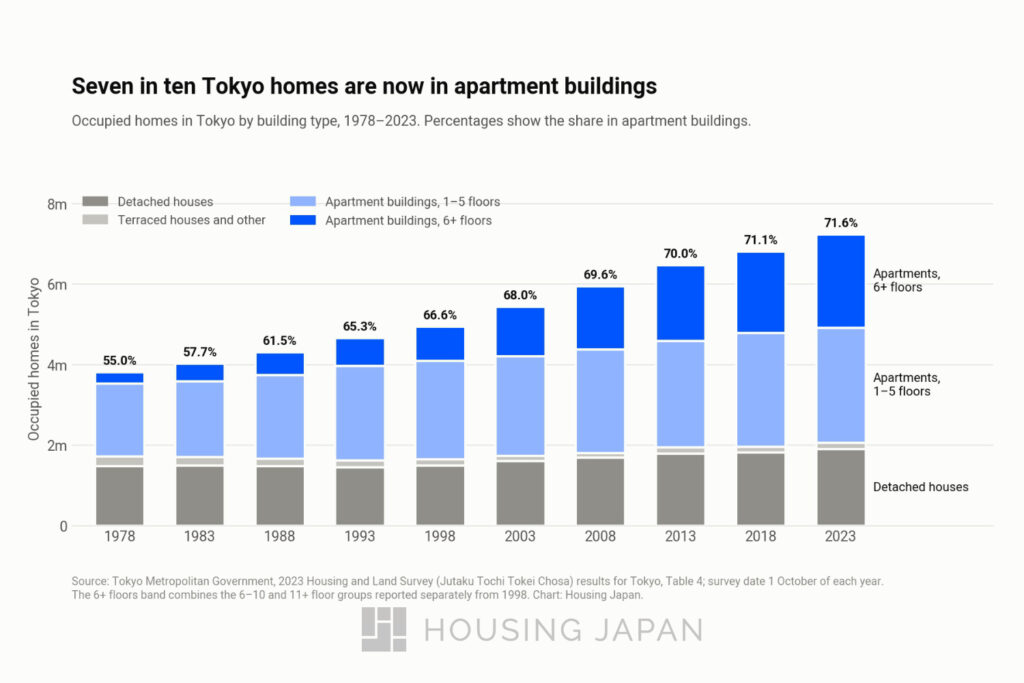
Apartment buildings of six floors or more held 279,700 Tokyo homes in 1978 and 2,318,800 in 2023, roughly eight times as many. Since 1998, when the survey began counting taller buildings separately, homes in buildings of 11 floors or more have risen from 354,400 to 1,097,100. They now account for 21.2% of all apartment homes in Tokyo.
The average home built purely for living in, senyō jūtaku (専用住宅),had 64.02 sqm of floor area in Tokyo in 2023 (TMG, Housing and Land Survey). That is the smallest of Japan’s 47 prefectures, against 91.66 sqm nationally. With homes this size, a second move can be about floor area alone, for example when a couple leaves a one-bedroom after their first child arrives. See our guide to Tokyo apartment sizes and costs.
Are Tokyo land prices higher now than in the bubble era?
The average official price of residential land in Tokyo’s 23 wards was ¥856,400 per sqm on 1 January 2026, which is 63% of the ¥1,361,000 recorded on 1 January 1988 (TMG Bureau of Finance, Land Price Publication). Prices then fell for most of the next 16 years, reaching a low of ¥438,000 per sqm in 2004.
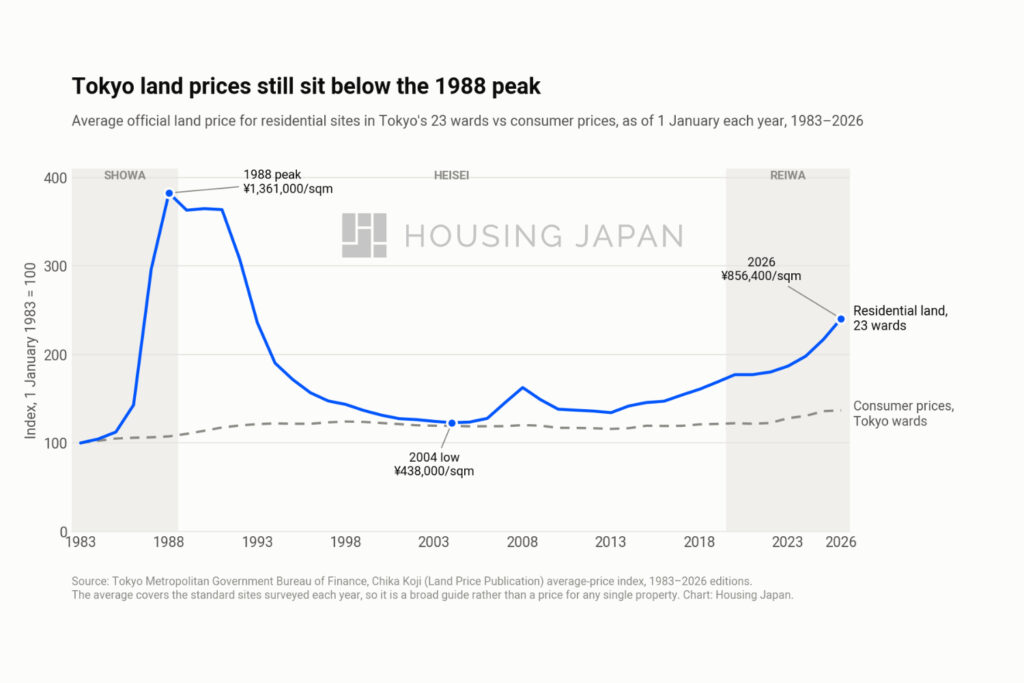
The ward average has risen every year since 2014 except 2021, when it was flat. The official survey sites in the 23 wards, known as hyōjunchi (標準地), rose in value by an average of 9.0% in the year to 1 January 2026, up from 7.9% a year earlier (TMG Bureau of Finance). All 23 wards rose for the fifth year running. Minato-ku recorded the fastest rise at 16.6%, taking its average residential land price to ¥3,013,700 per sqm; Chiyoda-ku’s average was ¥3,631,400.
Consumer prices in the wards were 36.8% higher in January 2026 than in 1983. Once inflation is taken into account, the 2026 land average is about half its 1988 level (calculated from the TMG index series). The average covers 871 residential survey sites in the 23 wards, so it shows the direction of the market rather than the price of any single home.
Apartment prices also depend on construction costs and building age, so they do not track land one-for-one.
At what age do Tokyo households buy their first home?
In 2023, 7.6% of Tokyo households whose main earner was aged 30 to 34 owned the home they lived in, against 19.2% across Japan (TMG, Housing and Land Survey). Ownership in Tokyo reached 24.0% at 40 to 44 and 33.0% at 50 to 54, still well below the national rate at each age.
| Age of main earner | Tokyo | Japan |
|---|---|---|
| 30 to 34 | 7.6% | 19.2% |
| 35 to 39 | 16.0% | 32.9% |
| 40 to 44 | 24.0% | 41.6% |
| 45 to 49 | 29.0% | 45.8% |
| 50 to 54 | 33.0% | 47.8% |
These figures count a household as an owner only if one of its members is the registered owner of the home. On that basis, 26.5% of all Tokyo households own their home. The owner-occupancy rate of 44.7% uses a broader definition, so the two figures are not directly comparable. Either way, Tokyo households buy later than the national average, and ownership rises fastest between the early 30s and the mid-40s.
Should you sell or rent out your first Tokyo apartment when you move up?
The residential property special deduction, kyojūyō zaisan no 3,000-man-en tokubetsu kōjo (居住用財産の3,000万円特別控除), lets you deduct up to ¥30 million from the gain on a home you used to live in. To qualify, you must sell by 31 December of the third year after the year you moved out (National Tax Agency, Tax Answer No. 3302, law as of 1 April 2026). For example, if you move out in March 2026, the deadline is 31 December 2029. The National Tax Agency states that the home can be used for any purpose after you move out. Renting it out in the meantime does not, by itself, rule the deduction out.
The deduction does not apply to a sale to a spouse, parent, child or other closely related person, or if you used the same deduction in either of the two previous years. It covers only the home you mainly lived in, not a holiday home.
A property owned for more than five years on 1 January of the year you sell counts as long-term (Tax Answer No. 3208). Long-term gains are taxed at 15% income tax plus 5% resident tax, with a 2.1% reconstruction surtax on the income tax. A shorter holding is taxed at 30% income tax plus 9% resident tax (Tax Answer No. 3211). An apartment bought in July 2021, for example, qualifies for the long-term rate only if you sell in 2027 or later.
| Sell the first home | Keep it and rent it out | |
|---|---|---|
| Deposit for the next home | Sale proceeds can fund it | Your money stays tied up in the first home |
| Tax on any gain | Up to ¥30 million deductible if sold by the deadline | Deduction lost if the sale comes after the deadline |
| Running costs | End at completion | Management fee, repair reserve and fixed asset tax continue |
| Income | None | Rent, taxed as real estate income |
| Existing home loan | Repaid from the proceeds | Check with your lender first; Flat 35 fixed-rate loans, for example, allow letting only on the basis that you will move back, such as after a job transfer (Japan Housing Finance Agency) |
| Day-to-day work | None | Tenant search, contracts and repairs, or a property manager |
If you plan to keep your first apartment as a rental, our property management service handles tenants, rent collection and repairs, and our selling service can give you a price guide for comparison.
How do low-rise apartments compare with towers in Tokyo?
Homes in Tokyo apartment buildings of 11 floors or more rose from 517,600 in 2003 to 1,097,100 in 2023, and made up 21.2% of the city’s apartment homes by 2023 (TMG, Housing and Land Survey). A low-rise building in a central ward holds far fewer homes, so each one takes up a larger share of costly land. Residential land averaged ¥3,013,700 per sqm in Minato-ku and ¥1,874,100 in Shibuya-ku in January 2026 (TMG Bureau of Finance).
If you are choosing between the two, compare how many homes share the lifts and running costs, how the building is designed to cope with earthquakes, and the monthly management fee, kanrihi (管理費), and repair reserve, shūzen tsumitatekin (修繕積立金). Our guide to Japan’s earthquake-resistant buildings explains the structural standards to check.
What do rising interest rates mean for the next step up?
The Bank of Japan raised its short-term policy interest rate from 1.0% to 1.25% at its meeting on 18 September 2026 (Bank of Japan). This followed a rise from 0.75% to 1.0% on 16 June 2026. Its statement said it would keep raising rates if the economy and prices develop as it expects, and its next meeting is on 29 and 30 October 2026.
Some owners keep a first home and borrow again for a second, or carry a home loan alongside a rental property’s costs. They should ask their lender how quickly a rate rise affects variable-rate loan payments, and work out what the monthly payments on both would be at higher rates. The same applies to a household that relies on rent from the first apartment to cover part of the new mortgage.
How can Housing Japan help at each step of the ladder?
Housing Japan has been a licensed real estate brokerage in Tokyo since 2000 (Tokyo Governor (3) No. 98912), with in-house licensed real estate transaction specialists, takken-shi (宅地建物取引士). Our team works with people at every step described in this article: renting a first Tokyo home, buying a resale or new-build apartment, selling or leasing a former home, and finding a low-rise residence in central wards such as Minato-ku and Shibuya-ku.
Planning your next move in Tokyo? Book a consultation with our team to talk through selling, leasing or buying through the contact us button below, or sign up to our newsletter for monthly Tokyo market data.
Frequently asked questions
What is jūtaku sugoroku?
Jūtaku sugoroku (住宅すごろく), the “housing board game”, is the Japanese name for the path from renting to owning a home. In the Showa era it ran from company housing or a small rental to a suburban detached house. In Tokyo today it more often ends in an apartment: 71.6% of the city’s occupied homes were in apartment buildings in 2023.
Only 7.6% of Tokyo households with a main earner aged 30 to 34 owned their home in 2023, against 19.2% nationally (TMG, Housing and Land Survey).
Are Tokyo land prices higher now than during the 1980s bubble?
Residential land in Tokyo’s 23 wards averaged ¥856,400 per sqm on 1 January 2026, about 63% of the 1988 figure of ¥1,361,000, according to the Tokyo Metropolitan Government’s Land Price Publication data. The average has risen every year since 2014 except 2021, when it was flat.
Standard sites in Minato-ku rose by an average of 16.6% in the year to 1 January 2026, against 9.0% for the 23 wards as a whole (TMG Bureau of Finance).
Can I rent out my old apartment and still use the ¥30 million deduction?
Yes, as long as you sell by 31 December of the third year after the year you moved out, and meet the other conditions. The National Tax Agency says a former home can be used for any purpose after you move out, which includes renting it to a tenant.
The deduction does not apply to a sale to a spouse, parent, child or other closely related person, or if you used it in either of the two previous years (Tax Answer No. 3302). A tax accountant can confirm how it applies to your case.
How long do I need to own a Tokyo property for the lower capital gains tax rate?
More than five years, counted on 1 January of the year you sell. Long-term gains are taxed at 15% income tax and 5% resident tax, plus a 2.1% surtax on the income tax. Short-term gains are taxed at 30% income tax and 9% resident tax, according to the National Tax Agency.
An apartment bought in July 2021, for example, reaches the long-term rate for sales made in 2027 or later (Tax Answer Nos. 3208 and 3211).
What share of Tokyo homes are apartments?
71.6% of Tokyo’s 7.24 million occupied homes were in apartment buildings on 1 October 2023, compared with 44.9% for Japan as a whole, according to the Housing and Land Survey. Around one in five of those apartment homes were in buildings of 11 floors or more.
About the authors

Maximilian Jacob is Research and Content Lead at Housing Japan K.K., a licensed real estate brokerage in Tokyo (Tokyo Governor (3) No. 98912) that has advised international buyers, sellers and tenants in central Tokyo since 2000. He researches the Tokyo prime residential market using primary Japanese sources, including Ministry of Land, Infrastructure, Transport and Tourism (MLIT) transaction and land price data, National Tax Agency (NTA) roadside land valuations, Bank of Japan policy statements and e-Stat national statistics. His work focuses on foreign buyer procedure, property taxation, non-resident financing, and the Minato, Shibuya and Chiyoda luxury markets.

Yudai Yamaguchi is Head of Sales and Head of Property Management at Housing Japan K.K. He has more than a decade of real estate experience across Japan and the United States, spanning development, sales operations, investment, acquisitions, leasing, construction and property management. He previously held management roles at the Open House Group in both countries, including General Manager of its Atlanta office, where he oversaw local real estate operations. He holds a bachelor’s degree in Liberal Arts from Waseda University and studied International Relations at the University of Washington.
Sources:
Tokyo Metropolitan Government Bureau of Finance, Land Price Publication 2026 (Tokyo) (令和8年地価公示価格(東京都分)), average prices, change rates and average-price index; earlier editions from 1983 to 2025 for the index series.\
Tokyo Metropolitan Government, 2023 Housing and Land Survey: summary of results for Tokyo (令和5年住宅・土地統計調査), Tables 4, 5, 6 and 15.
National Tax Agency, Tax Answer No. 3302: special deduction on selling your home, law as of 1 April 2026; see also Tax Answer Nos. 3208 (long-term gains) and 3211 (short-term gains).
Bank of Japan, change in the guideline for money market operations, September 2026 meeting, 18 September 2026.