Quick Answer: Japanese addresses are written from largest area to smallest: 7-digit postal code, then prefecture, municipality, ward or district, neighborhood subdivision (chōme), block (banchi), and finally building number (gō). A typical Tokyo address reads: 〒106-0032 Tokyo-to, Minato-ku, Roppongi, 6-10-1. This reverse order applies to all 47 prefectures and is standardized by Japan Post.
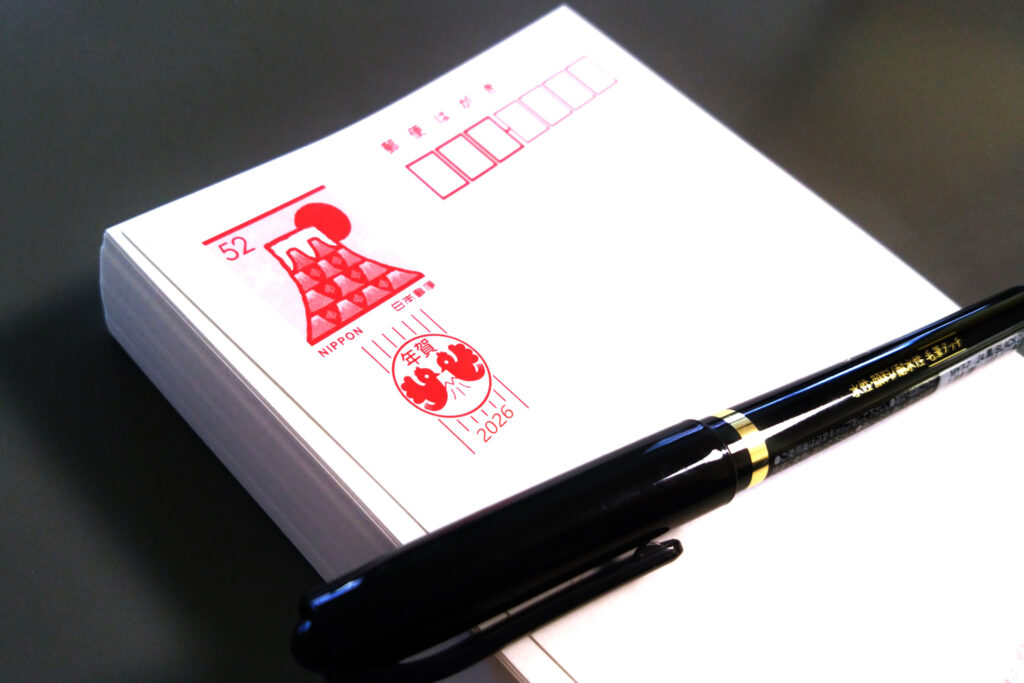
What is included in a Japanese address?
A complete Japanese address contains seven elements that move from the broadest geographic area to the most specific point. Each part has a defined role under Japan’s national addressing system, which Japan Post and government agencies use to route mail and identify property.
The standard components are:
- Postal code (郵便番号 / yūbin bangō) — A seven-digit number written 123-4567 and preceded by the 〒 symbol. Japan Post assigns these nationwide.
- Prefecture (都道府県 / todōfuken) — One of Japan’s 47 prefectures, ending in -to, -dō, -fu, or -ken.
- Municipality (市町村 / shichōson) — The city, town, or village. In Tokyo, this level is replaced by one of the 23 special wards (ku).
- Neighborhood / town name (町 / machi or chō) — A named subdivision within the municipality, such as Roppongi or Azabudai.
- Chōme (丁目) — A numbered sub-district within the neighborhood.
- Banchi (番地) — The block number within the chōme.
- Gō (号) — The building number within the block. Apartments add a floor and unit number after this.
What does a Tokyo address look like?
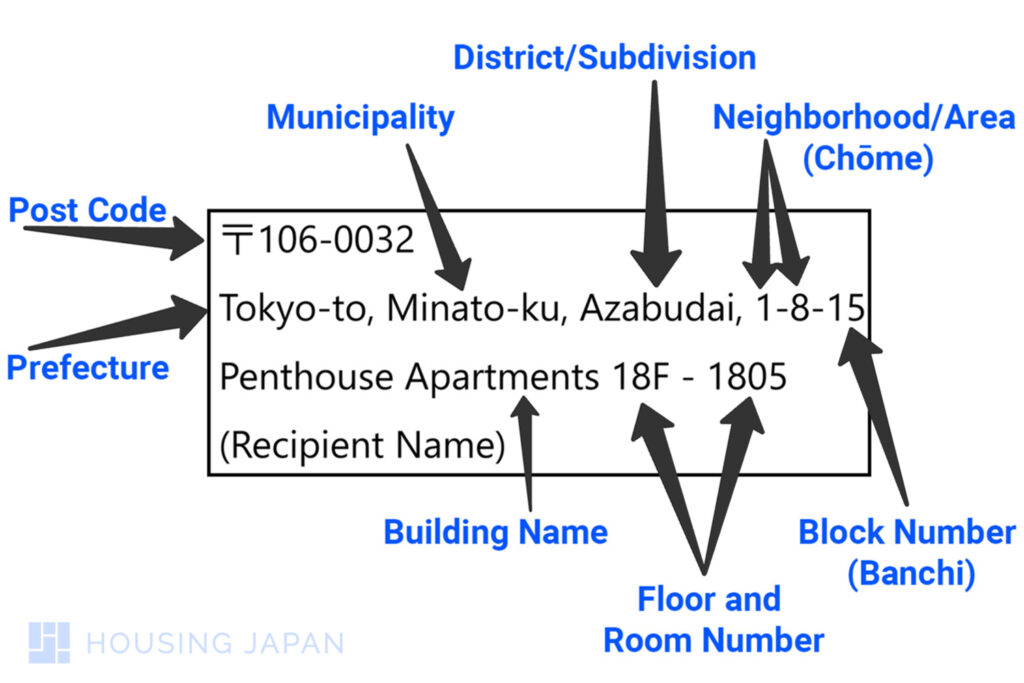
Below is a real-world example of a Tokyo apartment address, written in the standard Japan Post English format. Each line corresponds to a specific level of the addressing hierarchy.
〒106-0032
Tokyo-to, Minato-ku, Azabudai, 1-8-15
Penthouse Apartments 18F-1805
(Recipient Name)
Reading top to bottom: the 〒 symbol marks the postal code; 106-0032 is the seven-digit code for Azabudai in Minato. Tokyo-to is the prefecture, Minato-ku is the ward, Azabudai is the neighborhood, and 1-8-15 represents chōme 1, banchi 8, gō 15. Penthouse Apartments is the building name, 18F is the floor, and 1805 is the unit number. The honorific sama is added after the recipient’s name for formal mail.
Example Addresses in Japan
Tokyo business and location addresses
〒106-0032
Tokyo-to, Minato-ku, Azabudai, 1-11-9
BPR Place Kamiyacho 7F
Housing Japan KK
〒160-0022
Tokyo-to, Shinjuku-ku, Shinjuku, 3-38-1
Shinjuku Station
〒151-0052
Tokyo-to, Shibuya -ku, Yoyogikamizonocho, 2-1
Yoyogi Park
Fictional Tokyo apartment addresses examples
〒106-0032
Tokyo-to, Minato-ku, Azabudai, 1-8-15 Penthouse Apartments 18F – 1805
(Recipient Name)
〒150-0002
Tokyo-to, Shibuya-ku, Shibuya, 2-4-12
Sky Heights Shibuya 7F-702
(Recipient Name)
〒160-0022
Tokyo-to, Shinjuku-ku, Shinjuku, 3-7-6
Urban Tower Shinjuku 12F-1205
(Recipient Name)
Fictional addresses outside of Tokyo
Osaka House address:
〒530-0001
Osaka-fu, Osaka-shi, Kita-ku, Umeda, 2-5-18
17
(Recipient Name)
A beach house in Shimoda:
〒415-0012
Shizuoka-ken, Shimoda-shi, Shirahama, 2-8-4 Seaside Resort Villa Shimoda Japan
(Recipient Name)
A Hotel in Hakuba:
〒399-9301
Nagano-ken, Kitaazumi-gun, Hakuba-mura, Happoone, 4-2-15
Alpine Grand Hotel Hakuba
How does each part of a Japanese address work?
Understanding what each component represents makes it much easier to read addresses on forms, packages, and property listings. The system is logical once you see how the layers fit together.
How does the Japanese postal code work?
Japan Post uses a seven-digit numeric postal code written in the format NNN-NNNN, preceded by the 〒 symbol. The first three digits identify a broad postal area served by a major distribution center, and the last four digits narrow this to a specific delivery zone such as a town, neighborhood, or block.
The first two digits also broadly correspond to the prefecture. Tokyo postal codes start with 10 through 20, while Osaka codes start with 53 through 59. For example, in postal code 105-0011, “10” places the address in Tokyo, “5” narrows it to a specific area, and “0011” identifies Shiba-kōen in Minato Ward.
Source: Japan Post – Postal Code Search
What are Japan’s prefectures (都道府県)?
Japan has 47 prefectures, which function as the country’s first level of regional government. They include 43 ken (県), two fu (府 — Osaka and Kyoto), one dō (道 — Hokkaido), and one to (都 — Tokyo). All four types have the same administrative role under the 1947 Local Autonomy Law; the different suffixes reflect historical status rather than any difference in power today.
On official documents, prefectures are usually written in kanji: Tokyo-to (東京都), Osaka-fu (大阪府), Kyoto-fu (京都府), Hokkaido (北海道), and 43 prefectures ending in -ken such as Kanagawa-ken (神奈川県) and Shizuoka-ken (静岡県).
What is a municipality (市町村)?
Below the prefecture, the next level is the municipality. Major cities use the suffix -shi (市), such as Yokohama-shi or Osaka-shi. Smaller towns use -machi (町) or -chō (町), and villages use -mura (村) or -son (村). Rural addresses sometimes include a county-level district (-gun / 郡) before the town or village name.
Why does Tokyo use wards (区) instead of a city?
Tokyo’s 23 central wards are not subdivisions of a city – each is its own municipality. Officially called tokubetsu-ku (特別区, special wards), they were created under the 1947 Local Autonomy Law after the wartime abolition of Tokyo City. Each has an elected mayor and ward assembly, and many now refer to themselves as “cities” in English (for example, Minato City, Shibuya City).
This is why Tokyo addresses use -ku (区) where addresses in Osaka or Yokohama would use -shi (市). Outside the 23 special wards, Tokyo Metropolis also contains 26 cities, 5 towns, and 8 villages to the west and on outlying islands.
What is a chōme (丁目)?
A chōme is a numbered sub-district within a named neighborhood. It is the first of three numeric levels that pinpoint a specific location. Chōme numbers are usually assigned starting near the center of the neighborhood and moving outward. For example, Roppongi 6-chōme is one of several chōme that together make up Roppongi in Minato Ward.
What is a banchi (番地)?
The banchi is the city block within a chōme. Banchi numbers were originally assigned in the order land was registered, so older neighborhoods can have blocks that do not run in a linear sequence, block 5 may sit next to block 12. This is why Japanese navigation often relies on landmarks, train stations, or maps rather than counting blocks.
What is a gō (号)?
The gō is the building number within a block. In the formal written form, the three numeric layers appear as 1丁目8番地15号 (1-chōme 8-banchi 15-gō). In everyday use, this is almost always shortened to 1-8-15. Apartment buildings then add the floor and unit, for example 1-8-15-1805.
How do you write a Japanese address correctly?
Japanese addresses are written largest to smallest in both Japanese and English. The order stays the same, only the script changes. Start with the postal code, then prefecture, ward or city, neighborhood, the numeric block (chōme-banchi-gō), building name, floor, unit number, and recipient at the end.
For handwritten formal Japanese letters and traditional envelopes, addresses are often written vertically rather than horizontally. The postal code goes in the small boxes at the top right of the envelope, the address runs top-to-bottom down the right side, and the recipient’s name sits in the center. Most everyday mail, business correspondence, and printed labels use horizontal writing today, but the vertical format still appears on formal cards and on traditional Japanese-style envelopes (和封筒 / wa-fūtō).
| Written in Japanese | Written in English (romaji) |
|---|---|
| 〒106-0032 | 〒106-0032 |
| 東京都港区麻布台1-11-9 | Tokyo-to, Minato-ku, Azabudai, 1-11-9 |
| BPRプレイス神谷町 7F | BPR Place Kamiyacho 7F |
| Housing Japan株式会社 | Housing Japan KK |
This top-to-bottom, largest-to-smallest order works for domestic Japanese mail, business cards, government forms, and contracts. For international mail being sent to Japan from abroad, many countries’ postal services expect smallest-to-largest order with “Japan” added at the end, but once the package arrives in Japan, it is more likely to arrive at its location with the largest-to-smallest layout.
How do you fill in a Japanese address on online forms?
Many Japanese websites split the address into separate fields for each component, postal code, prefecture, city or ward, neighborhood, and chōme-banchi-gō, rather than one long box. Enter each part in its own field exactly as it appears on your residence card or lease. Japanese e-commerce sites and government portals will often auto-fill the prefecture and city once you type the postal code, so the postal code is usually the first field.
For international online shopping sent to a Japan address, some sites accept romaji throughout while others require Japanese characters. If a form rejects romaji, copying your address in Japanese from your residence card or My Number card normally solves it. When in doubt, ask a Japanese speaker to confirm the format, incorrect input is the most common cause of delayed deliveries.
What are the most common mistakes when writing Japanese addresses?

A few errors come up repeatedly, most often when people first move to Japan or when international companies fill out shipping forms. Avoiding them prevents most delivery problems.
- Using Western order on a Japanese form. If a form is in Japanese, write the address from largest to smallest. Reversing it confuses postal sorting.
- Skipping the postal code. The seven-digit code is the single most important element for Japan Post’s automated sorting. Always include it, with the 〒 symbol when writing in Japanese.
- Leaving off the building name, floor, or unit. Apartments without a unit number frequently get returned or held at the local post office, especially in large towers.
- Mixing scripts inconsistently. For domestic Japanese mail, use Japanese characters for official place names. For international mail, use romaji throughout. Mixing the two mid-address can slow delivery.
- Forgetting the honorific on formal mail. Add 様 (sama) after the recipient’s name on formal letters, or 御中 (onchū) when writing to a company or department rather than an individual.
Why is Tokyo’s address system more complicated than other cities?
Tokyo’s address system has more quirks than most because the city was rebuilt and renumbered several times, most significantly after the 1923 Great Kantō Earthquake and after the Second World War. Many neighborhoods were renumbered, and the ward system was restructured. Block numbers therefore do not always follow a tidy geographic pattern.
Each of Tokyo’s 23 special wards functions almost as a separate city. The ward you live in determines your local government services, garbage collection, child healthcare benefits, elementary school catchment, and ward-office paperwork. This makes the ward designation an important practical detail, not just a postal one.
Because the numeric system can be confusing, many Tokyo residents give directions by the nearest train station rather than the address itself. With Tokyo’s extensive rail network, stations are often a more reliable landmark than block numbers.
What’s different about Tokyo apartment addresses?
Tokyo apartments often have longer, more detailed addresses than a typical Japanese home because the city’s density means most properties sit inside named buildings with multiple floors and units. Getting every part of the address right — especially the building name and unit number — is what keeps mail and deliveries flowing smoothly.
Mansion vs. apartment
In Japanese property listings, “mansion” (マンション / manshon) refers to a concrete or steel-reinforced apartment building, usually mid-rise or high-rise. “Apartment” (アパート / apāto) refers to a smaller, typically wood or light-steel low-rise building. The building type sometimes appears in the address but is not required for postal delivery.
Room numbering
Apartment unit numbers in Tokyo usually include the floor. A unit numbered 301 typically means the first unit on the third floor, while 1805 means unit 5 on the 18th floor. Some buildings use letters as well, such as 3A for the A unit on the third floor. The unit number is always written after the building name and floor.
Building names
Many Tokyo apartment buildings have official names that form part of the address. These can be in Japanese, English, or a mix of the two — for example, パークマンション渋谷 (Park Mansion Shibuya) or ロイヤルハイツ麻布 (Royal Heights Azabu). The building name goes between the numeric address (chōme-banchi-gō) and the floor and unit number.
Multiple entrances and towers
Larger residential complexes often have several buildings or entrances on the same plot of land. These are usually labelled with letters or numbers, such as Building A, Tower 2, or East Wing. When this applies, write the building designation directly after the building name and before the floor and unit.
Why the full address matters
When sending mail to a Tokyo apartment, always include the postal code, full address, building name, building designation if relevant, floor, and unit number. Couriers such as Yamato Transport and Sagawa Express, as well as Japan Post, rely on the building name to locate large complexes — the chōme-banchi-gō alone often points to a whole plot rather than a specific entrance.
When viewing apartments in Tokyo, always ask for the complete address including the building name. This confirms exactly where the property sits, lets you check transport links and local amenities, and ensures you can receive mail and deliveries from day one.
Practical tips for daily life in Japan
A few habits make addresses easier to handle once you are living in Japan or doing business with someone there.
Write your full address in both Japanese and English, and keep a copy on your phone. This helps with delivery services, ward office visits, and any emergency situation. Apps such as Google Maps work well with addresses in either language, and pinning your home location lets you share it directly with taxi drivers, couriers, or friends.
If an address looks incomplete or doesn’t match what you expect, ask at the nearest post office. Japanese postal workers handle address corrections constantly and can usually verify a postal code or building location in seconds. The official Japan Post postcode search tool covers every assigned code in Japan.
See the official Japan Post postcode search tool (Japanese only) → Here
Q&A: Common questions about Japanese addresses
How do I find my postal code in Japan?
Look up your postal code on the official Japan Post search tool by entering your prefecture, ward, and neighborhood. Most online maps, including Google Maps, also display the postal code when you search for a specific address. If you cannot find it, any post office will look it up for you in seconds.
Why are Japanese addresses written in reverse order?
Japanese addresses go from largest area to smallest because the system is designed around administrative regions, not street names. Postal workers sort mail by prefecture first, then narrow down to ward, neighborhood, and block. Most Japanese cities do not name their streets, so this hierarchical system replaces the street-and-number model used in Western countries.
What does the 〒 symbol mean?
The 〒 symbol is the official Japan Post mark, called yūbin kigō. It is placed directly before the seven-digit postal code on envelopes, forms, and signs. The symbol has been the postal service’s identifier since 1887 and is now used specifically to flag the postal code in addresses.
Do Japanese streets have names?
Most do not. With a few exceptions such as Kyoto and parts of Sapporo, Japanese streets are usually unnamed. Locations are identified by block (banchi) and building number (gō) within a named neighborhood. Major roads such as Tokyo’s Yasukuni-dori do carry names, but they are rarely used in formal addresses.
How do I write my address in Japan for an international package?
Write the address in romaji using the standard largest-to-smallest order: postal code, prefecture, ward or city, neighborhood, block-banchi-gō, building name and unit, then the recipient’s name. Add “Japan” at the end so your country’s postal service routes it correctly. The order does not flip, only the script changes from kanji to romaji.
What is the difference between -ku, -shi, -machi, and -mura?
These are municipal suffixes. -shi (市) means city, -machi or -chō (町) means town, and -mura or -son (村) means village. -ku (区) means ward, in Tokyo’s 23 special wards, the -ku is itself a municipality, while in other cities such as Yokohama or Osaka, -ku is an administrative subdivision of a larger city.
Can I use just the postal code to find a Tokyo address?
No. A seven-digit Japanese postal code typically narrows the location down to a single neighborhood or block, but you still need the chōme, banchi, and gō to identify the exact building. For apartments, you also need the unit number. The postal code alone is usually enough to find the right neighborhood on Google Maps.
How do I read a Japanese address aloud?
Formal reading uses the full unit names: “san-chōme go-banchi jū-gō” for 3-5-10. Informal reading replaces the unit names with the particle no: “san no go no jū.” The informal version is what you will hear in everyday conversation, including with taxi drivers and delivery staff.
What if I don’t know the building name for my apartment?
Check your lease, the building entrance, or the mailboxes inside the lobby, the official building name is almost always displayed on a name plate near the front door. You can also ask your landlord, property manager, or building concierge for both the Japanese and romaji versions. For larger residential buildings in central Tokyo, the building name is also listed on Google Maps and in Housing Japan’s property listings.
Do I need to write “Tokyo-to” or just “Tokyo”?
For domestic Japanese mail, write 東京都 (Tokyo-to), it is the official prefecture name and Japan Post systems expect it. For international mail sent from abroad, “Tokyo, Japan” is widely understood and will reach the right destination, though adding “Tokyo-to” gives extra clarity. The same applies to Osaka-fu, Kyoto-fu, and Hokkaido.
What if I can’t read the kanji in my address?
Ask your landlord, real estate agent, or building manager for a romanized version of your full address. You can also enter the address into Google Maps or the Japan Post postcode tool, which will display the kanji alongside English readings. Keeping a romaji and a kanji version of your address saved on your phone and printed in your wallet, covers almost every situation you will run into.
Finding your home address in Tokyo
Understanding the Japanese address format takes a little practice, but it becomes second nature once you have written your own address a few times. For anyone moving to Japan, owning property in Tokyo, or running a business that ships to Japanese clients, getting the format right saves time on every form, package, and contract.
Whether you are looking for a short-term rental during a business trip, a family home in central Tokyo, or a luxury investment property, Housing Japan offers full-service support across buying, selling, and property management in the city’s most established residential neighborhoods, from Minato-ku and Shibuya to Shinjuku and beyond. Our multilingual team with over 25 years of experience can help you find the right address in Tokyo and handle every step of the process.
Related Housing Japan guides
- Where Are Tokyo’s Luxury Neighborhoods?
- Buying a House in Japan as an Expat
- Tokyo Property Taxes and Fees: A Complete Guide
- Tokyo Condo Prices and Sales Keep Rising
Written by the Housing Japan editorial team – licensed Tokyo real estate specialists with over 25 years of experience helping international clients buy, sell, and manage residential property in central Tokyo.