Private rents in Tokyo’s 23 wards rose 2.2% in the year to September 2026, while residential land prices in the five central wards rose 13.0% to January 2026. Buying a central Tokyo condominium replaces revisable rent with a one-off purchase and running costs, and the owner can live in the apartment or let it to tenants.
Key facts
- Private rents, Tokyo 23 wards: +2.2% year on year (September 2026, Statistics Bureau of Japan)
- Residential land prices, Minato-ku: +16.6%; central five wards: +13.0%; all 23 wards: +9.0% (to 1 January 2026, chika kōji)
- Foreign residents in Tokyo: 783,701, up 8.66% in a year (1 January 2026, Tokyo Metropolitan Government)
- Brokerage fee cap on purchases over ¥4 million: 3% + ¥60,000, plus consumption tax
- Acquisition tax on land and homes: 3% of assessed value until 31 March 2027
How much are rents rising in Tokyo?
Private rents in Tokyo’s 23 wards rose 2.2% year on year in September 2026, according to the consumer price index (CPI) for the Tokyo ward area published by the Statistics Bureau of Japan (総務省統計局). Rents in non-wooden buildings, the category that covers reinforced-concrete and steel-frame apartment buildings, rose 2.3%, up from 2.1% in August.
The CPI measures rents paid across existing tenancies as well as new ones, so the index moves gradually rather than in jumps. In other words, a 2.2% rise in this series means rents are climbing across the market as a whole, not only for the newest listings.
A tenant paying ¥500,000 a month whose rent rose in line with the index would pay about ¥11,000 more each month, or roughly ¥132,000 more a year. Over a two-year lease, that comes to about ¥264,000.
How fast are central Tokyo property values rising?
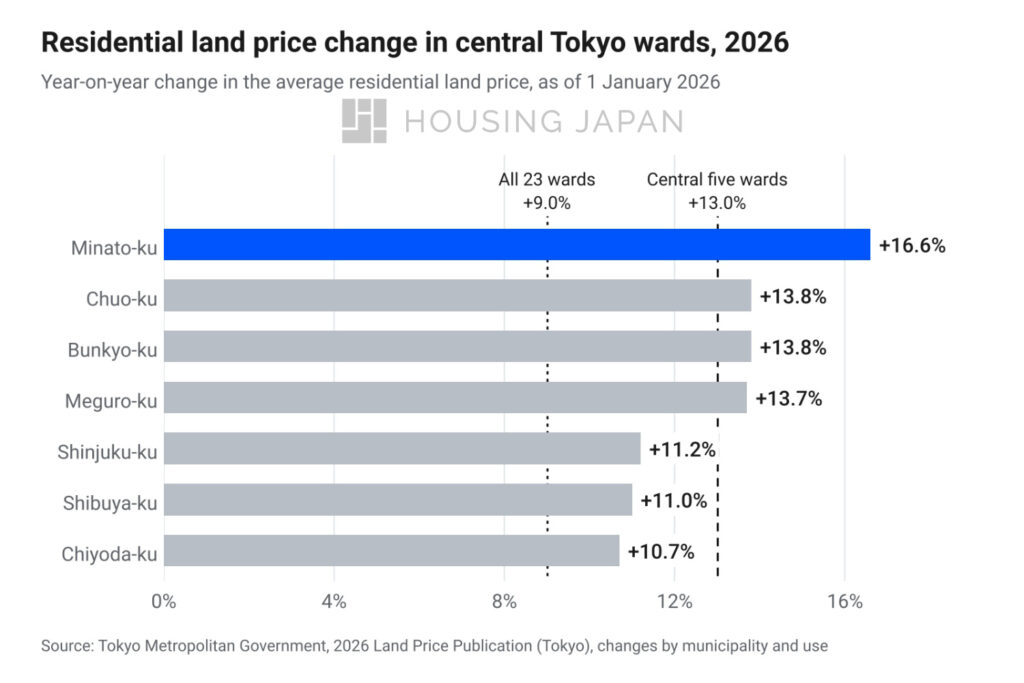
Residential land prices in Minato-ku rose 16.6% in the year to 1 January 2026, the largest increase of Tokyo’s 23 wards and up from 12.7% a year earlier. The figure comes from chika kōji (地価公示), the official land price publication, an annual survey of standard sites set by the Land Appraisal Committee of the Ministry of Land, Infrastructure, Transport and Tourism (MLIT).
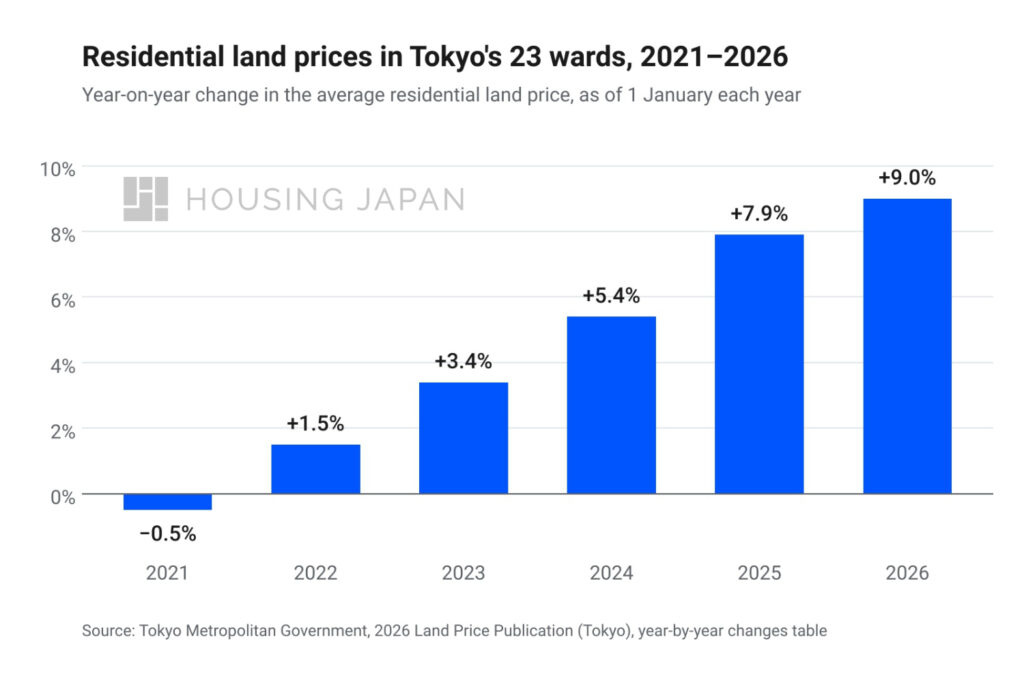
Across the 23 wards, residential land prices rose 9.0%, up from 7.9% in 2025. This was the fifth consecutive annual rise, and every one of the 1,530 continuing survey sites in the wards rose in price. In the five central wards of Chiyoda-ku, Chuo-ku, Minato-ku, Shinjuku-ku and Shibuya-ku, residential land rose 13.0%.
| Ward | Residential land price change (to 1 Jan 2026) | Average residential land price (¥/sqm) |
|---|---|---|
| Minato-ku | +16.6% | 3,013,700 |
| Chuo-ku | +13.8% | 1,930,000 |
| Bunkyo-ku | +13.8% | 1,448,100 |
| Meguro-ku | +13.7% | 1,404,500 |
| Shinjuku-ku | +11.2% | 1,131,600 |
| Shibuya-ku | +11.0% | 1,874,100 |
| Chiyoda-ku | +10.7% | 3,631,400 |
| Central five wards | +13.0% | 2,138,700 |
| All 23 wards | +9.0% | 856,400 |
Source: Tokyo Metropolitan Government, 2026 Land Price Publication (Tokyo), data as of 1 January 2026.
These figures measure land values, not finished apartments. The highest-priced residential survey site in the wards was in Akasaka 1-chome, Minato-ku, at ¥7,110,000 per sqm, up 20.5% in a year. The Tokyo Metropolitan Government attributes the rise to strong housing demand, centred on the central wards and neighbouring wards with good transport and living environments.
Is it cheaper to rent or buy in central Tokyo?
Renting and owning in central Tokyo carry different kinds of cost: a tenant pays rent that can be revised and builds no ownership, while an owner pays a one-off purchase price plus running costs and keeps the property. Ward-area rents rose 2.2% in the year to September 2026, and that rise comes out of a tenant’s monthly budget.
| Cost | Renting | Owning a condominium |
|---|---|---|
| Upfront | Security deposit (shikikin, 敷金), key money (reikin, 礼金) and a brokerage fee capped at one month’s rent plus consumption tax | Purchase price, brokerage fee capped at 3% + ¥60,000 plus consumption tax, acquisition and registration taxes |
| Monthly | Rent, often with a common-area fee | Management fee (kanrihi, 管理費) and repair reserve fund (shūzen tsumitatekin, 修繕積立金), plus loan repayments if financed |
| Periodic | Renewal fee (kōshinryō, 更新料) where the lease sets one, usually at a two-year renewal | Annual fixed asset tax (1.4% of assessed value) and city planning tax (0.3%) |
| Price changes | Rent can rise at renewal or on a new contract, depending on the lease type | Fees are set by the building’s owners’ association |
| At the end | Deposit returned, less any agreed deductions | The owner keeps, lets or sells the property |
Renting
Key money (reikin) is a non-refundable payment a Tokyo tenant makes to the landlord on signing, separate from the first month’s rent. The security deposit (shikikin) is returned when the tenancy ends, less any unpaid rent and the cost of repairing damage beyond normal wear and tear, under Japan’s Civil Code. The agent’s brokerage fee is capped at one month’s rent plus consumption tax under the fee rules MLIT sets under the Real Estate Brokerage Act (宅地建物取引業法), and a lease may also require a rent guarantee company (hoshō gaisha, 保証会社), fire insurance and rent paid in advance. Apart from the deposit, none of these payments comes back when the tenant moves out.
Under a standard lease (futsū shakuya keiyaku, 普通借家契約), a landlord can ask for a higher rent, but the tenant can refuse, and an increase the tenant does not accept needs mediation and then a court ruling under the Act on Land and Building Leases (借地借家法). Under a fixed-term lease (teiki shakuya keiyaku, 定期借家契約), the contract ends on its agreed date, and the landlord can set a new rent for any new contract. Ward-area private rents still rose 2.2% in the year to September 2026, so increases are reaching tenants despite these protections.
Buying
A buyer pays the agent’s brokerage fee once, capped at 3% of the price plus ¥60,000 and consumption tax on a purchase over ¥4 million, together with the transfer taxes covered in the section below. After that, the main running costs are the monthly management fee and repair reserve fund, plus the annual fixed asset tax and city planning tax. In Tokyo’s 23 wards, the Tokyo Metropolitan Government levies both taxes itself, based on an assessed value set under national valuation standards rather than the price paid.
An owner who lives in the property no longer faces rent increases and can still let it out later. This matters most to people who plan to stay in Tokyo for several years.
What does it cost to buy a home in Tokyo?
Buying a central Tokyo condominium costs the purchase price plus a brokerage fee, two property taxes on the transfer, stamp duty and the fees of a judicial scrivener (shihō shoshi, 司法書士), who handles the title registration. The taxes are calculated on the government-assessed value of the property, not the price paid.
The brokerage fee on a purchase over ¥4 million is capped at 3% of the price plus ¥60,000, plus consumption tax. On a ¥200 million apartment, that ceiling works out at ¥6,666,000 including 10% consumption tax.
| Tax | Rate | Period |
|---|---|---|
| Real estate acquisition tax (fudōsan shutokuzei, 不動産取得税), land and residential buildings | 3% of assessed value (standard rate 4%); land value halved for the calculation | Acquisitions by 31 March 2027 |
| Registration and licence tax (tōroku menkyozei, 登録免許税), land transfer | 1.5% of assessed value (standard rate 2%) | Until 31 March 2029 |
| Registration and licence tax, building transfer | 2% of assessed value; 0.3% for qualifying residential buildings | Reduced rate subject to conditions |
Source: MLIT, outline of taxes on land acquisition.
Before a buyer signs, a licensed real estate transaction specialist (takken-shi, 宅地建物取引士) must give the jūyō jikō setsumei (重要事項説明), the mandatory explanation of key property details, under Article 35 of the Real Estate Brokerage Act. It covers rights registered against the property, building rules, management fees, repair reserves and the state of the owners’ association. The legal documents are in Japanese, so overseas buyers can work with a bilingual agent who provides English translations, and the explanation can be given online with the buyer’s consent.
What changed for overseas buyers in 2026?
Two new reporting steps apply to purchases in 2026, and neither restricts who can buy, because Japan has no nationality or residency condition on owning a condominium. From 1 April 2026, a non-resident who buys any property in Japan, including a home for their own use, must file a report under the Foreign Exchange and Foreign Trade Act (外為法, FEFTA) within 20 days, according to the Ministry of Finance.
From 5 October 2026, every new owner registering title, Japanese citizens included, also declares their nationality at registration under a Ministry of Justice rule. A brokerage and judicial scrivener can handle both steps as part of the purchase. For the full process, from viewings and offers to settlement and registration, see our guide to buying a house in Japan as a foreigner.
Can you buy a Tokyo apartment to rent out?
Overseas and Japan-resident buyers can buy a Tokyo apartment and let it to tenants, and the number of foreign residents in central Tokyo has been growing. Minato-ku had 23,901 foreign residents on 1 January 2026, about 8.9% of its 269,877 residents, according to Minato City. That compares with 22,614 a year earlier in Tokyo Metropolitan Government figures.
Across Tokyo, the foreign population reached 783,701 on 1 January 2026, an increase of 62,478 or 8.66% in a year, according to the Tokyo Metropolitan Government. The largest five-year age group among Tokyo’s foreign residents was 25 to 29.
Ward-area private rents in September 2026 were 2.2% higher than a year earlier. For a landlord in Minato-ku, Shibuya-ku or Chiyoda-ku, the lease type decides how much flexibility the owner keeps.
| Lease type | How it works | Suits an owner who |
|---|---|---|
| Standard lease (futsū shakuya keiyaku, 普通借家契約) | Renews automatically; the landlord needs a justifiable reason (seitō jiyū, 正当事由) to refuse renewal under the Act on Land and Building Leases | Wants a long-term tenant |
| Fixed-term lease (teiki shakuya keiyaku, 定期借家契約) | Ends on the agreed date without renewal; needs a written contract and a separate written explanation before signing | May want to move in or sell at a set date |
A fixed-term lease lets an owner plan around a future move to Tokyo or a sale, while a standard lease gives the tenant stronger security of tenure and suits owners holding for the long term.
Housing Japan’s property management service can set up, find tenants and run the apartment day to day for owners living overseas.
What does owning a rental property in Tokyo involve for non-residents?
A non-resident landlord in Japan pays Japanese income tax on the rent, appoints a tax agent and usually hands day-to-day running to a property manager. Rent from Japanese property is Japan-source income, so it is taxed in Japan wherever the owner lives.
The tax agent (nōzei kanrinin, 納税管理人) is a person or firm in Japan who receives tax documents and files the owner’s annual return. The owner notifies the local tax office of the appointment.
When the landlord is a non-resident, the tenant generally has to withhold 20.42% of each rent payment and pay it to the tax office, according to the National Tax Agency. This applies to corporate tenants leasing a home for their staff, but not to an individual renting the home for their own or their family’s residence. The landlord’s annual return then sets the withheld tax against the final liability.
A property manager collects rent, handles repairs and tenant requests, and deals with the building’s management company. For an owner overseas, the manager also provides the rent and expense records the tax agent needs for the annual return. Housing Japan’s property management service handles central Tokyo apartments for owners in Japan and abroad.
Frequently asked questions
Should I rent or buy in Tokyo?
Buying suits people who plan to stay in Tokyo for several years or want to let the property later. Tokyo ward-area private rents rose 2.2% in the year to September 2026, and an owner-occupier no longer faces rent revisions. Renting suits short stays, because buying carries larger one-off costs such as brokerage fees and transfer taxes.
Do overseas buyers have to report a Tokyo purchase?
A non-resident who buys property in Japan files a FEFTA report with the Minister of Finance, through the Bank of Japan, within 20 days of acquisition. Since 1 April 2026 this includes homes bought for the owner’s own use, and since 5 October 2026 every new owner also declares their nationality at registration. A Japan-resident agent can file the FEFTA report on the buyer’s behalf. Our guide to buying a house in Japan as a foreigner covers the wider purchase process.
How fast are land prices rising in Minato-ku?
Residential land prices in Minato-ku rose 16.6% in the year to 1 January 2026, the largest increase of Tokyo’s 23 wards, according to the official land price publication. The five central wards rose 13.0% and the 23 wards as a whole rose 9.0%.
How is rental income taxed for a non-resident owner?
Rental income from Japanese property is taxed in Japan. Where the tenant is a company, it withholds 20.42% of each rent payment, and the owner files an annual Japanese tax return through a tax agent (nōzei kanrinin), which settles the final amount.
What is the difference between a standard and a fixed-term lease?
A standard lease renews automatically, and the landlord needs a justifiable reason to refuse renewal. A fixed-term lease ends on the agreed date without renewal, which suits owners who want the apartment back at a set time. It requires a written contract and a separate written explanation before signing.
Talk to Housing Japan about buying in central Tokyo
Housing Japan has helped local and international clients buy, sell, let and manage homes in central Tokyo since 2000, as a licensed real estate brokerage (Tokyo Governor (3) No. 98912) with English-speaking and bilingual staff. If you are considering a home to live in or an apartment to let in Minato-ku, Shibuya-ku or Chiyoda-ku, our team can take you through current listings, purchase costs and the reporting steps for overseas buyers. Contact us today using the button below:
About the authors

Maximilian Jacob is Research and Content Lead at Housing Japan K.K., a licensed real estate brokerage in Tokyo (Tokyo Governor (3) No. 98912) that has advised international buyers, sellers and tenants in central Tokyo since 2000. He researches the Tokyo prime residential market using primary Japanese sources, including Ministry of Land, Infrastructure, Transport and Tourism (MLIT) transaction and land price data, National Tax Agency (NTA) roadside land valuations, Bank of Japan policy statements and e-Stat national statistics. His work focuses on foreign buyer procedure, property taxation, non-resident financing, and the Minato, Shibuya and Chiyoda luxury markets.
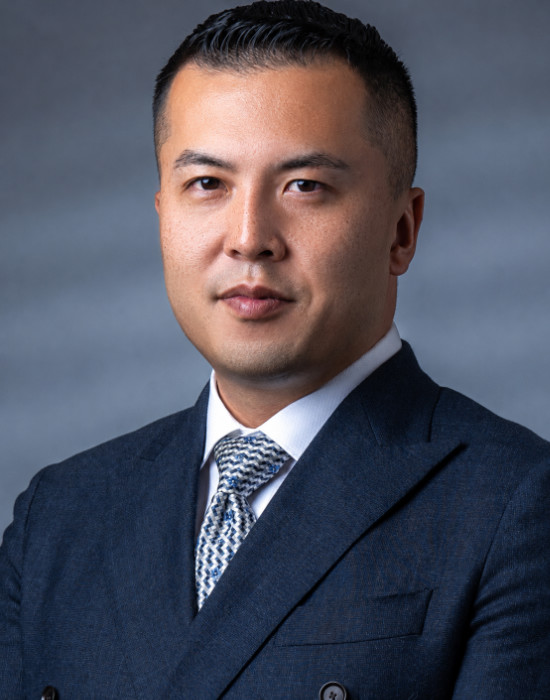
Yudai Yamaguchi is Head of Sales and Head of Property Management at Housing Japan K.K. He has more than a decade of real estate experience across Japan and the United States, spanning development, sales operations, investment, acquisitions, leasing, construction and property management. He previously held management roles at the Open House Group in both countries, including General Manager of its Atlanta office, where he oversaw local real estate operations. He holds a bachelor’s degree in Liberal Arts from Waseda University and studied International Relations at the University of Washington.
Sources:
Statistics Bureau of Japan, Consumer Price Index, Tokyo ward area
Tokyo Metropolitan Government, 2026 Land Price Publication (Tokyo)
Tokyo Metropolitan Government, Households and population by resident register
Ministry of Finance, FEFTA reporting for real estate acquired by non-residents
Ministry of Land, Infrastructure, Transport and Tourism, Outline of taxes on land acquisition