Azabudai Hills is an 8.1-hectare mixed-use district in Minato-ku, Tokyo, built around Japan’s tallest building. It opened in November 2023 and was completed in October 2025. The main draws are teamLab Borderless, three art galleries, a 33-shop food market, around 150 shops and restaurants, and 24,000 square metres of public gardens.

Key Facts
| Location | Toranomon 5-chome, Azabudai 1-chome and Roppongi 3-chome, Minato-ku |
| Opened | 24 November 2023; final buildings completed 29 October 2025 |
| Site area | Approximately 8.1 hectares |
| Tallest building | Azabudai Hills Mori JP Tower, 64 floors, about 330 metres |
| Green space | Approximately 24,000 sqm, around a third of the site, with 320 plant species |
| Shops and restaurants | Around 150, across roughly 23,000 sqm |
| Nearest stations | Kamiyacho (Hibiya Line) Exit 5 and Roppongi-itchome (Namboku Line) Exit 4, both directly connected |
| Developer | Mori Building Co., Ltd. |
What is Azabudai Hills?
Azabudai Hills is a compact city district combining offices, homes, shops, a hotel, a school, a clinic and cultural venues on one site. Mori Building calls the concept “Modern Urban Village,” and the design theme is “Green & Wellness.”
The project began in 1989. Mori Building spent more than thirty years negotiating with over 300 rights holders on a site of narrow lanes and steep level changes. Construction started in 2019, and the district opened on 24 November 2023.
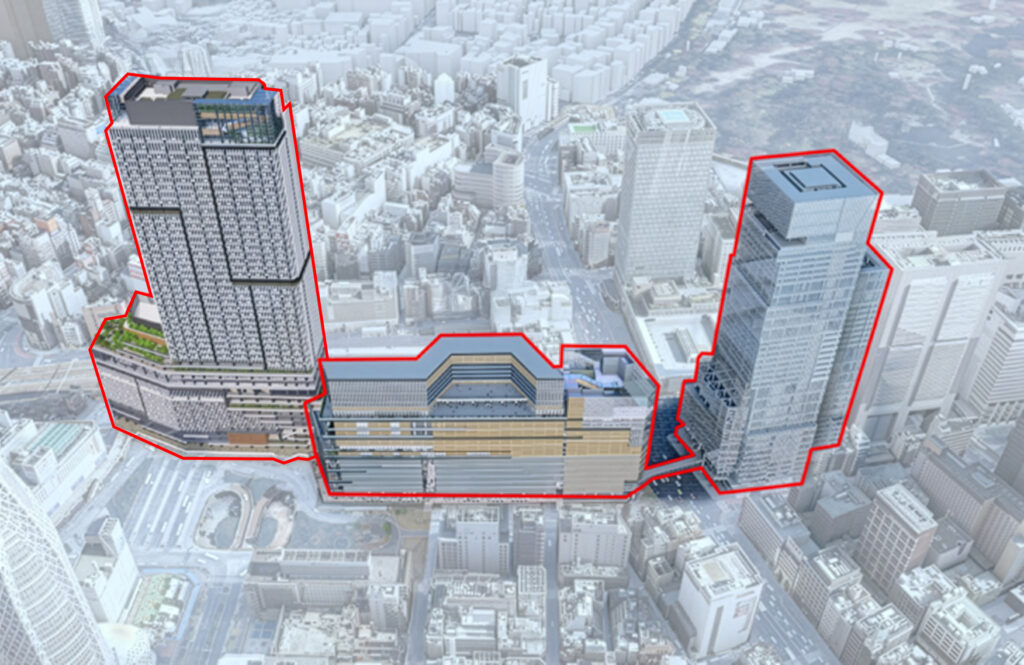
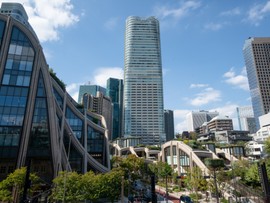
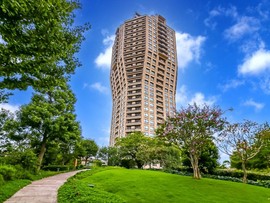
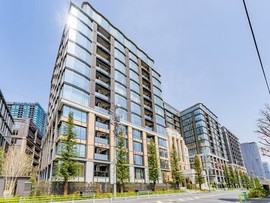
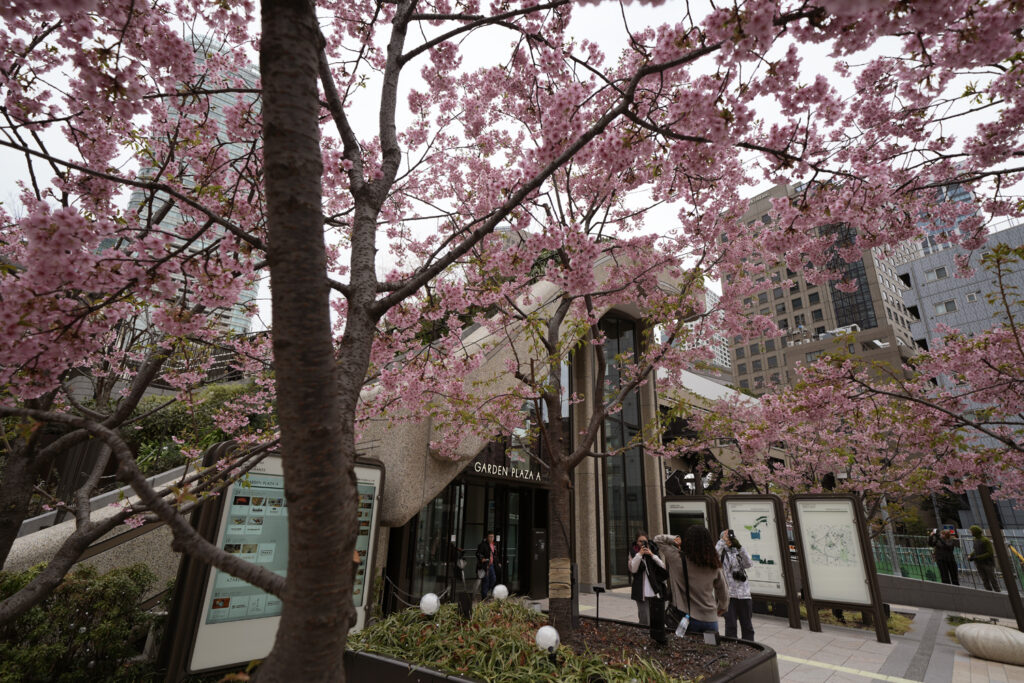
Three towers anchor the site. Mori JP Tower rises 64 floors to about 330 metres, making it Japan’s tallest building until Torch Tower near Tokyo Station completes in 2028. Residence A reaches about 240 metres, and Residence B about 270 metres. Four low-rise Garden Plaza buildings hold most of the shops and galleries.
The district was finished on 29 October 2025, when Residence B opened along with Central Walk, an underground passage linking Kamiyacho and Roppongi-itchome stations. The passage holds emergency supplies and doubles as a shelter for people unable to get home during a disaster.


How do you get to Azabudai Hills?
Kamiyacho Station Exit 5 on the Tokyo Metro Hibiya Line and Roppongi-itchome Station Exit 4 on the Namboku Line both connect directly to the complex underground. Roppongi Station is a ten-minute walk, and Azabu-juban ten to eleven minutes depending on the exit.
Restaurants generally open 11:00 to 23:00, shops 11:00 to 20:00, and the market 10:00 to 20:00. Individual hours vary, so check the shop listing before a special trip. The information counter sits on Tower Plaza B1 and opens 10:00 to 21:00.
Drivers pay ¥200 per fifteen minutes. Spending ¥3,000 earns one hour free, ¥6,000 earns two hours, and ¥20,000 earns four hours. Visitors with teamLab Borderless or Azabudai Hills Gallery tickets can also claim a parking discount at the information desks. Bicycle parking is free for the first two hours.
One useful detail many visitors miss: the “Chike-toku” scheme gives 10% off or a set menu at participating restaurants and cafés when you show a same-day ticket from a facility inside the complex.
What is teamLab Borderless, and how much are tickets?
teamLab Borderless is a digital art museum in the basement of Garden Plaza B, with more than fifty artworks that move between rooms rather than sitting in fixed displays. It reopened at Azabudai Hills on 9 February 2024 after leaving its original Odaiba site. Adult tickets start at ¥3,600.
The museum passed four million visitors on 31 July 2026, about two years and five months after opening. Roughly 70% of visitors come from overseas, from more than 185 countries and territories. Between February 2024 and June 2026, around one in twelve visitors to Japan from the United States and one in nine from Australia went to teamLab Borderless. TIME magazine included it in “World’s Greatest Places 2024.”
There are no maps and no set route. A free app explains whichever artwork you are standing closest to. Most people spend two to three hours inside, and re-entry is not allowed once you leave.
| Ticket type | Price |
|---|---|
| Adults (18+) | ¥3,600–¥5,600, dynamic pricing |
| Ages 13–17 | ¥2,800 |
| Ages 4–12 | ¥1,500 |
| Ages 3 and under | Free |
| Flexible Pass, no set entry time | ¥12,000 |
| Visitors with disability certificate | ¥1,800 |
Tickets are date and time specific and often sell out. Buying on site adds ¥200. Opening hours run roughly 8:30 to 21:00 with last entry an hour before closing, though closing times change frequently, so check the official calendar.
Until 8 October 2026 the Light Sculpture, Flow room holds a special exhibition, “On the Asymmetry of the Universe,” featuring two new series. In Asymmetric Existence, one light sculpture appears only in the room and casts no reflection, while a second exists only inside the mirror. Your brain reads the two as a single object.

What can you see at the three galleries?
Azabudai Hills holds three separate galleries, all in the Garden Plaza buildings near the teamLab entrance. Two are free.
Azabudai Hills Gallery
This is the ticketed exhibition space, on the mezzanine basement of Garden Plaza A, one minute from Kamiyacho Exit 2. It runs museum-standard shows across art, fashion, anime and entertainment, changing every few months. Past programmes have included Olafur Eliasson, Alexander Calder and an Isao Takahata retrospective.
From 28 August to 25 October 2026 the gallery hosts “RYUICHI SAKAMOTO + SHIRO TAKATANI AMBIENT KYOTO – TOKYO,” the first Tokyo edition of the Kyoto-based ambient sound and art series. The centrepiece is async – immersion, shown on a screen 26.4 metres wide.

Pace Tokyo
Pace opened its first Japanese gallery here in 2024, inside a Heatherwick Studio building with interiors by Sou Fujimoto. Exhibitions occupy the first two floors, and the third floor has an outdoor terrace. Entry is free, and the gallery opens Tuesday to Sunday, 11:00 to 20:00.
William Monk’s Noon Day Night runs until 16 August 2026, followed by Nigel Cooke’s Night Ruins from 28 August to 10 October 2026.

Shueisha Manga-Art Heritage Tokyo Gallery
Shueisha’s permanent gallery sits on B1 of Garden Plaza A and is free to enter. It produces archival art prints supervised by manga artists, with limited editions recorded on blockchain. The design mimics paper passing through a printing press, and a small three-mat tea room called Aan is used for hanging-scroll works.
Eiichiro Oda’s ONE PIECE / The Scroll II runs until 29 November 2026. The gallery opens 11:00 to 18:00 Tuesday to Thursday and 11:00 to 19:00 Friday to Sunday, closed Mondays. An adjoining lounge shows works beyond the current exhibition by advance booking.

Can you go up Mori JP Tower for the view?
Not as a free walk-in. The Sky Lobby on floors 33 and 34 was open to the public when the complex launched, but general access ended on 17 April 2024. Entry is now limited to office tenants and to customers of Hills House Azabudai.
In practice, this means you reach the view by using one of three venues. Dining 33 is a French grand bistro produced by chef Kiyomi Mikuni, seating about 170, serving lunch 11:00 to 15:00 and dinner 18:00 to 23:00. Sky Room Cafe & Bar on the 34th floor opens 9:00 to 21:00 with around sixty seats and serves coffee, cakes and cocktails. Dining 33 Pâtisserie à la Maison sells cakes and baked goods from 11:00 to 21:00.
All three look south and east towards Tokyo Tower and Tokyo Bay. The floors close occasionally for private events, so check before travelling. Several older guides still describe the Sky Lobby as a free observation deck, which is why visitors are turned away at the B1 entrance.
What is inside Azabudai Hills Market?
Azabudai Hills Market opened on 13 March 2024 across the first and basement floors of Garden Plaza C, under the Central Green. It brings together 33 specialist food shops covering fish, meat, vegetables, prepared dishes, groceries, wine, bread, sweets and flowers. It opens 10:00 to 20:00.
The fishmongers are Yamayuki and Nezu Matsumoto. Hiyama handles wagyu, Tsukiji Toritoh handles poultry, and Kyoto Yaoichi handles fruit and vegetables. Meidi-ya runs the general grocery. There is a nukazuke pickle specialist, a dashi shop, a rice and onigiri counter, Japanese tea from SABOE Tokyo, black tea from TEAPOND, and a caviar and champagne counter.
Bakery Comme’N Tokyo, patisserie Pierre Hermé Paris and chocolate and gelato shop Matte cover the sweet side. Two sit-down restaurants operate inside the market: sushi counter Sushi Saito and yakitori counter Torioka.
The most interesting part is Market Lab, a rotating pop-up space that changes roughly weekly. Recent slots have brought an Omi beef butcher from Shiga, a Sapporo soup curry specialist, an Uji matcha shaved-ice maker and a Ginza sushi counter. The lab also runs paid workshops, such as a session where participants shuck live sea urchins from an Iwate sea-urchin ranch.

Where should you eat at Azabudai Hills?
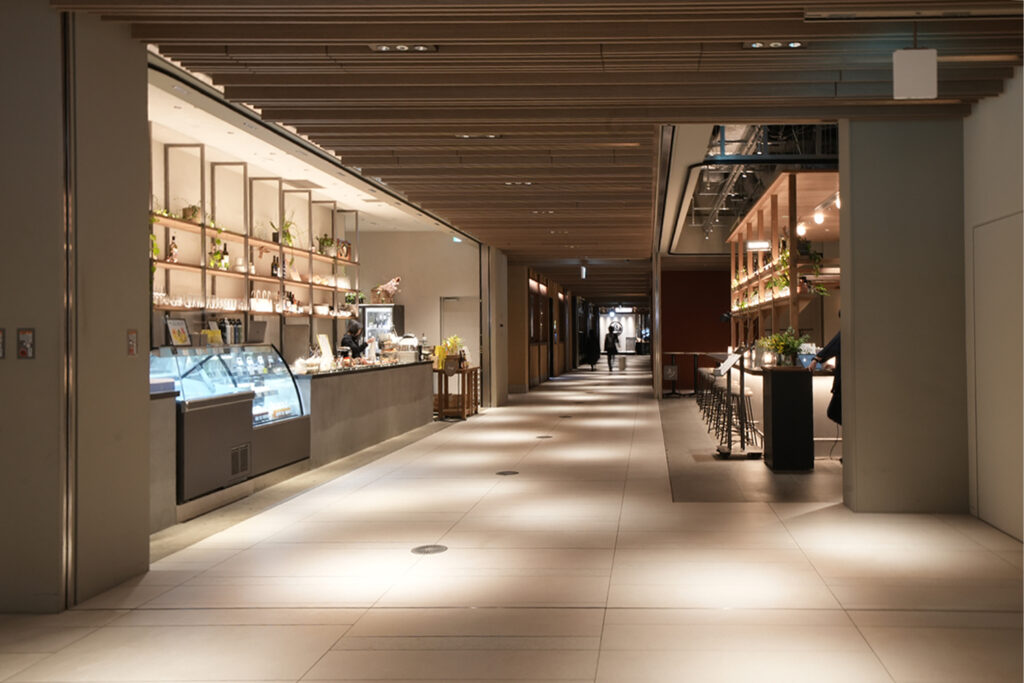
Around 150 shops and restaurants operate across the district, and the food ranges from a ¥900 karaage stall to two-star French. Florilège, on the second floor of Garden Plaza D, holds two Michelin stars and a Green Star in the Michelin Guide Tokyo 2026, and placed 31st in Asia’s 50 Best Restaurants 2026.
Chef Hiroyasu Kawate moved Florilège here from Jingumae in 2023. Guests sit around one long communal counter surrounding the open kitchen, and the menu leans heavily on vegetables and fermentation while still using meat, fish and dairy. Lunch is priced at around ¥15,000 and dinner at around ¥30,000.
Other named kitchens include Azabudai Nakamura for teppanyaki, Terakoya Sushi Sho for edomae sushi, Tenpura Niiryu, Tomikoji Yamagishi for Kyoto cuisine, and Fukahire-ya for Chinese. Sta. Azabudai does all-day dining, Ahilya covers Indian, Aldo serves Peruvian, and Mensonrage does chicken-based ramen and a vegan bowl. Gallery & Restaurant Butaiura combines an exhibition space with a wine-led menu.
Since February 2026 you can order ahead through Hills Mobile Order at 23 of the food outlets, choose a pickup time and pay in the app.
Where can you shop at Azabudai Hills?
Azabudai Hills holds around 150 shops and restaurants across roughly 23,000 square metres. Retail splits between the Tower Plaza, attached to Mori JP Tower, and the four low-rise Garden Plaza buildings designed by Heatherwick Studio. Shops generally open 11:00 to 20:00, and most process tax-free purchases in store.
The luxury boutiques opened in stages rather than all at once. Dior arrived on the first floor of Garden Plaza C, and Bvlgari followed on the first floor of Garden Plaza B. The full line-up is now trading.
| Brand | What it sells |
|---|---|
| Hermès | Bags, leather goods, shoes, menswear and womenswear |
| Cartier | Jewellery, watches, bags and leather goods |
| Dior | Womenswear, bags and leather goods |
| Bvlgari | Jewellery, watches, leather goods and fragrance |
| Celine | Womenswear, bags, leather goods and accessories |
| Bottega Veneta | Bags, leather goods, clothing, shoes and homeware |
| Berluti | Shoes, bags, leather goods and menswear |
| TimeVallée | Multi-brand watch boutique carrying Baume & Mercier, Chopard, IWC and Jaeger-LeCoultre |
| Saint-Louis | Crystal |
| Officine Universelle Buly | Fragrance and beauty |
| Fueguia 1833 | Fragrance, with an attached wine bar |
Bottega Veneta takes made-to-order commissions for bags and leather goods at this branch, and Fueguia 1833 built its Tower Plaza store around perfumer Julián Bedel’s own customised guitars. TimeVallée was the brand’s first boutique in Japan.
The site is not only luxury fashion. The Conran Shop sells furniture and homeware, Ogaki Books runs a large branch that hosts book fairs and original artwork exhibitions, and Kaneko Optical makes and sells Japanese-made eyewear. UGG has a Tower Plaza store carrying items its standard boutiques do not stock.
Two practical points worth knowing. Spending across the complex earns free parking on a sliding scale, starting at one hour for ¥3,000 and reaching four hours for ¥20,000, and there is no cap on how many receipts you combine. Shops in the Hills Points scheme also award points on the Hills App or Hills Card, though a few of the luxury boutiques sit outside it, so check at the till.


What can you do at Azabudai Hills for free?
Quite a lot. The Central Green covers about 6,000 square metres and is open to anyone, with a 550-square-metre lawn area beside the arena. The Azabudai Hills Arena sits underneath The Cloud, a canopy designed by Heatherwick Studio, and hosts events through the year.
A 200-square-metre orchard grows eleven fruit varieties including satsuma mandarin, blueberry, lemon, apple and daidai, and visitors can handle the fruit at harvest time. Across the whole site there are 320 plant species, and the greenery is more than five times what stood here before redevelopment.
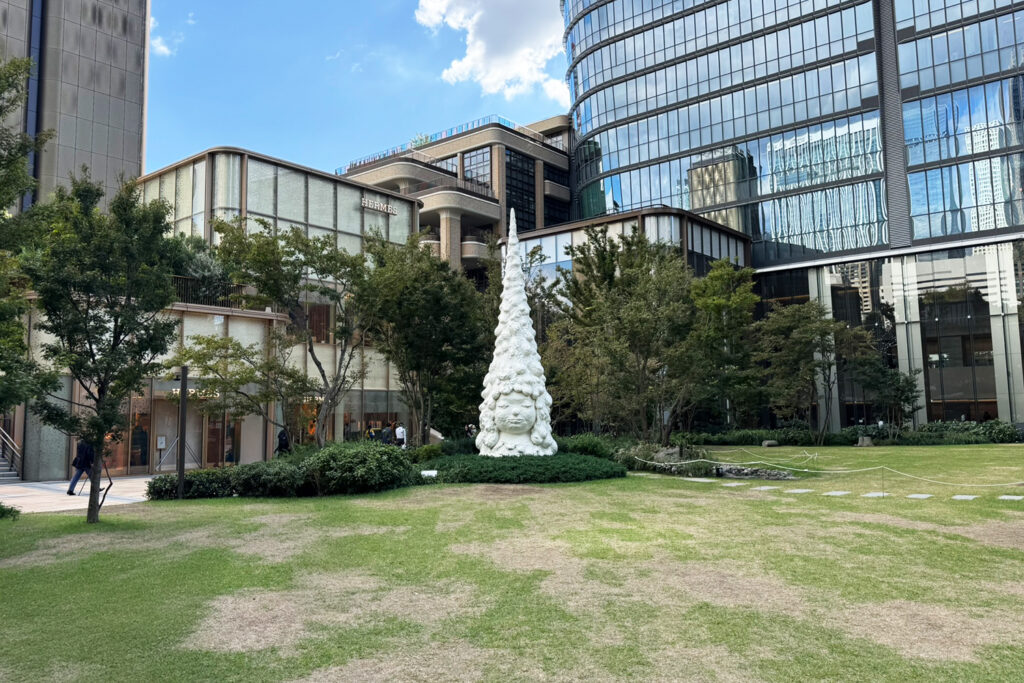
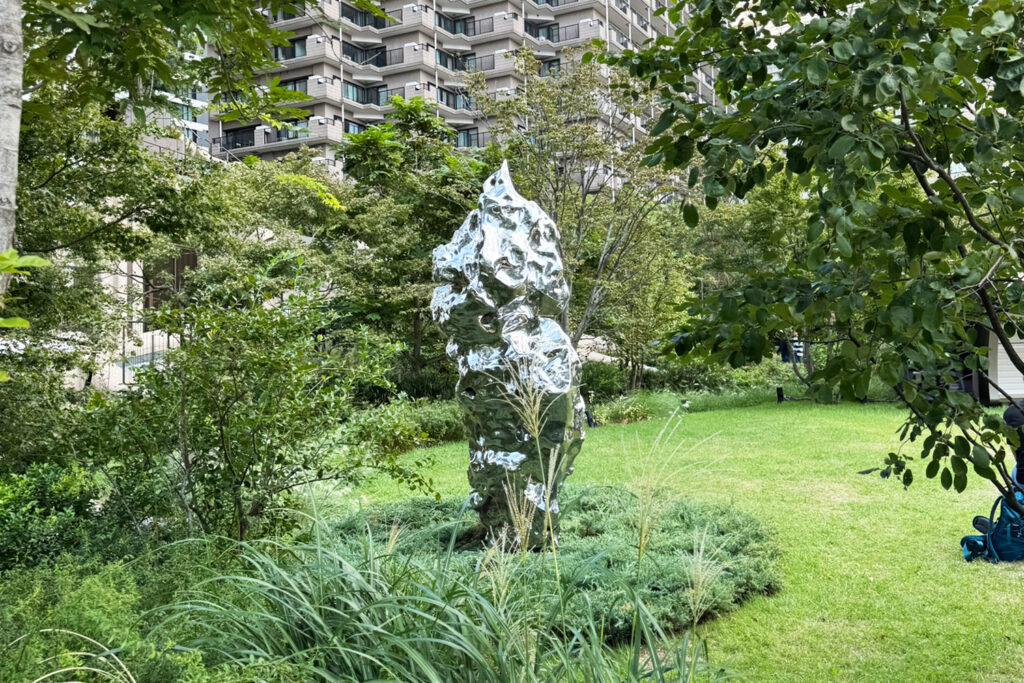
Four public artworks are permanently installed and free to see. Yoshitomo Nara’s Tokyo Forest Child (2023), Zhan Wang’s Artificial Rock No.109 (2015) and Yutaka Sone’s The Last Night of the Stone Age (2017/2023) stand in the Central Green. Olafur Eliasson’s A harmonious cycle of interconnected nows (2023) hangs in the Mori JP Tower office lobby. The Mori Art Museum supervised the selection.
The least-known free attraction is the Diplomatic Archives Exhibition Room on the fifth floor of Mori JP Tower, run by the Ministry of Foreign Affairs. It reopened here on 8 April 2024. The permanent display holds treaty documents from the late Edo period to the twenty-first century, and the adjoining room runs themed shows on subjects such as Chiune Sugihara, the history of the passport and how treaties are negotiated. No booking, no ID and no fee. It opens 10:00 to 17:30 and closes on Sundays and public holidays.
Nishikubo Hachiman Shrine sits next door. It was rebuilt as part of the redevelopment and connects to the complex by a walkway.
What is there for families with children?
The baby rest room on Tower Plaza 4F opens 9:00 to 21:00 and has three private feeding rooms, a nappy-changing area, a play space, a weaning area, a formula-water dispenser and a microwave. Four further nursing rooms sit in the basements of Garden Plaza A, C and D and Residence B.
Pushchairs are lent free from the information counter on Tower Plaza B1 between 10:00 and 20:00, for newborns up to 22 kilograms, on production of photo ID. Wheelchairs are lent on the same terms.
Inside teamLab Borderless, the Future Park section is built for children. In Sketch Ocean, children colour in a paper fish that then swims across the wall and can travel to teamLab venues in other countries. At Sketch Factory, just outside the museum, the drawing can be turned into a badge, tote bag, puzzle, magnet or T-shirt to take home.
There is also a multi-faith prayer room on Tower Plaza 4F, open to any religion or denomination, plus a post office and ATMs on the same floor.
What events are held at Azabudai Hills?
The Central Green runs a seasonal programme. Every August the district holds a summer festival, Azabudai Hills Matsuri, timed to coincide with the neighbouring shrine’s own festival. Food stalls from the complex’s restaurants line the arena and Sakura-asa-dori, and traditional festival games cost ¥500 a go. Pupils from the British School in Tokyo perform taiko in the lawn area.
Other recurring fixtures include Hills Workshop for Kids in the summer holidays, the Hills Gourmet Burger Grand Prix, and Hills Parfait Collection, a late-summer dessert programme at Hills House. The market’s pop-up calendar changes roughly weekly, so there is usually something new even for regular visitors.
Dogs are welcome on leads along the paved paths, and part of the Central Green has a designated pet-friendly lawn. Inside the buildings, pets must travel in a closed carrier.
What is Azabudai Hills like as a place to live?
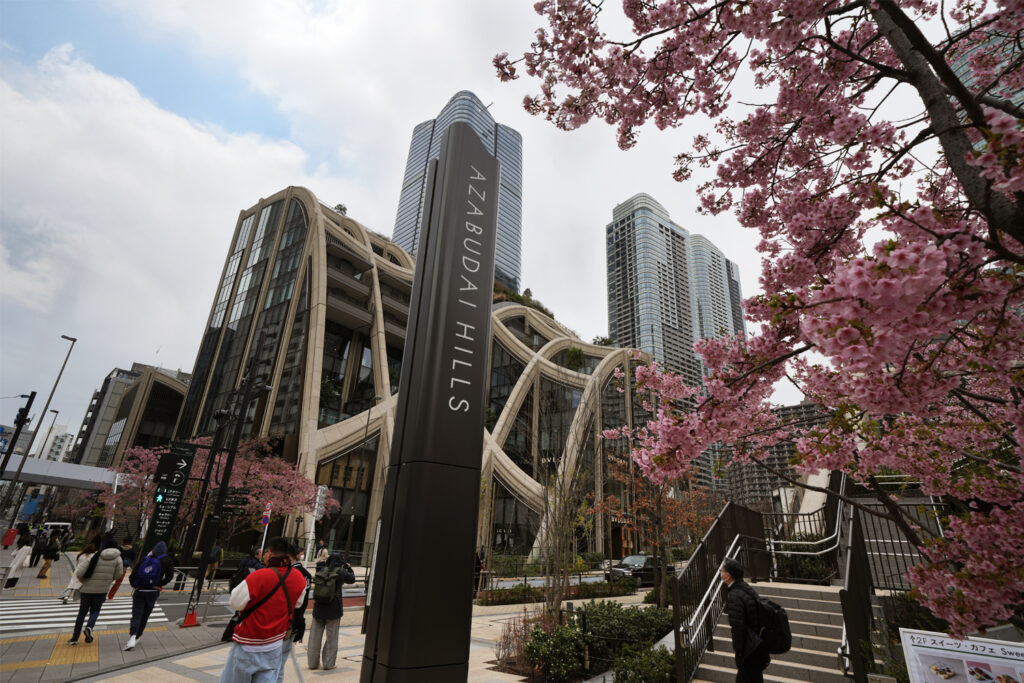
The district holds around 1,400 homes across its three towers, alongside roughly 214,500 square metres of office space. Aman Residences Tokyo occupies the top floors of Mori JP Tower with a dedicated lift lobby and spa. Azabudai Hills Residence covers the rest of the housing, from apartments to serviced apartments, and Residence B added around 970 homes when it completed in October 2025.
For internationally mobile families, the practical draw is what sits inside the site. The British School in Tokyo opened its primary campus here on 28 August 2023, teaching children from nursery age three to Year 6, in a Heatherwick Studio building with a 25-metre pool, a gymnasium, a digital technology studio and an auditorium. Secondary years continue at the Showa campus in Setagaya. Keio University’s Preventive Medicine Center, a general clinic, a dental surgery and a pharmacy are also on site.
Janu Tokyo, the first hotel from Aman’s sister brand, opened in March 2024 with 122 rooms, eight dining venues and a 4,000-square-metre wellness centre spread over four floors, including a 25-metre indoor pool and five movement studios. Non-residents can use the restaurants and, through membership, the wellness centre.
The whole district runs on renewable electricity and holds LEED-ND Platinum and WELL Platinum pre-certification for the Mori JP Tower office and retail areas. Mori Building designed it to function as a local disaster refuge, with high seismic performance and backup power.
For how the development has affected the surrounding property market, see our analysis of the Azabudai Hills effect on Tokyo real estate.
Looking for a home near Azabudai Hills?
Housing Japan has been brokering homes in central Tokyo since October 2000, and our office is in Azabudai, opposite the development. We have followed this site through every stage of its life: the narrow lanes and low-rise housing that stood here before construction began in 2019, the years of building work, the opening in November 2023, and the finished district completed in October 2025.
That history matters when you are deciding where to live. Kamiyacho, Azabudai, Toranomon, Roppongi-itchome and Azabu-juban read as one area on a map and feel completely different on foot. We can tell you which buildings sit within a realistic walk of the British School in Tokyo, which streets go quiet after the offices empty, which blocks front the main roads, and how the underground connections opened in 2025 have changed the daily walk to the station. We can also tell you honestly when a building that looks right online will not suit how you actually live.
We handle purchases, sales, rentals and property management, and we work in English and Japanese from first enquiry to handover. Whether you are relocating to Tokyo, moving within Minato-ku, or letting a home you already own here, we are a few minutes away and glad to talk it through.
Housing Japan K.K., BPR Place Kamiyacho 7F, 1-11-9 Azabudai, Minato-ku, Tokyo. Tokyo Governor Licence No. (3) 98912.
Questions people ask about Azabudai Hills
Is Azabudai Hills free to enter?
Yes. The grounds, gardens, shops, restaurants and public artworks are all free to access. Only teamLab Borderless and ticketed shows at Azabudai Hills Gallery charge admission. Pace Tokyo, the Shueisha manga gallery and the Diplomatic Archives Exhibition Room are all free.
Is there an observation deck at Azabudai Hills?
No public observation deck operates at Azabudai Hills. The Sky Lobby on floors 33 and 34 of Mori JP Tower closed to general visitors on 17 April 2024. You can still reach the view by booking Dining 33 or visiting Sky Room Cafe & Bar or the patisserie on those floors.
How long do you need at Azabudai Hills?
Allow two to three hours for teamLab Borderless alone. Adding the free galleries, the market and a walk through the Central Green makes a comfortable half-day. A full day works if you include lunch and one paid exhibition at Azabudai Hills Gallery.
Which station is best for Azabudai Hills?
Kamiyacho Station on the Hibiya Line, Exit 5, connects directly and lands you closest to teamLab Borderless and the galleries. Roppongi-itchome on the Namboku Line, Exit 4, also connects directly and is now linked to Kamiyacho by the Central Walk passage.
Do you need to book teamLab Borderless in advance?
Yes, in almost all cases. Tickets are date and time specific and frequently sell out, particularly at weekends. Same-day tickets appear online when a slot has not sold out, and on-site purchase adds ¥200 per adult ticket. Re-entry is not permitted.
What is the difference between teamLab Borderless and teamLab Planets?
Borderless sits at Azabudai Hills and has no fixed route, so artworks move between rooms and you wander. Planets, in Toyosu, is a set barefoot route through water and garden installations. They are separate museums with separate tickets, and most short-stay visitors choose one.
Is Mori JP Tower the tallest building in Japan?
Yes, as of August 2026. Mori JP Tower stands about 330 metres across 64 floors and has held the title since 2023, when it surpassed Abeno Harukas in Osaka. Torch Tower near Tokyo Station is due to overtake it on completion in 2028.
Can you shop for groceries at Azabudai Hills?
Yes. Azabudai Hills Market on Garden Plaza C holds 33 specialist food shops covering fresh fish, meat, produce, groceries, wine, bread and prepared dishes, plus a Meidi-ya general grocery. It opens 10:00 to 20:00 daily and has direct parking access.
Can you shop tax-free at Azabudai Hills?
Yes. Most shops at Azabudai Hills handle tax-free purchases at the till, including the luxury boutiques. Visitors on temporary visitor status can claim relief from the 10% consumption tax on qualifying purchases over ¥5,000 per shop per day, on production of a passport. From 1 November 2026 the process changes to an airport refund.
Until 31 October 2026, the current system applies: you show your passport, the tax comes off at the register, and you carry the goods away at the tax-exclusive price. Consumables such as cosmetics and food must stay in their sealed bag until you leave Japan.
From 1 November 2026 the National Tax Agency switches to the refund method. You pay the full tax-inclusive price in the shop, then confirm the goods with customs at your departure airport and receive the tax back afterwards. Sealed packaging and the ¥500,000 daily cap on consumables are abolished, and the split between general goods and consumables disappears, so everything bought in one shop on one day counts towards the ¥5,000 threshold. Departure must happen within 90 days of purchase, and if you board without completing the customs step, the refund is lost. There is no overlap period between the two systems.
Sources:
Azabudai Hills official site
Mori Building Co., Ltd.
teamLab
Pace Gallery
Ministry of Foreign Affairs of Japan, Diplomatic Archives